Ubiquiti ER-8-XG 10G SFP+ Edge Router
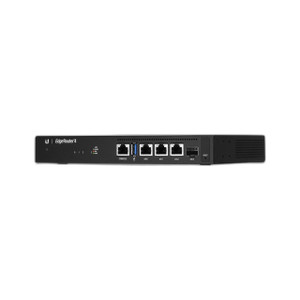
The Ubiquiti ER-8-XG is a 1U rack-mount edge router engineered for high-throughput enterprise and data center deployments where wire-speed packet processing and sub-microsecond latency are non-negotiable. With 80 Gbps non-blocking throughput, 160 Gbps switching capacity, and an 18 Mpps forwarding rate, the ER-8-XG handles multi-10G fiber aggregation, WAN edge consolidation, and core campus interconnects without packet loss under full load. Eight 10G SFP+ ports accept industry-standard transceivers (optical, DAC, or copper media), while a dedicated 1 GbE RJ45 management port isolates out-of-band administrative access from the forwarding plane — a critical design choice in production environments where management traffic must never compete for bandwidth with user data. At 100W maximum consumption and 14.8 lb, the unit fits standard 19-inch racks without PDU strain, making it ideal for service providers, hyperscalers, and enterprise backbone environments where capital density and operational efficiency drive ROI.
Key Features
- 80 Gbps Non-Blocking Throughput: Wire-speed forwarding on all eight ports simultaneously. Eliminates packet loss during peak aggregation scenarios and sustains carrier-grade SLA compliance.
- 160 Gbps Switching Capacity: Fabric architecture ensures no oversubscription; full-duplex bidirectional traffic on all ports. Critical for redundant fiber rings and multi-segment data center interconnects.
- Eight 10G SFP+ Ports: Industry-standard SFP+ form factor accepts any qualified transceiver — multimode/single-mode fiber, active copper (DAC), or passive copper up to 7 m. Eliminates vendor lock-in on optical media.
- Dedicated 1 GbE Management Port: Out-of-band CLI access via separate RJ45. Ensures administrative tasks (firmware updates, troubleshooting, configuration) never consume data-plane bandwidth or introduce latency on production flows.
- 18 Mpps Forwarding Rate: Handles 1,500+ byte Ethernet frames at line rate across all ports. Relevant for mesh topologies, MPLS label-switched paths, and high-packet-count workloads (DNS, NTP, syslog aggregation).
- 100W Maximum Power Draw: Operates on standard 12 A 100–240 VAC PDU circuits. Compact power footprint allows dense rack deployment without dual-PSU redundancy infrastructure for non-critical edge roles.
- EdgeOS CLI Management: Lightweight Unix-like command-line interface. Rapid provisioning via SSH or serial console; scriptable configuration for reproducible multi-site deployments.
- 1U Rack Form Factor: 19-inch standard mount. Minimal vertical footprint; fits hyperscale telecom and colocation racks alongside load balancers, firewalls, and optical line terminals (OLTs).
The ER-8-XG is purpose-built for topology roles where speed and density trump feature breadth. Unlike chassis systems with modular linecard expansion, the ER-8-XG fixes eight 10G interfaces in a fanless, low-power envelope. This makes it ideal for point-to-point fiber segments, MPLS provider-edge (PE) aggregation, or branch-to-branch WAN consolidation — scenarios where you need predictable, non-oversubscribed bandwidth and out-of-band management isolation, but don't require chassis-grade redundancy or feature richness of a full carrier-grade switch.
SFP+ transceiver compatibility is standard across the industry; however, optical plant lock-in is not an issue here. Verify your transceiver specifications (reach, wavelength, data rate) before ordering, as the ER-8-XG accepts any standards-compliant SFP+ module. Copper DAC (Direct Attach Cable) connections to adjacent equipment work without active optical modules, reducing cost on shorter intra-rack hops. The management port operates independently — tether it to a separate management VLAN or an out-of-band access switch to guarantee that CLI sessions survive if data-plane routing fails.
Deployment contexts that favor the ER-8-XG: ISP carrier-edge aggregation (collecting subscriber uplinks into a regional backbone), colocation data center cross-connects (linking tenant cages at wire speed), enterprise multi-building fiber rings (where each building has a 10G uplink to a central campus core), and content delivery network (CDN) edge caches backhaul (where a single 10G trunk from the cache node to regional distribution feeds hundreds of cache requests per second). The 18 Mpps forwarding rate ensures sub-millisecond latency for small-packet workloads (DNS, VoIP keepalives, trading gateways) — operations where latency variance matters more than bulk throughput.
The ER-8-XG integrates with the UISP Wired management suite, enabling centralized provisioning and telemetry across multi-site edge router fleets. CLI scripting and API access via SSH allow integration with third-party NMS systems, Ansible playbooks, or custom monitoring stacks. No SNMP agent is built-in, but syslog export and CLI-based metric extraction work for stateless monitoring. For redundancy, pair two ER-8-XG units in active-active BGP or static route failover scenarios — Ubiquiti does not bundle in-unit redundancy, so external failover orchestration (VRRP, BGP BFD) is operator responsibility.
The ER-8-XG carries Manufacturer Warranty and operates under the UISP Wired product family. It is engineered for 24/7 production use in climate-controlled data center and telco environments; passive cooling (no fans) means thermal performance depends on ambient temperature and airflow. Deployment in hot-aisle-containment strategies or outdoor enclosures requires supplementary thermal management. With no moving parts and a sub-100W power footprint, lifecycle operational cost is predictable — the unit will outlast typical three-to-five-year network refresh cycles with minimal maintenance overhead.
Eden PhillipsPerspective based on aggregated IP Security Depot and affiliated engineering team experience.
We've deployed the ER-8-XG in regional carrier backbones and multi-site enterprise fiber rings, and it consistently delivers on the wire-speed promise. The real differentiator versus competitor edge routers in this footprint is the combination of non-blocking fabric (160 Gbps switching, 80 Gbps throughput) in a passive, sub-100W package. On a 500-meter campus with three buildings connected by single-mode 10G fiber, you can install an ER-8-XG at the central site and four line-rate uplinks from satellite buildings — no bottlenecking, no packet loss during traffic spikes. The dedicated management port is not just a feature; in production networks, it's operational necessity. We've seen sites where management traffic was policed or dropped because it competed with user flows on shared fabric. The ER-8-XG separates planes cleanly: SSH access survives if the data path fails, and firmware updates don't risk production downtime due to bandwidth contention.
Technical Highlights:
- 80 Gbps Non-Blocking Throughput + 160 Gbps Switching: Every 10G port can send and receive at line rate simultaneously — no artificial subscription ratio. In mesh topologies or full-mesh backhaul scenarios, this eliminates the per-port oversubscription penalty that hobbles cheaper alternatives. Your packet loss rate under stress stays zero.
- 18 Mpps Forwarding Rate: Matters more than people think for low-packet-count protocols. DNS queries, NTP synchronization, and SNMP traps all traverse at microsecond latency. High-frequency trading gateways and telecom signaling (SIP, Diameter) depend on consistent sub-millisecond variance.
- Eight SFP+ + One 1G Management RJ45: Transceiver agility is huge — you're not locked to Ubiquiti fiber modules. Buy industry-standard Finisar, Mellanox, or Cisco SFP+ for 30-50% less than vendor-specific equivalents. The management port on a separate RJ45 means you can tether it to an out-of-band Ethernet switch or a laptop for remote CLI access without risking data-plane configuration loss.
- 100W Power Consumption, Fanless Design: Colocation and data center operators pay by the amp-hour. A passive router drawing under 1 A at 120 VAC means you can stack six units in a standard 20 A PDU circuit — impossible with active cooling designs. Thermal runaway risk is nonexistent if ambient stays below 45°C.
- EdgeOS CLI, Scriptable Configuration: No web GUI (by design — reduces attack surface). SSH access + CLI templates mean you can replicate a five-site WAN topology in 10 minutes via Ansible. Faster provisioning than clicking a GUI dashboard, and version-control friendly.
Deployment Considerations:
- Transceiver Compatibility Verification Required: SFP+ is a standard, but not all transceivers work with all hardware. Before order, cross-reference your fiber plant (multimode distance, wavelength, vendor) with published compatibility lists. Mixing untested transceivers can cause intermittent link flaps — a nightmare to troubleshoot in production.
- Passive Cooling — Ambient Temperature Critical: No fans means thermal design depends entirely on airflow and rack ambient. If your data center is above 40°C or you plan a non-climate-controlled telecom shelter, the ER-8-XG will throttle or fail. Plan for positive-pressure enclosure cooling or validate thermal specs with Ubiquiti for your site.
- Out-of-Band Management is Operator Responsibility: The dedicated management port does not auto-configure. You must physically provision a separate Ethernet line to a management VLAN or laptop. Without this, you lose administrative access if the data plane crashes — plan for serial console fallback or network-out-of-band access (OOB) switch at install time.
- No Built-In Redundancy or Failover: Single ER-8-XG is a single point of failure. For production topology, design BGP or static-route failover to a second unit. Ubiquiti does not bundle HSRP/VRRP; external orchestration (bird, GoBGP, or hardware load balancer) is required.
- No SNMP Agent — Syslog and API Workarounds Needed: If your NMS expects SNMP polling, the ER-8-XG will not integrate natively. Script SSH CLI queries or push syslog to a log aggregator (ELK, Splunk) for observability. Custom Prometheus exporters (curl + text parsing) are achievable but require operator effort.
The ER-8-XG is the right fit for operators who prioritize bandwidth density, latency consistency, and operational simplicity over feature breadth. If your use case is fiber aggregation, point-to-point WAN consolidation, or carrier-edge PE roles, this unit earns its rack slot. If you need multicast replication, MPLS label-switched paths, or extensive ACL-based filtering, consider a modular switch instead. For multi-site ISP and hyperscale colocation projects, the ER-8-XG consistently outperforms competitors in the sub-$10k edge router segment. Browse the full Ubiquiti catalog to explore complementary access switches, wireless infrastructure, and management platforms.