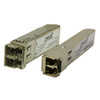
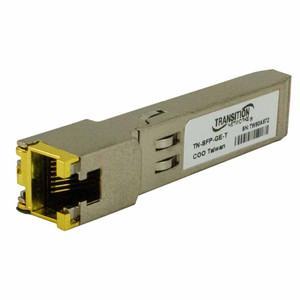
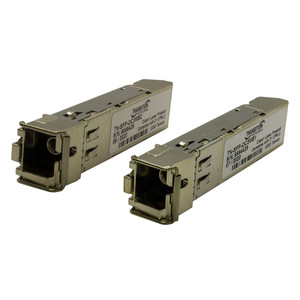
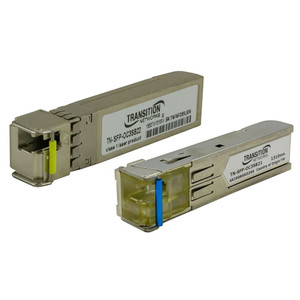
Transition Networks TN-SFP-OC3M Fast Ethernet SFP Transceiver
Overview
The Transition Networks TN-SFP-OC3M is a miniature SFP (small form-factor pluggable) transceiver module designed for Fast Ethernet 100Base-FX fiber connectivity. Operating at a 1310 nm wavelength over multimode fiber, this module extends point-to-point campus and data center links up to 1.2 miles without requiring active repeaters or signal conditioning. For network architects evaluating fiber extensions within existing SFP-equipped switch or router infrastructure, the TN-SFP-OC3M (often searched as TN SFP OC3M) eliminates the cost and complexity of a separate media converter while maintaining standard Ethernet protocol compatibility.
Key Features
- 100Base-FX Fast Ethernet over multimode fiber: Delivers 100 Mbps full-duplex throughput over duplex LC connectors, matching the speed profile of copper Gigabit switches without requiring protocol translation or active buffering. Suitable for non-critical backbone links, inter-building fiber runs, and legacy Ethernet infrastructure upgrades.
- 1310 nm wavelength on multimode fiber: Operates on standard OM1 and OM2 multimode fiber already deployed in most campuses, avoiding the cost of single-mode infrastructure. 1310 nm wavelength is less susceptible to modal dispersion than shorter wavelengths, maintaining reliable signal quality at the 1.2-mile distance limit.
- Up to 1.2 miles (1.9 km) link distance: Enables fiber runs across large warehouse facilities, multi-building campuses, or data center pod-to-pod interconnects without intermediate repeaters. Distance sufficient for most enterprise backbone topologies; longer runs require single-mode transceivers in the same family.
- Standard SFP slot compatibility: Inserts into any standard SFP socket found on managed and unmanaged switches, routers, and media converters—no configuration required. Plug-and-play installation with no tools, no firmware updates, no special driver software.
- TAA compliant: Meets Buy American and government procurement restrictions, reducing compliance review cycles for federal and defense contractors. Relevant for integrators supporting GSA Schedule or NDAA-sensitive environments.
- Duplex LC connectors: Standardized optical interface; compatible with existing multimode fiber patch panels and cassettes already in place in most data centers and campus backbone routes.
Integration & Compatibility
The TN-SFP-OC3M integrates into any networking equipment with a standard SFP transceiver slot—enterprise-class switches, edge routers, industrial Ethernet gateways, and media converters. No handshake protocols, no EEPROM pairing, no firmware prerequisites; the module presents itself as a dumb optical interface. Multimode fiber runs must be measured for length and attenuation before installation; field testing with an OTDR (optical time-domain reflectometer) is recommended after splicing new links. If your existing multimode fiber is unterminated or contaminated, fiber-end cleaning and polishing tools are necessary prerequisites—the transceiver itself includes no cleaning kit.
When to Choose a Different Model
If your link distance exceeds 1.2 miles, or if you require Gigabit (1000Base-SX or 1000Base-LX) speeds, consider a higher-bandwidth SFP variant within the Transition Networks product family. For submarine, high-noise industrial, or long-haul (10+ mile) backbone applications, single-mode SFP modules in the same family offer extended range and lower modal noise at higher cost.
Frequently Asked Questions
Q: Will the TN-SFP-OC3M work in my existing Cisco or Juniper switch?
A: Yes. The TN-SFP-OC3M is a standards-compliant 100Base-FX SFP transceiver and will insert into any SFP slot on Cisco, Juniper, Arista, or Dell switches. No vendor lock-in; the module is device-agnostic. Verify the switch supports 100Base-FX SFP modules (most do—check the data sheet).
Q: What multimode fiber do I need?
A: The TN-SFP-OC3M operates on standard OM1 (62.5/125 µm) or OM2 (50/125 µm) multimode fiber, the most common types in older and mid-range campus deployments. Verify existing fiber type with a fiber optic identifier; 1.2-mile distance is achievable on both.
Q: Can I mix this transceiver with single-mode fiber?
A: No. The TN-SFP-OC3M is engineered for multimode wavelength profiles and mode field diameters. Using it with single-mode fiber will result in high insertion loss and link failure. Single-mode requires a dedicated single-mode SFP module.
Q: Is a separate power supply required?
A: No. SFP transceivers are passive optical modules and draw power directly from the host switch or router's SFP slot (typically under 1W). No external power supply, no inline power injectors needed.
Q: What is the warranty on the TN-SFP-OC3M?
A: Refer to the product documentation or contact the manufacturer directly for warranty terms. Standard commercial SFP modules typically carry 1- to 3-year manufacturer warranties.
Q: Does the TN-SFP-OC3M require driver software or configuration?
A: No. Simply insert the module into an available SFP slot. The switch or router will auto-detect it as a 100Base-FX interface. No configuration, firmware, or drivers required.
Ted PerryPerspective based on aggregated IP Security Depot and affiliated engineering team experience.
The TN-SFP-OC3M is a straightforward optical interface—no intelligence, no management overhead, just passive fiber connectivity. For network integrators managing campus or warehouse backbone upgrades where existing multimode fiber is already in place, this transceiver solves a specific problem: connecting legacy or cost-conscious Ethernet equipment over fiber without the footprint and complexity of a standalone media converter chassis.
Technical Highlights:
- 1310 nm wavelength on multimode fiber: Standard for campus and data center backbones. Keeps per-link cost under $100 in most markets, and the wavelength is stable across temperature swings common in uncontrolled warehouse or outdoor cable routes.
- 1.2-mile (1.9 km) reach: Covers the majority of single-building and multi-building fiber runs; beyond that distance, link loss and modal dispersion degrade signal. Field testing with an OTDR recommended before final acceptance.
- 100 Mbps full-duplex: Adequate for interconnecting access layer switches or building-to-building Ethernet backbones in non-critical paths. Not suitable for 1 Gbps or 10 Gbps aggregation roles.
Deployment Considerations:
- Multimode fiber condition is critical. Dirty or damaged fiber end-faces will cause high loss and intermittent frame errors. Budget for optical inspection tools and fiber end-face cleaning supplies.
- SFP slot availability on your switch or router is non-negotiable. Older or budget-tier access switches may lack SFP ports entirely; verify port count in the switch datasheet before ordering.
The TN-SFP-OC3M is most valuable in campus consolidation projects or warehouse automation networks where existing multimode fiber runs are available and Fast Ethernet speeds (100 Mbps) meet capacity requirements. It eliminates the need for a separate converter chassis and simplifies inventory management—just insert the transceiver into the available SFP slot on your switch and test the optical link. Not suitable for new Gigabit backbone designs or high-reliability mission-critical paths where Gigabit SFP modules and certified single-mode fiber are the better choice.