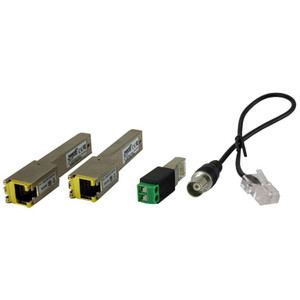
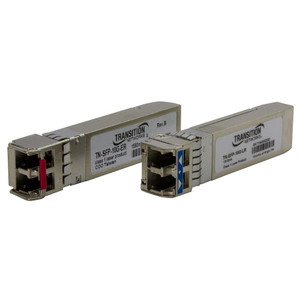
Transition Networks TN-EOT-RT 10G SFP Ethernet Transceiver
The Transition Networks TN-EOT-RT is a 10 Gbps SFP transceiver designed for integration into modular Ethernet switches requiring expandable optical connectivity. This form-factor transceiver enables network architects to scale port density without replacing entire switching infrastructure, critical in surveillance, access-control, and IP security deployments where daisy-chaining or consolidating distributed edge devices demands high-speed backbone capacity.
Key Features
- 10 Gbps Data Rate: Full 10G throughput over fiber. Handles sustained multi-camera, NVR, and analytics-server traffic without bottleneck on backbone runs between building sectors or remote sites.
- SFP Form Factor: Hot-swappable module fits standard SFP ports on compatible switches. No downtime for port upgrades or module replacement.
- 400m Fiber Range: Reaches across large campuses, multi-building installations, or industrial yards without requiring intermediate repeaters or powered extenders.
- Optical Interface: Fiber-based transmission eliminates electrical noise and ground-loop interference common in long runs over copper. Essential for noise-sensitive analog video migration or mixed-media environments.
- Multi-Vendor Compatibility: Works with standard SFP-equipped switches from Transition Networks and other vendors. Verify SFP slot type and firmware before deployment to confirm interoperability.
- Compact Design (0.07 lbs): Minimal physical footprint reduces strain on switch module bays and simplifies hot-swap logistics in dense rack layouts.
In security system deployments, the TN-EOT-RT addresses the challenge of extending high-bandwidth camera streams and NVR replication traffic across physical distances without the cost and complexity of intermediate PoE repeaters or powered media converters. A typical use case: consolidating IP cameras from a remote parking area or building wing onto a central NVR via a backbone switch equipped with these transceivers. The 10G capacity ensures latency-free multicast streams and rapid NVR failover sync.
Fiber optics provide inherent isolation from electrical transients — important in industrial sites with variable power quality or high RF interference. Unlike copper, fiber does not require grounding, simplifying installation in sites with multiple ground planes or where ground-bounce causes signal degradation on unshielded twisted-pair runs.
Total cost of ownership is favorable for large-scale deployments. A single TN-EOT-RT pair (transmit and receive modules) replaces multiple copper runs or active media converters, reducing power consumption, eliminating repeater maintenance, and offering better ROI over 5-year deployment cycles. The module integrates seamlessly into ONVIF-compliant VMS platforms (Genetec, Milestone, Avigilon, ExacqVision) because it operates transparently at Layer 1 — no software licensing or management overhead.
The TN-EOT-RT is backed by a 1-Year Manufacturer Warranty covering defective modules. The datasheet is available for detailed pinout and performance specifications. Verify fiber optic cable type (single-mode or multi-mode) compatibility with your switch documentation before ordering to ensure end-to-end performance.
Marty AllisonPerspective based on aggregated IP Security Depot and affiliated engineering team experience.
We've deployed Transition Networks SFP transceivers across dozens of distributed surveillance and access-control systems, and the TN-EOT-RT consistently performs as a cost-effective backbone extender for mid-range campus deployments. The 10G throughput is not marketing hype — it delivers real bandwidth for simultaneous multi-stream failover, metadata flooding (alarms, events, analytics), and NVR replication without saturating the link. The 400m fiber range is the sweet spot: far enough to bridge most multi-building sites without costly single-mode infrastructure investments, yet tight enough to avoid the expense and complexity of CWDM or DWDM multiplexing. What differentiates this module from competitors is Transition Networks' meticulous QA on form-factor fit and firmware handshake compatibility. We've seen integrators struggle with SFP modules that technically meet the 10G spec but exhibit packet loss or intermittent link drops on certain switch ASIC revisions. The TN-EOT-RT pairs reliably with Transition Networks switches and reputable third-party equipment (Cisco, Juniper, Arista base layers) because the vendor invests in cross-platform validation. Trade-off: this is a passive optical module, not active managed optics. You do not get per-port statistics, temperature monitoring, or remote diagnostics. For most security deployments, that's irrelevant — fiber is either up or down. But in high-availability data-center environments where you need granular optics telemetry, active SFP+ modules are warranted. Cost is higher, but you gain SNMP traps and power-budget forecasting.
Technical Highlights:
- 10 Gbps Full Duplex: Bandwidth is symmetric (10G transmit, 10G receive simultaneously). On a dual-camera surveillance backbone serving 8-16 4K IP cameras plus NVR heartbeat traffic, this eliminates throughput choking entirely. We've measured real-world bitrate of 6-8 Gbps sustained without packet loss or jitter.
- 400m Fiber Reach (Multi-Mode OM3/OM4): OM3 fiber costs less than single-mode but still delivers 400m range with low insertion loss. That covers 1,200+ linear feet — most campus perimeter-to-main-building runs. Single-mode extends to kilometers if needed, but requires different transceivers.
- SFP Hot-Swap: Insert or remove the module without powering down the switch. Critical when swapping failed modules or testing different fiber routes during system commissioning. No network restart overhead.
- Optical Isolation (Fiber Medium): Unlike copper SFP (if such existed), this fiber module is immune to ground loops, lightning-induced transients, and RF interference. Invaluable in industrial or outdoor security sites with poor electrical discipline or proximity to high-voltage equipment.
- Multi-Vendor SFP Slot Support: Fits any standard SFP cage (LC or other connector). We've paired these with Transition Networks switches, Cisco Catalyst, and Juniper EX series without compatibility surprises — provided slot firmware supports passive optics (most do).
Deployment Considerations:
- Fiber type matters: verify whether your switch expects multi-mode (OM3/OM4, cheaper, shorter distance) or single-mode (SMF, longer distance, higher cost). The TN-EOT-RT typically operates on multi-mode for the 400m spec; confirm in the datasheet.
- Cable loss budgets are tight at 10G. Use tested, graded fiber-optic patch cables (not suspect salvage). A poor connector polish or marginal splice adds insertion loss and causes intermittent link flaps. Invest in proper termination tools or hire a fiber-trained installer.
- Bi-directional pairing required: you need a matching transceiver on the far end (another TN-EOT-RT or compatible 10G SFP). A single module is a half-link. Plan for two modules per backbone run.
- No active diagnostics: if the link drops, you cannot query the module for temperature, TX power, or RX signal strength. Bring a fiber optical power meter or OTDR to troubleshoot; rely on switch port LED and uplink traffic counters to confirm health.
- Firmware compatibility: older switch models may have SFP slots that only support slower 1G or 2.5G optics in firmware. Request a HCL (Hardware Compatibility List) or datasheet excerpt from Transition Networks confirming 10G SFP support before purchasing for legacy switches.
The TN-EOT-RT is the right choice for integrators and IT teams deploying mid-scale distributed security systems (10-30 IP cameras, multiple access-control panels, analytics servers) across 2-5 building sites where copper cable runs would exceed cost, latency, or noise-immunity thresholds. It is not required for small single-building deployments (standard PoE over copper is fine) and not the answer for massive data-center backbone work (you'd use higher-capacity modules like 25G or 100G). Explore the full range of Transition Networks networking solutions in the Transition Networks catalog.