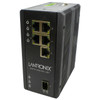
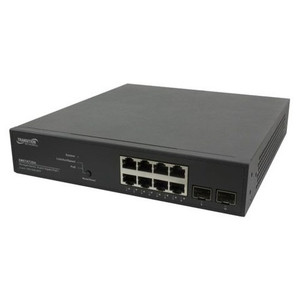
Transition Networks SISTP1040-551-LRT 10-Port Gigabit PoE++ Unmanaged Switch
Overview
The SISTP1040-551-LRT is a 10-port Gigabit unmanaged switch engineered for hardened security and telecom environments where simplicity and reliability matter more than feature bloat. Every port delivers 10/100/1000 Mbps speeds with PoE++ capability, meaning you can power high-draw devices — PTZ cameras, WiFi access points, and industrial IoT endpoints — directly from the switch without a separate power infrastructure. Because it's unmanaged, there's no configuration menu to navigate, no firmware updates to stage, and no IP address to assign. Plug in cables and power; it works. That elimination of management overhead translates to faster field deployment and fewer support callbacks, which compounds across dozens of sites.
Key Features
- 10 × Gigabit PoE++ ports: All 10 ports support 10/100/1000 Mbps and deliver PoE++ (802.3bt), so you're not limited to low-power endpoints. A high-draw PTZ camera pulling 60W or a dual-radio WiFi 6 access point won't starve the other ports — each gets its own power envelope.
- Zero configuration: No managed switch learning curve. Plug in the SISTP1040-551-LRT, connect devices, and it bridges traffic. No VLAN setup, no QoS tuning, no SSH access. Field integrators can deploy in minutes instead of hours.
- 2K MAC address table: Supports standard enterprise LANs without MAC thrashing or broadcast storms. Sufficient for typical security camera clusters, door controllers, and distributed IoT nodes in a single facility or small campus.
- Hardened form factor: Black powder-coat finish and compact footprint designed to fit into harsh environments — warehouses, outdoor equipment closets, industrial facilities. Not IP-rated itself, so keep it indoors or in a weatherproof enclosure, but it tolerates dust and vibration better than consumer-grade switches.
- Integrated PoE power budgeting: Delivers PoE++ across all 10 ports simultaneously without throttling. If you're running four 60W PTZ cameras and six access points on a single switch, the SISTP1040-551-LRT allocates power fairly. No port stealing power from another.
- 5-year manufacturer warranty: Covers defects in materials and workmanship. Standard lead time on replacements. Useful if you're specifying for 24/7 security or access control — one failed switch is a site outage, so warranty coverage and predictable replacement cycles reduce operational risk.
Integration and Deployment Context
The SISTP1040-551-LRT fits into network switches deployments where you're consolidating power and data for multiple powered devices. Typical scenarios: a warehouse loading dock with four PTZ domes and two WiFi backhaul points; a parking structure with a dozen IP intercoms and access readers; a manufacturing floor with IP cameras and industrial sensors. In each case, running a separate 12VDC or AC power supply to each device is expensive and error-prone; PoE++ from a single switch cuts labor and component cost. The unmanaged design also appeals to integrators who don't want to maintain another device in the stack — no SNMP monitoring, no firmware patching, minimal troubleshooting surface.
Pair this switch with a network video recorder or managed core switch for sites that demand monitoring and redundancy. The SISTP1040-551-LRT is a leaf node — simple, reliable, and disposable in topology terms.
When to Choose a Different Model
If you need port monitoring, QoS, VLAN segregation, or redundant ring topologies, step up to a managed Gigabit switch in the same product family. If power consumption per port must be precisely metered for compliance reasons, a managed model with per-port power reporting is worth the setup cost. If you need faster-than-Gigabit aggregation (10G uplinks), look to Transition Networks' higher-tier offerings. For small deployments with only two or three PoE devices, an unmanaged 5-port variant may suffice and save cost.
Frequently Asked Questions
Q: Does the SISTP1040-551-LRT require any configuration?
A: No. It is an unmanaged switch — plug in power and Ethernet cables, and it begins forwarding frames immediately. No IP address, no login, no firmware updates.
Q: Can all 10 ports deliver full PoE++ power at the same time?
A: Yes. The switch's internal power budget supports simultaneous PoE++ delivery across all 10 ports. Total power capacity is sufficient for high-draw endpoints like PTZ cameras.
Q: What is the warranty period on the SISTP1040-551-LRT?
A: Five years, covering defects in materials and workmanship. Replacement lead times and support terms are available from the manufacturer.
Q: Is the SISTP1040-551-LRT suitable for outdoor installation?
A: The switch itself is not IP-rated and should not be exposed directly to rain or high humidity. Mount it indoors or inside a weatherproof enclosure. The PoE++ ports can power outdoor devices connected via outdoor-rated cabling.
Q: What is the MAC address table capacity?
A: 2K MAC addresses. This is adequate for standard enterprise LAN environments with dozens of endpoints per switch. If you anticipate much larger broadcast domains, a managed switch may be a better fit.
Q: Can I daisy-chain multiple SISTP1040-551-LRT switches?
A: Yes, use one or more ports on each switch to cascade to another switch. No special configuration is required — unmanaged operation means they will bridge traffic transparently. For redundancy or loop prevention, a managed switch upstream is recommended.
Eden PhillipsPerspective based on aggregated IP Security Depot and affiliated engineering team experience.
The SISTP1040-551-LRT (often searched as SISTP1040 551 LRT) is the right pick if your integration demand is straightforward: push power and data to a cluster of endpoints without management overhead. The 10-port PoE++ configuration is the key differentiator — it means you're not compromise-shopping between port count and power capacity. Every port is equal.
Technical Highlights:
- 10 × Gigabit PoE++ (802.3bt): Each port supplies PoE++ simultaneously, eliminating the power bottleneck that plagues cheaper 5-port switches. A 60W PTZ camera and a 30W access point can coexist on the same switch without one throttling the other.
- 2K MAC address table: Handles typical security and IoT clusters (30–50 endpoints per switch) without saturation. Larger broadcast domains risk MAC table exhaustion; for those, segment with a managed switch upstream or deploy multiple SISTP1040-551-LRT units in a cascade.
- Unmanaged architecture: Zero configuration means zero misconfiguration risk. Field integrators don't need to understand VLAN tagging or QoS queues to make it work. Deploy speed improves measurably — especially on multi-site contracts where repetition counts.
Deployment Considerations:
- This switch has no built-in redundancy or failover. If it dies, the entire downstream segment goes dark. For critical access control or 24/7 surveillance, consider a backup unit on hot standby or a managed switch with ring topology support.
- The unmanaged design means no per-port power metering or firmware updates. If your compliance posture requires detailed audit trails of PoE consumption or security patching, a managed model is a better fit — the SISTP1040-551-LRT is more 'install and forget' than 'monitor and maintain.'
- No onboard intelligence for loop detection or BPDU filtering. If you're daisy-chaining multiple units, add a managed switch at the core to prevent spanning-tree failures.
Best fit: warehouse access control clusters, parking structure camera nodes, and loading-dock endpoint aggregation — any scenario where you're aggregating 5–10 PoE devices on one site and don't want to troubleshoot switch config. Avoid for high-availability 24/7 surveillance where a single point of failure is unacceptable.