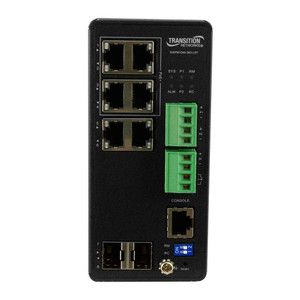
Transition Networks SISTG1040-242-LRT 6-Port Unmanaged Gigabit Switch
Overview
The SISTG1040-242-LRT is a 6-port unmanaged gigabit switch built for hardened industrial and telecom installations where simplicity and uptime matter more than managed features. If your deployment demands straightforward plug-and-play connectivity without configuration overhead—typical in field cabinets, remote sites, or retrofit applications—this DIN rail unit eliminates the complexity of managed switches while delivering the port density you need. Designed by Transition Networks, a vendor focused on industrial-grade networking, the SISTG1040-242-LRT (often searched as SISTG1040 242 LRT) is purpose-built for security integrators and systems engineers who value reliability over feature bloat.
Key Features
- 6 Gigabit Ethernet Ports: All six ports operate at full gigabit line rate (1000 Mbps), delivering enough bandwidth for multiple simultaneous IP camera streams, access control readers, or sensor networks without port congestion. In a typical deployment with four 5MP cameras at 8 Mbps each, you're drawing roughly 32 Mbps—leaving 968 Mbps headroom per port for management traffic or future expansion.
- Unmanaged Operation: No VLAN configuration, no SNMP polling, no web interface to maintain. The unit forwards packets immediately upon power-up. This cuts provisioning time in field installations and eliminates a potential security attack surface—no credentials to compromise, no firmware to patch on the switch itself. Ideal for integrators who want to ship a cabinet and have it work without day-one configuration calls.
- DIN Rail Form Factor: Mounts directly to standard 35mm DIN rail in enclosures, control panels, or 19-inch racks using DIN adapters. Saves cabinet space compared to desktop switches and keeps cabling organized in tight installations. Industry-standard mounting—your electricians and integrators already know how to work with it.
- Industrial Hardening: Built for telecom and industrial environments where temperature swings, vibration, and power transients are routine. The ruggedized design means fewer field failures in uncontrolled spaces (outdoor cabinets, factory floors, vehicle-mounted installations) compared to commercial-grade consumer switches.
- Auto-Negotiation & Auto-MDI/MDIX: Automatically detects link speed (100 Mbps or 1000 Mbps) and cable polarity, so you don't need to worry about wiring order or speed mismatches. Plug in any compliant Ethernet cable and it just works—critical when integrators are commissioning sites under time pressure.
- 5-Year Limited Warranty: Provides confidence in remote deployments where physical access is difficult. Covers hardware defects and manufacturing faults, giving you contractual recourse if a unit fails in the field.
Integration & Deployment Context
The SISTG1040-242-LRT fits well into any network infrastructure that values simplicity—whether you're building a small-to-medium switch infrastructure for a security system, a distributed access control deployment, or a multi-site industrial automation network. Because it's unmanaged, it works seamlessly with any IP camera brand, any ONVIF-compliant endpoint, and any standard network architecture. It doesn't care about VLANs, QoS, or spanning tree—it just moves packets. This makes it particularly valuable in retrofit scenarios where you're adding cameras or sensors to existing buildings without touching core network gear.
Pair this unit with a network video recorder or central PoE injector in the same cabinet for a self-contained system. The six ports give you flexibility: four ports for cameras, one for a management connection, and one spare or for an uplink to a backbone switch.
When to Choose a Different Model
If your deployment requires VLAN isolation (multi-tenant sites, strict traffic separation), QoS prioritization, SNMP monitoring, or remote management, step up to a managed switch in the Transition Networks industrial line. If you need PoE power delivery integrated into the switch itself, look for a managed PoE-enabled model—the SISTG1040-242-LRT is data-only and requires external PoE injectors or switches. For applications with more than six gigabit ports, consider larger unmanaged or managed models from the same family.
Frequently Asked Questions
Q: Does the SISTG1040-242-LRT include integrated PoE power?
A: No. This is a data-only gigabit switch. You'll need to supply PoE power via a separate injector, PoE switch, or midspan device connected to your cameras or powered endpoints.
Q: Can I manage or monitor the SISTG1040-242-LRT remotely?
A: No. It's unmanaged, so there's no IP address, no web interface, no SNMP agent, and no remote access. Once it's powered and cabled, you can't check link status or statistics via the network. You can physically inspect LED indicators on the unit for link status.
Q: What's the power consumption and supply requirement?
A: The unit requires external DC power (exact voltage and amperage are in the datasheet). Confirm your cabinet's power supply can provide the required current before ordering.
Q: Will the SISTG1040-242-LRT work with any IP camera or network device?
A: Yes. Since it's a standard Layer 2 gigabit switch, it works with any ONVIF-compliant IP camera, any access control reader, sensor, or other Ethernet device. No compatibility issues.
Q: Is the SISTG1040-242-LRT NDAA-compliant or TAA-compliant?
A: Consult the datasheet or contact Transition Networks directly for compliance documentation. Compliance certifications are not confirmed in the product overview.
Q: What's the warranty coverage?
A: 5-year limited warranty covering hardware defects and manufacturing faults. Refer to the warranty terms in the datasheet for exclusions and service procedures.
Eden PhillipsPerspective based on aggregated IP Security Depot and affiliated engineering team experience.
The SISTG1040-242-LRT is the right choice when you need a switch that doesn't require babysitting. Six unmanaged gigabit ports running at full line rate (1000 Mbps per port) means you can push real bandwidth—ideal for multi-camera deployments or sensor-dense installations—without worrying about configuration drift or firmware vulnerabilities on the switch itself. The DIN rail form factor locks into standard industrial enclosures, and the 5-year warranty gives you confidence in remote sites where you won't see the hardware again for years.
Technical Highlights:
- 6 × 1000 Mbps Ports: Each port handles full gigabit throughput independently. A four-camera 5MP stream at 8 Mbps per camera draws 32 Mbps—less than 4% of a single port's capacity. Headroom for growth, and no port contention in typical security or industrial deployments.
- Zero Management Overhead: Unmanaged means no IP address, no password, no VLAN configuration, no firmware updates to schedule around maintenance windows. It powers up and forwards packets. Your ticket queue stays shorter, and your security posture doesn't hinge on switch credentials.
- Industrial-Grade Durability: Built for telecom and factory environments where commercial switches fail. Temperature tolerance, vibration resistance, and power-supply filtering are engineered in from the start—not an afterthought.
Deployment Considerations:
- This unit has no integrated PoE. You'll need separate PoE injectors or a PoE-enabled switch upstream if your cameras require power. Plan your power architecture before ordering—a common oversight on retrofit jobs.
- No remote visibility: Because it's unmanaged, you cannot poll it for link status, packet counts, or error rates over the network. You see LEDs on the front panel. If you need SNMP-based monitoring or remote troubleshooting, move to a managed model. For simple fixed installations (cabinet doesn't move, links don't flap), this is fine. For mobile or temporary setups, lack of remote diagnostics can slow troubleshooting.
- DIN rail mounting is standard in industrial and telecom cabinets, but confirm your enclosure has DIN rail. If you're mounting in a 19-inch rack, you'll need a DIN-to-rack adapter—typical cost is $20–50, but it's an extra line item.
The SISTG1040-242-LRT earns its place in hardened field deployments: remote camera arrays, industrial access control nodes, and telecom distribution closets where you want the switch to simply work without becoming a management burden. If you're building a cabinet that ships and runs for years with minimal touch, this is a sound choice.