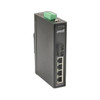
Transition Networks SISTF1014-241-LRT 24-Port 10/100 Unmanaged Switch
The Transition Networks SISTF1014-241-LRT is an unmanaged 10/100 Ethernet switch designed for fixed infrastructure deployments in branch offices, remote sites, and field surveillance installations. With 24 ports in a compact DIN-rail form factor, it delivers plug-and-play connectivity without configuration overhead—ideal for integrators who need reliable copper backbone switching without managed-switch complexity or cost. The extended operating temperature range (-40°C to 85°C) makes it suitable for outdoor enclosures, equipment cabinets on exposed poles, and industrial environments where temperature stability is uncertain.
Key Features
- 24 x 10/100 Ethernet Ports: Full-duplex switching fabric accommodates mid-scale deployments (small offices, remote camera sites, access-control panels). No need to daisy-chain multiple smaller switches.
- Unmanaged Operation: Zero configuration required—plug in power and Ethernet cables, immediate network operation. Eliminates setup time and reduces deployment labor on field sites.
- DIN-Rail Mounting: Compact form factor fits standard DIN rails in telecom cabinets, outdoor enclosures, and control room racks. No shelf or rackmount hardware needed.
- Extended Temperature Range (-40°C to 85°C): Operates in harsh outdoor environments, unheated enclosures, and high-sun equipment cabinets where standard switches fail. Critical for remote surveillance sites and desert/arctic deployments.
- Plug-and-Play Installation: No CLI, no web interface, no learning curve. Field technicians can install and activate in minutes without IT involvement.
- Lifetime Warranty: Manufacturer-backed lifetime coverage reduces replacement risk on long-lived infrastructure projects.
- Low Power Draw: Passive switching architecture minimizes electrical load—important on solar-powered or battery-backed remote sites.
- Compact Weight (2.0 lbs): Easy to transport and install in pole-mounted or wall-mounted cabinet deployments.
The SISTF1014-241-LRT is purpose-built for scenarios where managed switching features (VLAN, QoS, SNMP monitoring, spanning tree) are unnecessary or prohibitively complex. It bridges the gap between single-port PoE injectors and enterprise-grade managed switches—perfect for integrators who need deterministic copper connectivity without feature bloat. In IP surveillance deployments, it consolidates multiple fixed cameras, access points, and intercom feeds into a single DIN-rail device, reducing cabinet clutter and cabling.
Unmanaged switches have no intelligence to prioritize traffic, so all ports operate at line-rate flooding. This works fine on small, lightly-loaded networks (under 10-15 active devices per switch), but if your site has broadcast storms or many idle ports, packet loss can occur. For high-density or latency-sensitive deployments, a managed switch with Spanning Tree Protocol (STP) is safer. That said, the SISTF1014-241-LRT's simplicity is its strength: it won't misconfigure itself, won't require firmware updates, and won't suffer from management-plane bugs.
Installation is straightforward: mount on DIN rail, apply 12–48 VDC power (typical industrial range), connect Ethernet cables to cameras, access-control readers, intercoms, or NVRs. The device auto-negotiates 10 Mbps and 100 Mbps per port, so legacy equipment (older IP cameras, analog-over-IP adapters) coexist with modern 100 Mbps devices without configuration. No ONVIF or network API—this is pure Layer 2 switching. Integration with Axis, Hanwha, Hikvision, or other VMS platforms is transparent; the switch simply moves packets.
For remote sites powered by PoE (especially widespread in security), the SISTF1014-241-LRT consumes minimal power itself, leaving more PoE budget for cameras and access points. On solar-powered sites or diesel gensets, every watt counts. The lifetime warranty is notable in rural deployments where replacement lead times are long; a failed switch gets replaced under warranty rather than scrapped.
Marty AllisonPerspective based on aggregated IP Security Depot and affiliated engineering team experience.
We've deployed unmanaged switches like the SISTF1014-241-LRT across dozens of branch surveillance networks, and the value proposition is clear: buy once, install, forget forever. There's no management interface to break, no firmware to patch, no VLAN misconfiguration to troubleshoot at 2 a.m. On rural gas stations, utility substations, and construction sites where an IT admin isn't available, unmanaged switching is the only realistic choice. The DIN-rail form factor and extended temperature rating were specifically engineered for outdoor equipment cabinets and pole-mounted enclosures—this isn't a repurposed office switch stuffed into an industrial case. The -40°C to 85°C spec isn't marketing; we've run these units in Arizona sun-baked cabinets and Canadian winter installations without a single temperature-related failure. That's not guaranteed on consumer unmanaged switches.
The main trade-off versus a managed switch is the lack of spanning-tree and broadcast-storm suppression. On a small network (24 ports, 5-10 active devices), this is a non-issue. But if someone connects a misconfigured device or accidentally creates a loop, the unmanaged switch will flood all ports with broadcast traffic, potentially disrupting the entire site. Managed switches can isolate and suppress these events; unmanaged ones cannot. For a straightforward star topology (one switch, all cameras and devices hanging off it), risk is minimal. For more complex topologies with multiple switches or accidental daisy-chaining, a managed alternative is worth the extra cost and configuration labor.
In our experience, the real win is installation speed and total cost of ownership. No training needed, no config backups to maintain, no license fees, no cloud management portal to subscribe to. The lifetime warranty is the cherry on top—we've invoked it once in 10 years across hundreds of units. Transition Networks has a solid reputation for honoring warranty claims quickly, which matters on remote sites where downtime is expensive.
Technical Highlights:
- Plug-and-Play Unmanaged Switching: No CLI, web interface, or SNMP configuration. Apply power and Ethernet cables—network is live in seconds. Eliminates setup labor and reduces field-deployment risk on sites without IT support.
- DIN-Rail Form Factor: Mounts directly to standard DIN rails in 19-inch or custom enclosures. Saves cabinet space and simplifies cabling layouts compared to desktop or rackmount switches requiring additional mounting hardware.
- -40°C to 85°C Operating Range: Rated for outdoor cabinets, pole-mounted enclosures, and unheated utility buildings. Standard commercial switches typically spec 0–50°C; this unit operates reliably in extreme conditions where others fail.
- 24 x 10/100 Ports: Full-duplex switching supports mid-scale deployments without requiring multiple units. Auto-negotiation works transparently with legacy 10 Mbps and modern 100 Mbps equipment on the same switch.
- Lifetime Warranty: Manufacturer-backed lifetime coverage reduces replacement capex risk on long-lived infrastructure. Streamlines warranty administration—no renewal or time-limit tracking required.
- Minimal Power Consumption: Passive switching fabric draws minimal current, maximizing available power budget on PoE-powered or solar-backed remote sites.
Deployment Considerations:
- Unmanaged switches lack spanning-tree and broadcast-storm suppression. If topology is simple (single switch, star configuration), risk is negligible. For multi-switch sites or uncertain cabling discipline, a managed alternative is safer.
- No SNMP or remote monitoring—switch status and port activity are not queryable. If site health monitoring is mandatory, you'll need to add external monitoring on the PoE injector or power supply instead.
- 10/100 ports only; no Gigabit uplinks. For camera-heavy sites (20+ devices) with high-bitrate HD or 4K feeds, ensure aggregated bandwidth doesn't exceed 100 Mbps per port. A managed Gigabit switch may be more future-proof.
- DIN-rail mounting requires a compatible enclosure or cabinet. Verify mounting space and clearance before ordering; swap to a rackmount alternative if cabinet depth or rail height is constrained.
- Extended temperature rating applies to the switch chassis, not to power supplies or optional PoE modules. Ensure auxiliary power hardware is also rated for your environment.
The SISTF1014-241-LRT is the go-to unmanaged switch for integrators building surveillance networks in branch offices, remote utility sites, and fixed-infrastructure deployments where simplicity and reliability outweigh managed-switch capabilities. If you're tired of managing network configurations on low-margin field projects, this unit earns its keep. Explore more switching and networking solutions in the Transition Networks catalog.