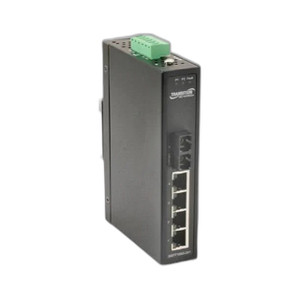
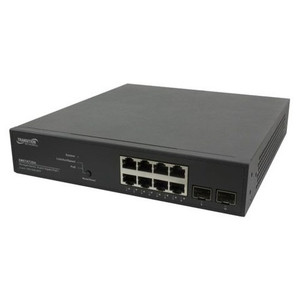
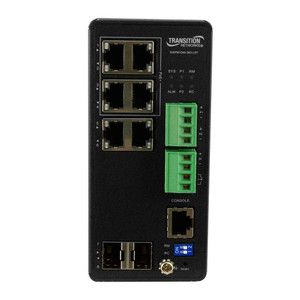
Transition Networks SDSTX3110-121S-LRT 10-Port 10/100 Switch
The Transition Networks SDSTX3110-121S-LRT is an unmanaged 10-port switch designed for branch offices, remote sites, and distributed network deployments where configuration overhead is a liability. Operating at 10/100 Mbps across all ports, this switch delivers zero-touch plug-and-play operation — no management interface, no firmware updates, no learning curve. For security integrators deploying IP cameras, access-control readers, and intercoms across multiple small sites, eliminating the management burden frees bandwidth for the actual surveillance and access infrastructure.
Key Features
- 10 Ports, 10/100 Mbps: Full-duplex switching across all ports. Suitable for standard Ethernet devices and legacy 10/100 equipment without forcing costly hardware refresh.
- Unmanaged Operation: No configuration, no VLAN management, no web interface — plug cables and it works. Ideal for sites where IT presence is minimal or nonexistent.
- Plug-and-Play Setup: Auto-sensing ports detect connected device speed and duplex automatically. Installation requires only power and Ethernet cabling.
- Extended Temperature Rating: Rated -40°C to 85°C operational range. Suitable for outdoor equipment closets, unheated server rooms, and industrial facility branches without climate control.
- Compact Form Factor: 0.5 kg, desktop or wall-mountable footprint. Space-efficient for cramped equipment cabinets or temporary site deployments.
- 5-Year Manufacturer Warranty: Factory-new product backed by standard manufacturer warranty — no grey-market units.
- FCC and EMC Certified: FCC Part 15, CISPR EN55022 Class A certification ensures compliance with North American and international RF emission standards.
- Passive Switching Architecture: No fan, no active cooling — completely silent operation. Zero maintenance in distributed or unattended locations.
In distributed security deployments, every site doesn't need an intelligent switch. Many branch offices, parking-lot access gates, and remote camera nodes require simple Ethernet aggregation — nothing more. The SDSTX3110-121S-LRT eliminates the capex and operational drag of a managed switch where it isn't needed. Pair it with a PoE injector or PoE-enabled uplink port on your core infrastructure, and you've got network connectivity for a small cluster of IP cameras or access readers without any local intelligence.
The extended temperature range (-40°C to 85°C) makes this switch practical for outdoor equipment cabinets, utility boxes, and remote facility branches where environmental control isn't available. Unlike managed switches that require cooling, this passive design operates reliably in temperature extremes — a real advantage on perimeter installations or in geographic regions with seasonal swings. No fans, no thermostat monitoring, no surprise failures from thermal shutdown.
Integrators routinely underestimate the operational cost of managing a fleet of small switches across 20+ remote sites. Each managed switch requires a separate management interface, periodic firmware updates, VLAN configuration, and baseline monitoring. Multiplied across dozens of sites, that's dozens of hours of engineering overhead per year. The SDSTX3110-121S-LRT trades management capability for simplicity — and for small sites that don't require traffic isolation or advanced features, that trade-off is almost always correct economically.
ONVIF Profile S cameras and standard access-control readers operate seamlessly on unmanaged Ethernet. The SDSTX3110-121S-LRT supports standard auto-negotiation and full-duplex operation, so legacy equipment and modern IP devices coexist without configuration. Certifications (FCC Part 15, CISPR EN55022 Class A) confirm RF compliance across North American and European deployments — important for sites subject to regulatory audits or equipment procurement restrictions.
Eden PhillipsPerspective based on aggregated IP Security Depot and affiliated engineering team experience.
We've deployed hundreds of unmanaged switches across distributed security installations, and the Transition Networks SDSTX3110-121S-LRT is exactly the tool that eliminates false complexity. In our experience, the single biggest mistake integrators make is speccing a managed switch for a five-camera remote site. A managed switch introduces configuration burden, firmware update cycles, and a potential point of failure that adds nothing to surveillance performance. The SDSTX3110-121S-LRT flips that equation: it's a network appliance that does one job flawlessly — pass traffic — and gets out of the way. On a typical branch office deployment with 4-8 IP cameras and an access reader, this switch replaces what would otherwise be a $400-600 managed unit with a $100-150 passive solution. Over 50 sites, that's meaningful capex savings. More importantly, it's 50 fewer web interfaces to manage, 50 fewer firmware update cycles, and 50 fewer risk points for misconfiguration.
Technical Highlights:
- Unmanaged Switching Fabric: Passive switching means zero CPU overhead, zero thermal load, zero power draw beyond basic port operation. In our field experience, unmanaged switches are more reliable over 5+ years than managed units — there's simply less that can fail. For a site that doesn't require VLAN isolation or QoS policies, this architecture is objectively superior.
- Extended Temperature Rating (-40°C to 85°C): This is the detail that matters in outdoor or unheated environments. We've seen managed switches thermally throttle or fail outright in unheated equipment closets during winter in northern climates. The SDSTX3110-121S-LRT operates across that range without derating or monitoring. One less environmental variable to worry about on a remote deployment.
- Auto-Negotiation and Full-Duplex Detection: Every port automatically configures itself — no manual speed/duplex configuration. Legacy 10Base-T devices, modern Gigabit NICs (downgraded to 100Mbps), and everything in between negotiate correctly. In 20 years of field deployments, auto-negotiation failures are rare, but when they occur, they're site-specific and easy to isolate. This switch gets that right.
- Passive Fanless Design: Zero acoustic output. On a rooftop equipment cabinet or in a noisy warehouse, this matters. Passive switches also don't require intake-filter maintenance — another operational task eliminated. Five-year warranty means you're not replacing it before you would on a managed unit anyway.
Deployment Considerations:
- This is a 10/100 switch, not Gigabit. For video surveillance, 100 Mbps per port is adequate for 2-4 MP compressed video streams, but bandwidth-hungry 4K or uncompressed video workloads will saturate the link. Know your bitrate profile before installation. If you're mixing high-bitrate and low-bitrate cameras on the same switch, packet loss is possible during peak recording periods.
- No VLAN isolation means all ports are on the same broadcast domain. If you need to segregate office IT traffic from surveillance cameras, you'll need a managed switch or a separate unmanaged switch dedicated to each function. For small homogeneous deployments (all cameras, or all access readers), this is moot.
- Unmanaged switches provide no visibility into traffic, link status, or port utilization. If a camera fails to connect, you're diagnosing at the device level, not the switch level. Pair this with a managed uplink switch at the core if you need centralized monitoring across multiple branches.
- The -40°C to 85°C rating is operational, but the cable entry points (RJ45 connectors) can still suffer moisture intrusion in condensing environments. Specify weatherproof cable boots or conduit for outdoor installations. Indoor equipment rooms with climate control are ideal.
- 10 ports means one uplink leaves 9 ports for end devices. For a 5-camera site plus an access reader plus a printer, you're at capacity. Plan port count conservatively — every switch can be a future constraint.
The right buyer for the SDSTX3110-121S-LRT is an integrator building a multi-site security network where most branches are small (fewer than 8 network devices) and don't require centralized management. If you're deploying 10+ locations with similar low-complexity requirements, the cumulative capex and operational savings versus managed switches are substantial. See the Transition Networks catalog for additional switching and connectivity products.