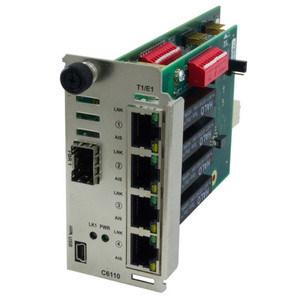
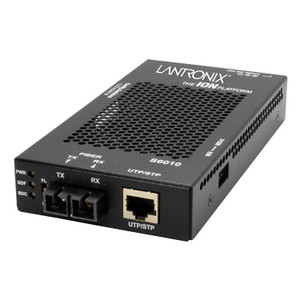
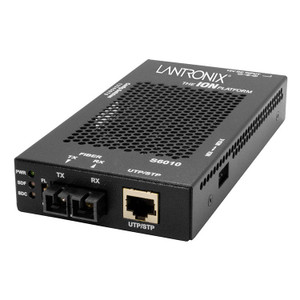
Transition Networks S6110-1040-NA 4x T1/E1 ION Module
Overview
The Transition Networks S6110-1040-NA is a dedicated 4-port T1/E1 interface module engineered for enterprise and carrier deployments that still rely on legacy circuit-switched telecom infrastructure. This modular unit integrates into the Transition Networks ION appliance platform, providing high-density T1/E1 port termination without forcing you to overprovision Ethernet bandwidth where circuit connectivity is the primary requirement. If your network still carries voice, fax, or data over T1/E1 circuits—particularly in branch offices, carrier points-of-presence, or hybrid legacy-to-IP migration scenarios—the S6110-1040-NA (often searched as S6110 1040 NA) delivers the port density and industrial reliability you need.
Key Features
- 4x T1/E1 Ports: Four dedicated legacy telecom circuit ports mean you can terminate four separate T1 (1.544 Mbps) or E1 (2.048 Mbps) lines in a single module. This is critical if you're consolidating branch office circuits or managing carrier SLA handoffs without consuming switch ports intended for IP traffic.
- ION Platform Integration: The module slots into compatible Transition Networks ION appliance architectures, letting you expand port density on a single chassis rather than stacking separate units. Reduces rack footprint and simplifies cable management compared to standalone circuit aggregation boxes.
- Industrial Temperature Rating: Rated for industrial operating temperature ranges, meaning the S6110-1040-NA won't throttle or shutdown in environments where standard commercial-grade equipment fails—a real advantage in uncontrolled spaces (remote cell sites, outdoor cabinets, utility enclosures) where thermal management is difficult.
- 10G Platform Support: Compatible with ION appliances capable of 10G backbone integration. This matters if you're bridging legacy T1/E1 circuits to high-speed IP backhaul; you won't bottleneck upstream throughput at the circuit-to-IP demarcation point.
- Modular Expansion Design: Add or remove T1/E1 capacity without replacing the entire appliance. Useful when circuit counts fluctuate or when you're gradually migrating branches from TDM to SIP/IP—buy only the port density you need today.
- Carrier-Grade Reliability: Built for environments where downtime on a single circuit affects SLA compliance and revenue. The module integrates into a platform designed for 99.9%+ availability in telecom operations.
Integration & Compatibility
The S6110-1040-NA is purpose-built for installations running Transition Networks ION appliance platforms. Verify your ION chassis supports modular T1/E1 interface expansion before ordering; not all ION models accept this module. The unit provides T1/E1 termination only—Ethernet integration is managed by the host ION appliance or separate IP infrastructure, which is appropriate for deployments where circuit aggregation and IP switching are handled by distinct systems.
When to Choose a Different Configuration
If your branch office is already fully IP-enabled and you have no active T1/E1 circuits, this module adds no value. Similarly, if you need fewer than four ports, consider whether a smaller Transition Networks ION variant might reduce cost. If you require integrated Ethernet switching alongside circuit termination, evaluate whether a converged appliance fits your architecture better than a modular approach.
Frequently Asked Questions
Q: Is the S6110-1040-NA compatible with all Transition Networks ION platforms?
A: No. The S6110-1040-NA is designed for ION appliance architectures that support modular T1/E1 interface expansion. Confirm your specific ION chassis model supports this module before purchase.
Q: Can I mix T1 and E1 ports on the same module?
A: The S6110-1040-NA provides 4x T1/E1 ports, meaning each port can be provisioned as either T1 (1.544 Mbps) or E1 (2.048 Mbps) depending on your circuit provider and network configuration. Consult the datasheet for port-by-port configuration options.
Q: What happens if I lose power to the S6110-1040-NA?
A: The module draws power from the host ION appliance chassis. If the appliance loses power, the T1/E1 circuits will drop. Implement UPS protection at the appliance level to maintain circuit availability during power events.
Q: Does the S6110-1040-NA require separate network management?
A: No. The module is managed through the ION appliance management interface. Port provisioning, alarms, and statistics roll up into the parent appliance's management console.
Q: What's the typical deployment scenario for this module?
A: Branch office circuit aggregation, carrier point-of-presence TDM termination, legacy voice/fax circuit consolidation, or hybrid TDM-to-IP migration staging. Any environment where four T1/E1 circuits must terminate on a single appliance.
Ted PerryPerspective based on aggregated IP Security Depot and affiliated engineering team experience.
I've fielded a lot of questions about whether legacy T1/E1 infrastructure is still worth supporting in 2024. The answer is simple: yes, if you have active circuits. The Transition Networks S6110-1040-NA solves a real problem—cramming four T1/E1 termination points into a modular ION appliance chassis without forcing you to buy separate circuit aggregation hardware. This is particularly valuable in carrier environments and branch consolidations where TDM circuits are still carrying revenue traffic.
Technical Highlights:
- Four T1/E1 Ports: Each port can be independently configured as T1 (1.544 Mbps) or E1 (2.048 Mbps), giving you flexibility to mix circuit types on the same module. This is critical in multinational deployments or carrier handoff points where you may have both North American and European circuit standards in play.
- Industrial Temperature Rating: Rated for industrial temperature ranges, which means no throttling or shutdown in uncontrolled environments. Real advantage when the appliance is installed in outdoor cabinets or remote cell sites where HVAC is not an option.
- 10G Backbone Integration: The module integrates into ION appliances with 10G uplink capability. Don't underestimate this—if you're using the S6110-1040-NA as a circuit aggregation point feeding IP backbone, you need backhaul bandwidth to match. The 10G support means circuit-to-IP handoff won't be your bottleneck.
Deployment Considerations:
- Verify ION chassis compatibility before ordering. Not all ION models accept this module—mismatch is a common procurement mistake that results in expensive rework.
- Power and management are handled entirely by the host appliance. If you lose the appliance, you lose all four circuits. Size your UPS accordingly and ensure your management monitoring covers both the appliance and the T1/E1 interface module.
- T1/E1 circuit provisioning requires carrier coordination. Don't assume standard CSU/DSU termination—validate framing, line coding, and impedance with your carrier before installation.
The S6110-1040-NA is best suited for integrators and carriers managing branch office TDM consolidation, point-of-presence circuit termination, or hybrid legacy-to-IP migration strategies. It's not a fit if you're greenfield IP-only, but if you're managing installed base T1/E1 infrastructure, this module delivers solid port density and industrial reliability without overspending on unnecessary Ethernet capacity.