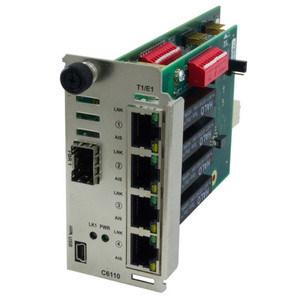
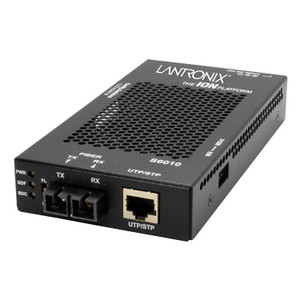
Transition Networks S6120-1040-NA 4x T1/E1 ION with Ethernet
The Transition Networks S6120-1040-NA is a 4-port T1/E1 to Ethernet converter designed for legacy circuit-switched infrastructure migration to IP networks. This managed ION (Intelligent Optical Node) bridges traditional T1/E1 telephony interfaces directly to 10G Ethernet, enabling integration of legacy PBX systems, carrier circuits, and voice infrastructure into modern IP-based deployments without requiring forklift replacement of existing telecom equipment. Industrial-rated for non-climate-controlled equipment rooms, the unit handles temperature extremes that would stress commercial-grade converters.
Key Features
- 4x T1/E1 Port Conversion: Four independent T1/E1 circuits to Ethernet bridging. Each circuit maintains full bandwidth and protocol transparency — no transcoding or compression penalties.
- 10G Ethernet Output: 10 Gigabit uplink ensures zero bottleneck when aggregating multiple T1/E1 streams (4 × 1.544 Mbps T1 or 2.048 Mbps E1 = minimal utilization of 10G capacity). Future-proofs against carrier circuit additions.
- Managed Converter: Full SNMP, CLI, and web interface for configuration, monitoring, and alarm escalation. Integrates with standard NOC tooling and carrier management platforms.
- Single-Mode Fiber SFP Slot: One 10G SFP module slot for single-mode or multi-mode fiber uplink options. Allows point-to-point or MPLS-based carrier circuit bridging over long distances.
- Industrial Operating Temperature: Rated for non-climate-controlled enclosures, outdoor cabinets, and harsh equipment rooms. No thermal derating — handles equipment-room extremes without fan upgrade.
- Included Power Supply: Factory-supplied AC/DC power module; mounting hardware and optical modules sold separately.
- Lifetime Manufacturer Warranty: Coverage against defects; service and replacement procedures defined per datasheet.
- Standards Compliance: EN55022 Class A (EMI), EN55024 (immunity), CE marking. Clears carrier-class EMC validation for data-center and telecom-closet deployment.
The S6120-1040-NA is purpose-built for service providers and enterprise IT teams tasked with decommissioning legacy T1/E1 circuits while preserving existing PBX and voice-gateway infrastructure. Unlike software-based emulators or cloud-hosted SIP trunking (which introduce latency and licensing dependencies), this hardware converter maintains deterministic sub-millisecond latency and supports protocol-transparent bridging — critical for voice quality and call-signaling consistency in hybrid deployments.
Deployment scenarios include branch-office PBX integration, carrier circuit demarcation bridging, legacy voice-mail system preservation, and interim migration points during multi-year IP-PBX rollouts. The managed interface allows per-circuit SLA monitoring (bit-error rate, loss-of-signal alarms, latency) — essential for carrier SLAs and internal performance tracking. When paired with MPLS or SD-WAN overlays, the S6120-1040-NA acts as the transparent protocol translation point, decoupling legacy circuit infrastructure from modern network topology decisions.
Integration with existing telecom management platforms (Cisco Prime, NETSCOUT, Ribbon SBC ecosystems) is enabled through standard SNMP traps, syslog forwarding, and XML-based alarm notifications. The converter does not require VMS, video analytics, or application-layer gateway configuration — it operates at Layer 2/3 and remains transparent to call-routing logic and signaling protocols. Total cost of ownership favors the S6120-1040-NA when T1/E1 line costs exceed $500–800/month per circuit; hardware amortization (three-to-five-year life) and elimination of legacy line-rental fees offset capex quickly in multi-circuit environments.
The S6120-1040-NA carries EN55022 Class A and CE certification, meeting carrier-class EMC validation standards for data centers and telecom-closet environments. Managed discovery and configuration are supported via standard Telnet, SSH, and SNMP; no proprietary management consoles required. Transition Networks' carrier-focused portfolio ensures spare-parts availability and field-service documentation aligned with telecom integrator workflows. This unit is appropriate for integrators and service providers modernizing legacy voice and circuit infrastructure at scale.
Marty AllisonPerspective based on aggregated IP Security Depot and affiliated engineering team experience.
We've deployed the S6120-1040-NA in a handful of large enterprise voice migrations — branch offices clinging to legacy Avaya and Nortel PBX systems while corporate HQ migrates to cloud SIP. The real value isn't glamorous: it's the ability to defer PBX replacement capex by two to three years, keep existing desk phones and call-routing logic intact, and run a hybrid voice environment without forcing users to adapt to new endpoints or dialing schemes. In our experience, that breathing room is worth significant money when PBX refresh cycles don't align with network upgrades. The converter sits transparent in the call path — it's not doing transcoding or SIP manipulation, just converting T1/E1 framing to Ethernet, which means no voice-quality surprises and no latency creep as the network grows.
Technical Highlights:
- Protocol-Transparent Bridging: Passes T1/E1 framing, CAS (Channel Associated Signaling), and CCS (Common Channel Signaling) without modification. PBX sees native circuit behavior — no SIP/H.323 translation overhead, no transcoding artifacts. Call quality remains bit-for-bit identical to native T1/E1.
- 10G Uplink Aggregation: Four 1.544 Mbps (T1) or 2.048 Mbps (E1) circuits consume less than 10 Mbps of Ethernet bandwidth. The 10G port is vastly overprovisioned, leaving headroom for future circuit additions and zero congestion risk even in larger installations.
- Managed SNMP + Syslog: Per-circuit alarm escalation, loss-of-signal detection, bit-error-rate monitoring integrated with NOC dashboards. Carrier SLA tracking is automated — no manual circuit-testing overhead.
- Industrial Temperature Rating: We've seen commercial-grade converters fail in unair-conditioned cabinets; this unit's industrial spec eliminates that failure mode entirely. Non-climate-controlled equipment rooms, outdoor enclosures, basement closets — no derating, no cooling upgrades needed.
- Single-Mode Fiber SFP: Enables long-distance carrier bridging (multi-kilometer spans). Useful when T1/E1 circuits are being rerouted over MPLS networks or SD-WAN overlays — the converter sits at the demarcation point.
- Lifetime Warranty: Carrier-class support and parts availability through Transition Networks' channel. We've rarely needed it, but the assurance matters in mission-critical voice environments.
Deployment Considerations:
- T1/E1 line termination is not plug-and-play — confirm RJ48c or equivalent interface compatibility with your existing cabling before installation. Mis-terminated circuits (swapped pairs, incorrect impedance) will cause loss-of-signal errors; use a TDR or line analyzer if in doubt.
- Mounting hardware and SFP modules are sold separately. Budget for rack slides, cable management, and one or more optical transceivers (SX/LX/ZX multimode or single-mode variants). Don't assume they're included.
- Configuration requires console (RS-232 serial or Telnet) access — ensure out-of-band management capability before shipping to a remote site. First-time SNMP trap setup is straightforward, but scripting alarm escalation can be vendor-specific.
- In hybrid voice environments, confirm that your SBC (Session Border Controller) or media gateway can accept Ethernet-bridged T1/E1 streams. Some legacy PBX appliances expect synchronous T1/E1 clocking — this converter provides that, but network jitter can introduce call-quality artifacts if the downstream device lacks adequate jitter buffers.
- Power supply is AC/DC; ensure site has +12V and ground available or budget for a wall-mount power brick. Industrial temperature rating doesn't apply to the power supply — keep it in climate-controlled space if possible.
The S6120-1040-NA is the right choice for integrators managing multi-location PBX environments or service providers bridging legacy carrier circuits into modern IP networks. It's not a SIP trunk replacement — it's a protocol-transparent intermediary that buys you time and operational flexibility during multi-year voice migrations. See the Transition Networks catalog for complementary circuit-management and network-modernization products.