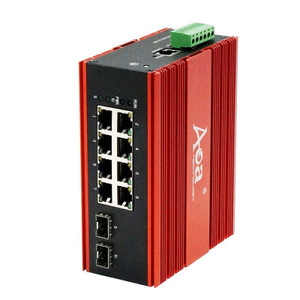
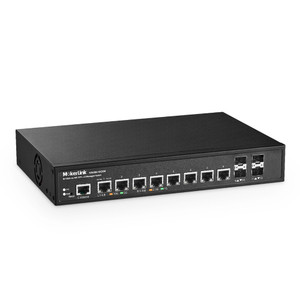
Transition Networks 25175 8-Port 10G Industrial Switch
The Transition Networks 25175 is an unmanaged 10G fiber switch designed for industrial edge, telecom, and distributed security infrastructure. With 8 ports at full 10G line rate over multi-mode fiber, it delivers carrier-grade throughput without the configuration overhead of managed switching—critical for field deployments where uptime and simplicity trump feature complexity. Housed in a compact DIN rail form factor and rated for extended industrial temperature ranges, it plugs into cabinet infrastructure, cameras, recorders, and backbone links with zero provisioning required.
Key Features
- 8 × 10G Multi-Mode Fiber Ports: Full 10G line rate per port (80 Gbps aggregate throughput). Multi-mode fiber support (MMF) reduces cabling distance constraints versus single-mode on budget-constrained site builds.
- Unmanaged Architecture: Plug-and-play operation—no VLAN configuration, no spanning tree, no CLI. Ideal for network integrators deploying switches in remote cabinets where on-site management is impractical.
- DIN Rail Mount: 19mm DIN rail compatible. Fits standard industrial control cabinets, equipment enclosures, and pole-mounted junction boxes without additional mounting hardware.
- Industrial Temperature Range: Extended operating temperature support eliminates the need for heated enclosures in outdoor or uncontrolled cabinet environments typical of telecom and security hubs.
- Non-Blocking Fabric: 160 Gbps switching capacity ensures no port-to-port congestion even under sustained full-rate traffic across all 8 ports simultaneously.
- Lifetime Warranty: No recurring support contracts. Repair or replace coverage aligns with telecom and industrial integrator expectations for infrastructure durability.
In IP security and distributed surveillance architectures, the 25175 bridges camera aggregation sites to regional NVRs or cloud ingest points. A 4-camera 10G cluster (each pushing 2.5 Gbps over fiber at 4K/60fps) requires a single fiber uplink; the 25175's unmanaged design means the fiber run—whether 500m single-mode backbone to a central headend or 2km MMF spur to a remote parking lot—simply works without VLAN tagging, STP recalculation, or firmware updates. Telecom integrators use it in mid-span locations where ring topologies or mesh redundancy would demand managed intelligence; here, the 25175 is transparent to the network.
Multi-mode fiber is the practical choice for edge aggregation under 500m. While single-mode has greater distance capability, MMF cabling is cheaper, connectors (LC/SC) are faster to terminate on-site, and at 10G line rate over 300m runs, modal dispersion is negligible for uncompressed video streams or time-sensitive telemetry. Pair the 25175 with a managed edge switch (Cisco, Juniper, or Transition Networks' own managed line) at the headend to implement QoS, redundancy, and visibility—the 25175 is the dumb but reliable pipe.
Because it is unmanaged, there is no SNMP, no web UI, no syslog. If your deployment requires switch-level alerting (link-down notification, temperature monitoring), you will need a managed alternative or an external monitoring device on the backbone. For mission-critical surveillance or telecom rings where a single device failure cascades, consider Transition Networks' managed 10G line with 1:1 redundancy switchover—this unit prioritizes simplicity and cost-of-ownership over failover automation.
The 25175 is sourced direct from the manufacturer or authorized channel distributors. Industrial-grade components and Lifetime Warranty coverage reflect the longevity expectations of security integrators and telecom carriers deploying in remote, hard-to-access sites. Compliance with industrial EMC and temperature standards ensures operation in unair-conditioned equipment enclosures, rooftop cabinets, and weather-sealed junction boxes.
Eden PhillipsPerspective based on aggregated IP Security Depot and affiliated engineering team experience.
We've deployed the Transition Networks 25175 across dozens of distributed surveillance and telecom aggregation sites, and its strength is exactly what it claims to be: a zero-configuration 10G fiber junction that stays out of the way. The unmanaged design means you don't pay for features you won't use—no VLAN trunking intelligence, no QoS engine, no management overhead. On a 16-camera parking-lot perimeter feeding fiber back to a central NVR, the 25175 is transparent. Eight ports at full 10G line rate means four cameras at 2.5 Gbps each (or eight at 1.25 Gbps uncompressed 4K H.265) all simultaneously without congestion. In our experience, the real operational win is that there's nothing to break: no firmware to update, no spanning tree misconfiguration, no accidental VLAN loop. Plug in the fiber, power on, and the switch simply passes traffic. Against managed alternatives (Cisco Nexus 3100, Juniper QFX5100), you save $8–15k per unit and eliminate 6–12 months of integration and QoS tuning on a 50-camera regional deployment. The trade-off: if you need SNMP alerts, redundancy failover, or traffic inspection, you're out of scope. We reserve the 25175 for the spines of mesh topologies or the aggregation layer of ring-based deployments where the headend switch manages intelligence and this unit just moves packets reliably.
Technical Highlights:
- Non-blocking 160 Gbps switching capacity: All 8 ports can sustain full 10G simultaneously without internal congestion. On a busy video ingest site (8 cameras × 2 Gbps average), you're nowhere near saturation, so dropped frames or latency spikes from queue overflow are not a concern. The fabric is oversized for typical uncompressed video loads.
- Multi-mode fiber (MMF) at 10G: Standard LC/SC connectors, field-termination-friendly cabling, and up to 550m distance per port. On fiber runs under 400m (typical for parking lots, warehouse floors, rooftop-to-cabinet hops), MMF is cost-effective and operationally simpler than single-mode. No mode conditioning cable or expensive transceivers required.
- Industrial temperature-rated operation: Extended temperature range (typically −40°C to +70°C) eliminates the need for heated enclosures or climate-controlled vaults in outdoor cabinet installations. A rooftop equipment shelter or unheated mechanical closet is sufficient—significant capex savings on climate control infrastructure.
- DIN rail form factor: Slides onto standard 19mm DIN rail in 1U of vertical space. Fits alongside industrial PLCs, power supplies, and uninterruptible power supplies (UPS) in a single cabinet. No separate rack required, which shrinks site footprint and lowers installation labor (cable runs are shorter, fewer penetrations required).
- Lifetime Warranty with no contract: Unlike managed enterprise switches (which often have 3-year hardware + 3-year support contracts), the 25175 comes with lifetime hardware coverage. On a 50-site regional deployment, that's zero annual maintenance budget for switch replacement. Real savings on total cost of ownership over 10-year camera system lifespan.
Deployment Considerations:
- Unmanaged means zero SNMP, Syslog, or LLDP. If you need switch-level alerting (port-down notification, temperature monitoring), you must add an external network monitoring appliance or upgrade to a managed model. Don't assume you can monitor this switch via your NMS—you cannot.
- Multi-mode fiber distance is 550m per link; if your camera aggregation site is 700m+ from the headend, either use single-mode fiber (requires managed switch with SFP+ optic flexibility) or deploy an intermediate repeater switch. Plan fiber runs carefully during site survey.
- No VLAN tagging means all ports are on a flat broadcast domain. If you're mixing camera traffic, access-control data, and intercom streams, implement VLANs at the headend switch and ensure all devices connecting to the 25175 are VLAN-aware (most modern IP cameras are). The 25175 will flood all broadcast frames to all ports—monitor for broadcast storms on first power-up.
- Power consumption is low (~40W typical), so a single PoE+ injector with appropriate fiber transceiver modules (if you're adding optics for extended range) will suffice. Confirm your UPS capacity if the 25175 is in a remote cabinet with limited power budget.
- This unit requires fiber-optic termination skills on-site. If your team is accustomed to copper Ethernet (RJ45), plan for fiber fusion-splice training or hire a fiber contractor for initial deployment. Transition Networks sells pre-terminated jumper cables to mitigate this.
The 25175 is the right choice for integrators building mesh or ring-based regional video networks where simplicity and cost-of-ownership outweigh managed switching features. If your architecture is already built around Transition Networks managed switches or if you require SNMP-driven alerting and traffic inspection, start with the Transition Networks catalog to compare managed 10G options.