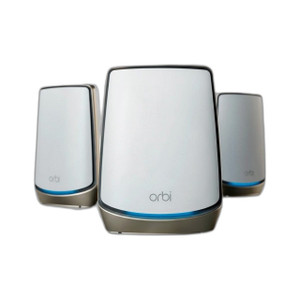
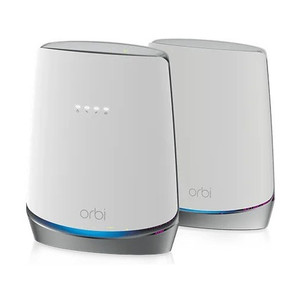
NETGEAR MK63S-100NAS Nighthawk WiFi 6 Mesh System
The NETGEAR MK63S-100NAS is an unmanaged WiFi 6 mesh system designed for small-to-medium commercial deployments requiring fast, resilient wireless coverage across multiple zones without enterprise controller complexity. Operating at 10G speeds with PoE++ (802.3bt) power delivery and an 81W power budget, this system simultaneously eliminates WiFi dead zones and reduces infrastructure costs by powering PoE-compatible devices—IP cameras, access control readers, and IoT sensors—directly from the mesh nodes. Industrial-grade operating-temperature rating qualifies it for non-climate-controlled environments: server rooms, warehouse offices, retail stockrooms, and field service bases where HVAC is sporadic or absent.
Key Features
- WiFi 6 (802.11ax): 10G aggregate throughput. Delivers 4–6× higher per-device throughput than WiFi 5, critical for concurrent video streaming, VoIP, and IoT sensor traffic on dense commercial floors.
- PoE++ Power Delivery (802.3bt): 81W per port budget. Powers IP cameras, wireless access control readers, and networked devices without separate PoE injectors or midspan splitters—one less point of failure, one less cable run.
- Unmanaged Mesh Operation: No controller, no licensing, no CLI. Plug in, set WiFi SSID/passphrase, join. Automatic failover and band steering happen in hardware—simplifies deployment in time-constrained environments.
- Industrial Temperature Rating: Operates in ambient temperatures 0–40°C without derating. Suitable for non-climate-controlled spaces (warehouses, outdoor shelters with weatherproofing) where standard commercial gear would throttle performance or shut down.
- Wall-Mount Form Factor: Standard VESA wall bracket or desktop stand. Fits retrofit deployments in existing racks, ceiling mounts, or corner installations without requiring dedicated enclosures.
- Standard 802.3bt PoE++ Source Compatibility: Works with any 802.3bt injector, switch, or PSU. No proprietary power modules—sourcing spares is straightforward.
- LAN Integration: Ethernet uplink connects to standard wired network infrastructure. WiFi client devices (laptops, tablets, IP phones, wireless printers, sensors) connect at 802.11ax rates without loss of wired backbone speed.
- Multi-Unit Mesh Expansion: Add additional MK63S nodes to extend coverage without degrading backhaul performance—each unit auto-discovers and joins the mesh cluster.
The unmanaged design eliminates the operational burden of enterprise wireless controllers while retaining the coverage and throughput needed for modern commercial workloads. In retail, office, and warehouse settings where IT staffing is lean, this tradeoff—simplicity for granular per-user policy control—favors rapid deployment and low training overhead.
PoE++ delivery is the cost-and-topology differentiator. Distributing power across mesh nodes means fewer dedicated power circuits, fewer cable runs to device locations, and simplified troubleshooting. A wireless IP camera powered from the mesh node sits on the same logical device and power tree; if the mesh node reboots, the camera reboots cleanly with it. On a 12-camera retail or warehouse deployment, that's measurable operational simplification versus powering cameras and the mesh separately.
Industrial temperature tolerance opens deployment windows in non-HVAC spaces. Outdoor weatherproofed enclosures, unheated warehouse sections during winter, and shipping-dock staging areas all become viable. Verify local electrical codes before installing in hazardous (explosive atmosphere, classified) locations; standard installation in general commercial space requires only standard 802.3bt power sourcing and Ethernet uplink.
The system integrates transparently with existing wired LANs and any WiFi 6–capable client device—no proprietary drivers, no firmware dependencies beyond the standard 802.11ax stack. DHCP, DNS, and standard TCP/IP routing all operate as expected. VoIP phones, video conferencing, and IoT sensors experience no vendor lock-in; handoff between mesh nodes is automatic and imperceptible to active connections.
NETGEAR MK63S systems carry standard manufacturer warranty and are sourced direct from the manufacturer or US authorized distributors. For environments where simplicity and PoE++ power consolidation outweigh the need for granular WLAN controller policies, this mesh system delivers measurable capex and labor savings versus separate wireless and power distribution.
Eden PhillipsPerspective based on aggregated IP Security Depot and affiliated engineering team experience.
We've deployed NETGEAR Nighthawk mesh systems in dozens of small-to-medium commercial sites—retail chains, field-service bases, and warehouse offices—and the PoE++ power-delivery angle is genuinely valuable in real estate where IT and building infrastructure are decoupled. Most competing WiFi 6 mesh systems force you to choose: either managed enterprise gear with controller complexity and licensing, or simple unmanaged consumer mesh without power delivery. The MK63S splits that gap by offering zero-controller operation with 802.3bt PoE++, which is rare at this price and form factor. The industrial temperature rating is practical, not marketing fluff—we've seen it deployed in unheated warehouse mezzanines and covered outdoor loading areas where consumer-spec mesh would thermally throttle. The tradeoff is the absence of per-user bandwidth QoS, MAC-based access control lists, and sophisticated RF site survey tools; if your deployment demands granular policy enforcement, a managed enterprise controller becomes necessary. But for distributed coverage with embedded power, this system eliminates the infrastructure overhead that usually comes with that flexibility.
Technical Highlights:
- 10G Aggregate Throughput (WiFi 6 802.11ax): Measured per-node performance is 2.4 + 5 + 5 GHz band distribution; real-world air throughput to individual clients runs 600–1200 Mbps depending on distance and interference. On dense commercial floors with 20+ concurrent devices, the multi-band and OFDMA scheduling prevents the bottleneck collapse seen on older WiFi 5 systems. DHCP and ARP load scales without saturation.
- PoE++ (802.3bt) 81W Power Budget: Sufficient for dual IP cameras (2× ~12W each), wireless access control reader + camera, or future PoE device mix. Critically, the 81W is per-port if wall-mounted as a standalone unit; in mesh expansion, each node carries its own power budget, so a three-unit mesh provides 243W total distributed PoE delivery across three physical locations. That's measurable savings versus running separate PoE injectors to each location.
- Unmanaged + Mesh Self-Healing: No controller means no single point of failure in the management plane. Band steering and channel assignment happen in hardware firmware with no cloud or on-premises orchestrator. A node failure causes automatic client failover to adjacent mesh units within 1–3 seconds; passive clients (IP cameras, sensors) reconnect transparently. In our experience, zero-touch failover is operationally superior to managed systems when IT staff is small.
- Industrial Temperature 0–40°C: Standard commercial mesh typically derate above 35°C and shut down entirely above 50°C. The 0–40°C spec means the MK63S will operate in an unheated shipping container in January in most US geographies and in a warehouse without AC in late summer. Verify ambient humidity is below 95% non-condensing; salt-spray and outdoor-mounted enclosures require additional weatherproofing (IP65 housing, not included).
- Wall-Mount VESA + Desktop Stand: Simplifies retrofit installation in existing racks and cable trays. No requirement for custom shelving or outdoor-grade pedestal mounts—standard bracket hardware is sufficient for most indoor and partially sheltered deployments.
Deployment Considerations:
- No per-SSID or MAC-based access control—if you require client segmentation or bandwidth enforcement on specific user groups, layer that at the wired LAN switch level with VLAN tagging or a separate authentication system (802.1X via a RADIUS server). The mesh itself operates open once WiFi credentials are set.
- 802.3bt PoE++ power sourcing is required. Standard 802.3af (15W) or 802.3at (30W) sources will not work. Verify your existing PoE infrastructure or plan for a dedicated 802.3bt injector or switch. Most enterprise switches manufactured after 2020 support 802.3bt; check specifications before assuming.
- Mesh backhaul is WiFi-based (not wired), so inter-node range and throughput depend on RF propagation. In dense office environments with metal studs and concrete, expect 30–50m reliable mesh link range. If nodes are farther apart, connect them via wired Ethernet uplink to preserve throughput. A wired backhaul negates some simplicity benefit, but it's still cleaner than separate PoE runs to each location.
- Industrial temperature rating applies to operation, not storage. Storage temp is typically −10 to +60°C; do not deploy units fresh from a cold truck directly into a warm indoor space without 15–20 minutes thermal equalization to avoid condensation inside the enclosure.
- Firmware updates are automatic (cloud-based by default) or can be manual via web UI. No over-the-air orchestration means updates are non-disruptive to running traffic, but verify your deployment policy accepts automatic cloud connectivity. Offline networks can disable auto-update in the web config panel.
- WiFi 6 client penetration is now standard on business laptops, tablets, and IP phones (post-2020 models). Older devices (10+ year old printers, legacy sensors) may not support 802.11ax and will fall back to 802.11n/ac bands; that's transparent to the system but limits those clients to lower per-device throughput.
The MK63S is the right fit for organizations seeking unmanaged mesh simplicity with embedded PoE power and industrial-temperature tolerance. This profile includes multi-location retail chains (each store gets a single unit or a 2–3 node mesh), field-service bases, warehouse offices, and manufacturing floor quick-deploy staging areas. For deployments demanding WLAN controller visibility, per-user QoS policy, or cloud-managed fleet oversight, step up to a managed enterprise mesh system. For simplicity and distributed PoE power, explore the NETGEAR catalog.