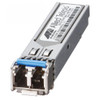
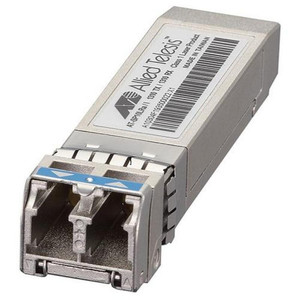
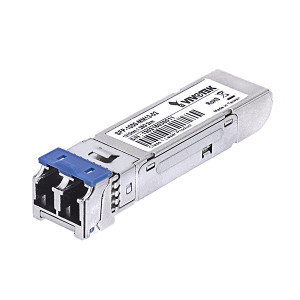
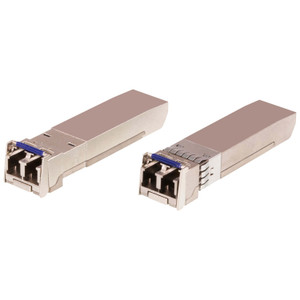
Allied Telesis AT-SPLX10A 1G Single-Mode SFP Fiber Transceiver
Overview
The Allied Telesis AT-SPLX10A is a 1 Gigabit SFP transceiver designed for single-mode fiber runs up to 10 kilometers at 1310nm — the workhorse reach spec for campus backbones, inter-building surveillance network segments, and enterprise WAN edge connections where multimode fiber simply won't span the distance. If you're extending a network switch or NVR uplink across a campus ring or between buildings on a single-mode fiber plant, this is the module that fits.
TAA compliance makes the AT-SPLX10A suitable for U.S. federal procurement and government-adjacent deployments where Trade Agreements Act sourcing is a contract requirement — a spec that often eliminates transceiver options from non-compliant supply chains without flagging in the initial RFP review.
Key Features
- 10km Single-Mode Reach (1310nm): Spans inter-building distances on standard OS1/OS2 single-mode fiber — no optical amplifiers, no media converters in the middle. At 10km, this covers virtually any campus footprint or adjacent facility connection without repeaters, simplifying the fiber plant and reducing failure points.
- 11 dBm Power Budget: The difference between transmit power (-9 to -3 dBm) and receive sensitivity (-20 dBm) gives you 11 dBm of link budget to work with. In practice, that means aging fiber runs with moderate connector loss and a few in-line splices will still close the link — you're not operating on a razor-thin margin that fails the moment a connector gets dirty.
- -20 dBm Receive Sensitivity: The receiver is tuned to pull in a clean signal at -20 dBm, which is genuinely useful when the far-end transmitter is running at the low end of its output range or the fiber plant has accumulated loss over years of adds, moves, and changes. You won't be chasing intermittent link drops caused by a marginal optical budget.
- -3 dBm Overload Protection: The receiver clips at -3 dBm before saturation causes errors. On short runs where the transmitter is close to the receiver and optical power is high, this prevents the receiver from being driven into saturation — a failure mode that causes bit errors without triggering link-down alarms, making it unusually hard to diagnose without an optical power meter.
- Full-Duplex Operation: Single-mode, full-duplex — two fiber strands, one for TX and one for RX. This is the standard configuration for structured cabling plants on campus infrastructure, compatible with standard duplex LC patch panels and fiber cassettes without any WDM multiplexing complexity.
- LC Connector Interface: LC is the dominant small-form connector on modern fiber infrastructure. Patch panels, cassettes, and breakout cables all default to LC on single-mode plants, so terminating this module requires no adapter sleeves or specialty hardware — plug-and-play with your existing structured cabling infrastructure.
- 0°C to 70°C Operating Range: Covers standard commercial and enterprise equipment room environments. This is a commercial-grade temperature rating appropriate for conditioned telecom closets, IDF/MDF rooms, and equipment cabinets with forced-air cooling — not rated for outdoor or industrial unconditioned enclosures.
- TAA Compliance: Sources material from TAA-designated countries, meeting the procurement requirements for GSA schedules, DoD contracts, and many state and local government RFPs. If your project has a Buy American or TAA clause, this module clears that gate where generic transceivers from non-compliant origins would not.
Integration and Compatibility
The AT-SPLX10A is designed for the Allied Telesis switch and router portfolio and is validated against Allied Telesis equipment. SFP transceivers operate under MSA (Multi-Source Agreement) standards, so physical compatibility with third-party SFP slots is common, but always verify against your specific switch vendor's compatibility matrix before deployment — some vendors enforce module authentication at the firmware level and will refuse to bring up a port with a non-approved transceiver, even one that is electrically and optically compliant.
For network video recorder uplinks and surveillance network backbone segments, this module delivers 1G full-duplex bandwidth — sufficient for aggregating camera streams from a distribution switch to a core switch or NVR over a fiber inter-building segment. Pair it with the matching AT-SPLX10B (1550nm) if you need to run a single fiber strand in each direction using simplex WDM — the A and B variants are wavelength-matched complements for bi-directional single-fiber links.
For fiber networking infrastructure planning on surveillance deployments, confirm that the fiber plant is OS1 or OS2 single-mode glass before ordering — this module will not operate correctly on OM1/OM2/OM3/OM4 multimode fiber, where a different SFP variant with an 850nm or 1300nm multimode-optimized laser is required.
Frequently Asked Questions
Q: Is the AT-SPLX10A TAA compliant?
A: Yes. The AT-SPLX10A carries TAA (Trade Agreements Act) compliance, making it eligible for U.S. federal, DoD, and GSA schedule procurement where TAA sourcing is a contract requirement.
Q: What fiber type does the AT-SPLX10A require?
A: The AT-SPLX10A requires single-mode fiber (SMF), specifically OS1 or OS2 grade. It operates at 1310nm and will not function correctly on multimode fiber (OM1 through OM4) — a multimode-optimized SFP variant is needed for those fiber plants.
Q: What is the maximum reach of the AT-SPLX10A?
A: The rated maximum reach is 10 kilometers (approximately 6.2 miles) over single-mode fiber at 1310nm, with an 11 dBm optical power budget to accommodate connector and splice losses along the run.
Q: What connector type does the AT-SPLX10A use?
A: The AT-SPLX10A uses an LC duplex connector — the standard small-form connector on modern single-mode fiber infrastructure. Two fibers are used: one for transmit and one for receive in full-duplex operation.
Q: Can the AT-SPLX10A be used in non-Allied Telesis switches?
A: The module is MSA-compliant in its optical and electrical specifications, but Allied Telesis validates it against their own switch portfolio. Third-party switch vendors may enforce SFP authentication at the firmware level and reject non-approved modules. Verify your switch vendor's compatibility list before deploying in non-Allied Telesis equipment.
Q: What operating temperature range does the AT-SPLX10A support?
A: The AT-SPLX10A is rated for 0°C to 70°C — a standard commercial equipment room range. It is not rated for outdoor or unconditioned industrial environments; install it in a conditioned IDF, MDF, or equipment cabinet with adequate airflow.
The AT-SPLX10A is one of those modules I spec without much deliberation when the fiber plant is single-mode and the hop is under 10km — the 11 dBm power budget gives enough headroom to handle real-world cabling plants that aren't perfectly pristine, and the TAA compliance clears the procurement gate on federal and municipal jobs where non-compliant transceivers get kicked out of the BOM during contract review.
Technical Highlights:
- 11 dBm Power Budget: At -9 to -3 dBm TX and -20 dBm RX sensitivity, you have room for real-world connector insertion loss (typically 0.3–0.5 dBm per mated pair) and splice loss (0.1–0.3 dBm per fusion splice) across a multi-hundred-meter or multi-kilometer run without stressing the link margin.
- -3 dBm Overload Threshold: On short single-mode runs — say, 100–300 meters in a dense campus environment — high optical power at the receiver can saturate the detector and cause bit errors that don't trip link-down alarms. The -3 dBm overload spec tells you where you need an optical attenuator in the patch path to protect the receiver.
- 1310nm Wavelength: 1310nm is the standard operating wavelength for 1G single-mode inter-building links and is compatible with the vast majority of existing OS1/OS2 fiber plants. No exotic WDM filters or specialty patch cables required — pairs with the AT-SPLX10B at 1550nm if you ever need to migrate to simplex bi-directional operation on the same fiber strand.
Deployment Considerations:
- Confirm your fiber plant is OS1 or OS2 single-mode before ordering — this module produces a 1310nm laser that will not close a link on multimode glass, and mismatched fiber type is one of the more common installation errors on mixed-fiber campuses where OM and OS cable runs are both present.
- The 0°C lower temperature limit means this module is not rated for unheated outdoor enclosures or uninsulated rooftop equipment rooms in cold climates — if the installation environment drops below freezing, you need an industrially rated SFP variant.
Where this module earns its place is on surveillance network backbone segments connecting distribution-layer switches in remote buildings back to a central IDF or core switch over an existing single-mode fiber plant — a TAA-compliant 1G link that closes cleanly at 10km and doesn't require anything exotic in the fiber plant to work.