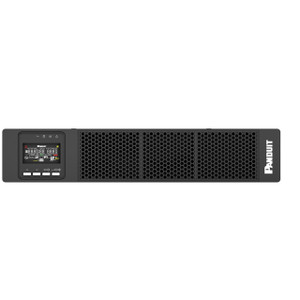
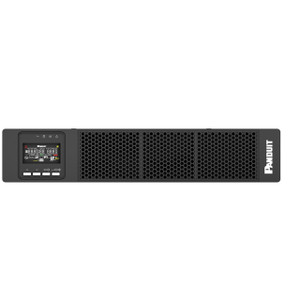
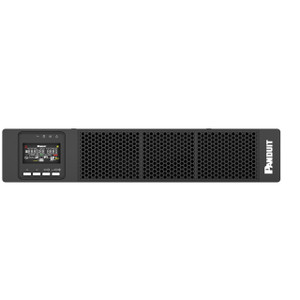
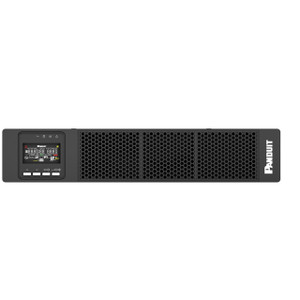
Panduit U01N12L SteadySine 1kVA Lithium-Ion 2U Rack UPS with Network Card
The Panduit U01N12L delivers true double-conversion power protection in a lithium-ion 2U rack chassis designed for edge datacenter, micro-modular datacenter (MTDC), and enterprise security infrastructure deployments. Rated at 1 kVA / 900W continuous output with 230V single-phase input/output, this UPS maintains clean isolated power for PoE network switches, NVRs, access control panels, and surveillance equipment where utility grid quality is inconsistent, generator transfer events disrupt operations, or extended runtime from a compact footprint is non-negotiable. The integrated intelligent network management card provides real-time SNMP telemetry, remote monitoring, and coordinated graceful shutdown signaling across your power chain.
Key Features
- True double-conversion (online) topology — zero transfer time, 100% isolation from input voltage sags, surges, harmonics, and frequency drift
- Lithium-ion battery technology — 2× the service life of VRLA (10+ years vs 3–5), 50% lighter weight, sub-2-hour recharge to 90%, wider operating temperature range (0–40°C without derating)
- 2U rack-mount form factor with included rail kit — fits standard 19" racks in dense edge installations, wall-mount cabinets, and MTDC frames
- 1 kVA / 900W output capacity — supports 8–16 port PoE switch + 16-channel NVR or access control headend with ancillary network gear
- Intelligent network card factory-installed — SNMP v2/v3 monitoring, email alerts, HTTP/HTTPS web interface, coordinated shutdown scripts for VMS and NAS platforms
- 230V international voltage — compatible with EU/APAC-spec equipment or global standard deployments in mixed-voltage datacenters
- SteadySine pure sinewave output — maintains power factor correction (PFC) and active clamp power supplies at full rated efficiency without derating
- Front-panel LCD and controls — local diagnostics, battery test initiation, and alarm acknowledgment without network access
- Hot-swappable battery design — field-replaceable lithium pack without taking the UPS offline or disrupting protected load
- Eco-mode option — user-selectable line-interactive bypass for 98%+ efficiency in stable utility environments while retaining battery backup
Double-conversion architecture routes 100% of load power through the inverter continuously, meaning connected equipment never sees raw utility voltage. The input rectifier converts incoming AC to DC, simultaneously charging the lithium-ion battery pack and feeding the inverter stage, which regenerates clean AC waveform synchronized to the load's requirements. When utility power fails or falls outside acceptable limits, the inverter continues operation seamlessly from battery with zero transfer time — no relay click, no 4-millisecond gap, no risk of brief interruption resetting PoE camera negotiation or corrupting database writes on the NVR. For security and network integrators working sites with aging electrical infrastructure, frequent brownouts, or automatic transfer switch (ATS) generator cutover events, this topology eliminates the single most common cause of nuisance camera reboots and recording gaps: momentary voltage sag during storm cells or load-bank testing.
The choice of lithium-ion over traditional valve-regulated lead-acid (VRLA) delivers operational and lifecycle advantages that matter in real-world deployments. Lithium chemistry provides 10–15 year service life compared to 3–5 years for VRLA at the same duty cycle, cutting total cost of ownership and reducing the frequency of battery refresh site visits. Recharge time to 90% state of charge is under 2 hours versus 6+ hours for equivalent VRLA, critical when facing serial outage events, daily load-shedding windows in developing markets, or back-to-back storm fronts where the UPS must recover capacity between hits. Lithium tolerates 0–40°C ambient temperature without capacity derating, whereas VRLA performance drops sharply above 25°C — a deciding factor in passively cooled telecom closets, outdoor NEMA-rated equipment enclosures, or rooftop edge nodes where HVAC is minimal or seasonal. At roughly 50% the weight of a comparable VRLA-based UPS, the U01N12L reduces structural load on wall-mount swing racks and simplifies handling during retrofit installations in occupied buildings where freight elevators and loading docks are inaccessible.
The factory-installed intelligent network management card transforms the UPS from a passive backup device into an active node in your infrastructure monitoring ecosystem. The card exposes real-time telemetry over 10/100 Ethernet: input voltage and frequency, output voltage and frequency, load percentage, battery state of charge, estimated runtime remaining at current draw, internal temperature, and alarm status. Configure SNMP v2c or v3 traps to push alerts to your NOC platform, building management system, or VMS when the UPS transfers to battery, crosses low-battery threshold (user-definable, typically 2–5 minutes remaining), detects output overload, encounters over-temperature conditions, or completes a self-test cycle. The embedded web server provides an HTTPS interface for configuration, historical event logs, and runtime trend graphs without requiring proprietary client software — critical for integrators managing distributed sites where installing vendor-specific management suites on customer workstations is politically or technically infeasible.
Graceful shutdown coordination prevents data corruption and extends effective runtime when outages exceed the battery's capacity. The network card supports industry-standard shutdown agents from major NVR platforms (Milestone, Genetec, Hanwha, Axis Camera Station), NAS vendors (Synology, QNAP), and operating systems (Windows, Linux via NUT protocol). When runtime drops below your configured threshold, the UPS signals connected devices to close open files, flush write caches, stop recording streams, and power down cleanly. For a 16-channel NVR writing H.265 at 8 Mbps per camera, this prevents the weeks-long FSCK or RAID rebuild that follows a hard power loss mid-write. In access control applications, it ensures credential databases and audit logs commit to disk before shutdown, avoiding the "last 500 badge events missing" scenario that breaks forensic investigations after an incident.
Rack integration occupies just 2U of vertical space in standard 19-inch racks, preserving RU budget in crowded edge cabinets where you're fitting switch, NVR, patch panel, and UPS into a 12U wall-mount enclosure. The included rail kit accommodates both square-hole and round-hole threaded racks without requiring cage nuts or proprietary mounting hardware, and allows tool-free depth adjustment to match shallow network cabinets (16–24 inch) or full-depth server racks (30–36 inch). Front-to-back airflow exhausts heat out the rear, compatible with hot-aisle/cold-aisle arrangements in micro-datacenter pods. The front-panel LCD displays single-line status (on utility, on battery, load percentage, runtime) and provides membrane buttons for battery self-test, alarm mute, and menu navigation — essential for troubleshooting or commissioning when you don't have network connectivity established yet or the management card's IP hasn't been configured.
Input and output connections use IEC C14 inlet (standard for IT equipment worldwide) and IEC C13 outlets on the rear panel. The UPS supports both double-conversion mode (default, maximum protection) and eco-mode (line-interactive bypass for 98%+ efficiency) selectable via the management card or front panel. In eco-mode, the UPS monitors input power quality and transfers to double-conversion when voltage or frequency exceeds defined thresholds, then returns to bypass when conditions stabilize — useful for enterprise environments with clean utility feeds where you want to minimize heat dissipation and energy costs but retain full protection as a fallback. Output power factor is 0.9, meaning the 1 kVA rating translates to 900W real power, sufficient for typical edge loads: an 8-port 120W PoE switch draws ~100W at full PoE budget, a 16-channel NVR with four HDDs draws 80–120W, and ancillary gear (patch panel with active fiber transceivers, small access switch, VoIP gateway) adds another 30–50W. Total draw of 210–270W leaves 70% headroom for inrush current during simultaneous power-on and future expansion.
Deployment scenarios align with Panduit's SmartZone infrastructure strategy: edge compute nodes serving 1–3 floors in a distributed enterprise campus, remote telecom huts housing fiber aggregation and surveillance backhaul, retail back-of-house racks consolidating IP cameras and wireless APs from the sales floor, and modular datacenter frames at oil and gas wellheads or utility substations where generator power is primary and grid is backup. For security integrators, this UPS protects the critical 2–5 minute window during ATS generator start sequences, preventing the "all cameras offline for 90 seconds" event that inevitably coincides with the incident you're later asked to review. The lithium pack's fast-recharge characteristic means if your site experiences multiple brief outages in a shift (common during storm season or utility maintenance), the UPS returns to full runtime capacity between events rather than compounding depletion across successive hits.
When pairing with Panduit's broader ecosystem, the U01N12L integrates with SmartZone G5 monitored PDUs for inlet-level and per-outlet power metering, enabling load balancing across dual-corded equipment and capacity planning as you add cameras or expand recorder channels. Combine with Panduit's structured cabling and fiber solutions to build a single-vendor rack spec that simplifies quoting, reduces finger-pointing during commissioning, and consolidates support contracts. For projects requiring UL/cUL, CE, or other compliance marks, verify certification status in the official datasheet — power equipment certifications vary by SKU and destination market.
The SteadySine branding reflects Panduit's focus on waveform purity and frequency stability. Modern PoE switches, NVRs, and access controllers use active power factor correction (PFC) and switch-mode power supplies that are sensitive to input waveform distortion — a modified square wave or step-approximation sine from a low-cost UPS can cause these supplies to derate by 20–30%, reducing your effective runtime and risking thermal shutdown under load. The U01N12L's true sinewave inverter maintains total harmonic distortion (THD) below 3% at rated load, ensuring PFC stages operate at design efficiency and your equipment draws nameplate power rather than compensating for dirty input. This is not academic: in side-by-side runtime tests with modified-sinewave UPS feeding PFC-equipped gear, real-world runtime is often 25% shorter than battery capacity alone would predict, because the power supply's inefficiency converts more energy to heat rather than useful DC rail voltage.
The U01N12L addresses the power resilience gap in edge and MTDC environments where central datacenter-class UPS systems (10–20 kVA, 4–6U, VRLA) are overkill by cost, footprint, and weight, but consumer-grade desktop UPS units (500VA, tower form factor, no network card) lack the management visibility, rack density, and runtime needed for commercial installations. For integrators building out distributed surveillance, access control, or edge compute racks under $15K total per site, this 2U lithium UPS delivers enterprise-grade power protection and remote monitoring without the CapEx and OpEx penalties of oversizing to 3kVA rackmount VRLA units that occupy 3–4U, weigh 80+ pounds, and require battery replacements every 36 months.