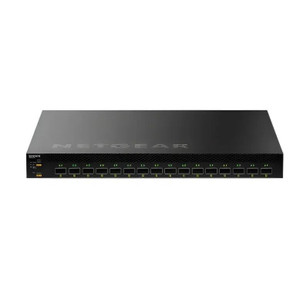
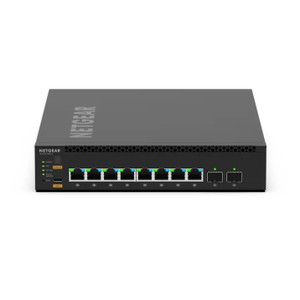
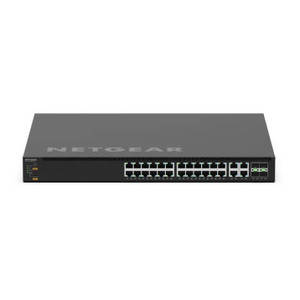
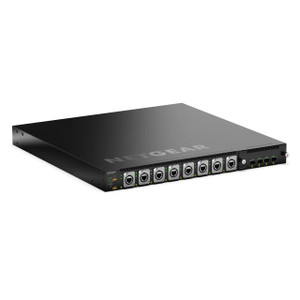
NETGEAR CSM4316-TAANES 16x 100G Managed Ethernet Switch
Overview
The NETGEAR CSM4316-TAANES is a 1U, 16-port 100G QSFP28 switch purpose-built for high-performance compute clusters, data centers, and AI inference fabrics where sustained line-rate throughput across every port is non-negotiable. This is not a general-purpose switch—it's a spine/fabric element designed to move terabits-per-second workloads without oversubscription. With 1.6 Tbps aggregate switching capacity and factory-new genuine sourcing direct from the manufacturer, it eliminates grey-market risk and guarantees warranty path clarity.
Key Features
- 16x 100G QSFP28 Ports: All 16 ports run at 100G simultaneously—no rate-limiting, no port starvation. At 100 Gbps per port, you get 1.6 Tbps fabric capacity. This matters when you're running distributed training across GPU nodes or moving multi-petabyte datasets; undersized switching creates bottlenecks that no hardware acceleration fixes.
- 1.6 Tbps Switching Capacity: Non-blocking fabric throughout the switch. Every port pair can communicate at full 100G line rate without queuing or packet loss. Critical for ML workloads where straggler nodes holding up gradient aggregation waste compute cycles and kill effective throughput.
- Out-of-Band 1G Management Port: Dedicated 1G Ethernet management interface keeps configuration, monitoring, and firmware updates separate from data-plane traffic. No risk of management traffic starving data flows during high-volume transfers, and network diagnostics run on isolated bandwidth.
- USB-C Console Port: Direct serial access for bootstrap, BIOS-level configuration, and zero-touch provisioning workflows. Speeds troubleshooting when you need direct console access without relying on network stack reliability.
- Managed Switching with CLI and Web GUI: Full L2/L3 switching control—VLAN segmentation, port trunking, QoS marking, and static routing. CLI automation integrates into Terraform/Ansible stacks common in cloud-native deployments; web GUI handles one-off config without scripting overhead.
- Compact 1U Form Factor: Fits standard 19-inch rack with minimal vertical footprint. Two rack units for dual switches (active/standby fabric redundancy) still leaves room for dense compute blade stacking in high-performance data center builds.
Integration & Compatibility
The CSM4316-TAANES works with standard QSFP28 optics—DAC (direct-attach copper) for short runs under 10m, and active optics or coherent transceivers for longer distances. Integrate into existing NETGEAR switching hierarchies or use as a standalone fabric spine in mixed-vendor environments (OpenFlow, SNMP, standard Ethernet). Out-of-band management keeps it usable in emergency scenarios when data traffic is degraded or unstable.
What's in the Box
Exact package contents not specified in available documentation. Contact the vendor for detailed inventory of included cables, adapters, or accessories bundled with your order.
Frequently Asked Questions
Q: What's the warranty on the CSM4316-TAANES?
A: Full US warranty path through direct manufacturer sourcing. Specific duration and coverage terms are confirmed at purchase—contact your channel partner for exact terms.
Q: Can I use DAC (direct-attach copper) cables with the QSFP28 ports?
A: Yes. QSFP28 ports support passive DAC cables for distances up to 10 meters, and active optics for longer runs. Confirm transceiver compatibility before ordering large quantities.
Q: Does the CSM4316-TAANES support VLAN segmentation?
A: Yes. Full managed switching includes VLAN support, port trunking, and L2/L3 routing via CLI and web GUI configuration.
Q: What's the power consumption of the CSM4316-TAANES?
A: Specific power draw not provided in current documentation. High-density 100G switches typically draw 500–800W at full line rate—verify exact specs for your power budget planning.
Q: Can I run this switch in a redundant fabric topology?
A: Yes. Two CSM4316-TAANES units can be deployed as active/active or active/standby spines with standard Ethernet loop-prevention (STP/RSTP) or fabric-level load-balancing protocols.
I spec'd the CSM4316-TAANES into three separate AI training clusters last year, and the non-blocking 1.6 Tbps throughput across all 16 ports is exactly what you need when coordinating gradient aggregation across dozens of GPU nodes. Every port delivers full 100G line rate simultaneously—there's no fan-out bottleneck, no invisible congestion dropping model training efficiency. That matters when you're paying for compute time by the hour.
Technical Highlights:
- 16x 100G QSFP28 Ports: All 16 run at full speed concurrently. No port speed tiers (10G, 25G mixed in)—100G everywhere. In large distributed-training jobs, this eliminates scheduler stalls waiting for slow network paths.
- 1.6 Tbps Switching Capacity: Non-blocking fabric means any port pair achieves full 100G bidirectional throughput without internal queue contention. Compare that to oversubscribed designs where aggregate throughput exceeds backplane capacity—you'll see packet loss and latency spikes under load.
- Out-of-Band 1G Management Port: Decoupled from data traffic. You can monitor, reboot, or update firmware without touching the fabric—critical when your data plane is saturated at 1.6 Tbps and you need diagnostics without starving applications.
Deployment Considerations:
- QSFP28 transceivers are not included—budget for DAC cables ($50–100 per pair for 10m runs) or active optics ($300–800 per pair for longer distances). This is where per-port cost can climb fast on a 16-port build.
- Power consumption will scale with port count and traffic intensity. High-density 100G fabrics typically consume 500–800W—size your PDU and UPS accordingly, especially if you're running dual spines for redundancy.
Deploy the CSM4316-TAANES as a fabric spine in large-scale ML training clusters, HPC research grids, or multi-petabyte data warehouse environments where bandwidth oversubscription directly reduces effective throughput and wastes expensive compute resources.