NETGEAR CSM4316-100NES M4350-16C 16-Port 100G Switch
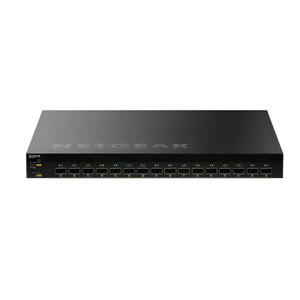
The NETGEAR M4350-16C (model CSM4316-100NES) is a 1U rack-mount switch purpose-built for AI compute clusters and high-performance data center environments where 100G QSFP28 interconnect is non-negotiable. Sixteen ports of 100G density in a single rack unit means you can wire up large GPU clusters, distributed training infrastructure, or dense HPC workloads without sprawling across multiple switch chassis.
Overview
This is a fixed-configuration switch with no modular slots—what you see is what you deploy. The 16 QSFP28 ports run at 100 Gbps each, delivering 3.2 Tbps of aggregate switching capacity. The design assumes you're moving petabytes of data between compute nodes, storage arrays, and external networks. Out-of-band 1G Ethernet management port keeps the control plane separate from your 100G data traffic, which is standard practice in AI ops where you don't want administrative traffic competing for precious fabric bandwidth. USB-C connectivity on the chassis supports out-of-band console access—useful when the management network is saturated or unreachable.
Key Features
- 16x 100G QSFP28 ports: 3.2 Tbps switching capacity supports north-south flows for external data ingestion and east-west communication between GPU nodes without blocking. Scale from 32 GPUs to 256+ GPUs per switch fabric depending on your oversubscription tolerance.
- 1U form factor: Fits standard 19-inch racks with minimal footprint, critical when you're building dense compute pods in colocation or private cloud environments.
- Out-of-band 1G management Ethernet: Dedicated management port isolates administrative traffic from your data plane. SSH, SNMP, and web GUI stay operational even under 100% data utilization on the fabric.
- USB-C console: Direct serial access to the switch CLI without requiring a separate terminal server. Useful for initial commissioning or emergency troubleshooting when network access fails.
- Fixed port configuration: No flexibility to add or remove ports—you're committing to 16x 100G. Verify your topology before purchase. For smaller clusters, confirm this density won't result in wasted ports.
- Managed switch architecture: Supports VLAN, LACP link aggregation, and quality-of-service (QoS) policies essential for isolating training traffic from monitoring, backup, or inter-cluster replication flows.
Integration & Compatibility
The CSM4316-100NES integrates into Kubernetes cluster networks, HPC job schedulers (SLURM, PBS), and distributed training frameworks (PyTorch Distributed, TensorFlow) via standard Ethernet. QSFP28 optics are commodity—you'll use either passive DAC (direct-attach copper, up to 3m) for intra-rack cabling or active or passive fiber modules (SM/MM) for inter-rack or campus distances. Interoperability with Mellanox, Broadcom, or Cisco fabric endpoints is standard; confirm your specific optic SKUs with your integrator. NETGEAR Insight cloud management (if enabled) provides dashboard visibility, but many AI operators prefer local controller-based management (Ansible, Terraform, or custom Python) to avoid external dependencies during training runs.
Frequently Asked Questions
Q: What QSFP28 optics do I need to populate the CSM4316-100NES?
A: The switch itself does not include optics. You'll source them separately based on distance and budget—passive DAC for same-rack connections (0–3m), active DAC for medium distances, or fiber modules (100GBASE-SR, 100GBASE-LR, etc.) for longer runs. Verify compatibility with your specific optic part numbers before deployment.
Q: Can I mix different port speeds on the CSM4316-100NES?
A: No. All 16 ports are hard-wired for 100G QSFP28. There is no downshift to 40G or 10G on this model. If you need mixed speeds, consider a different NETGEAR switch family with modular or multi-rate ports.
Q: Does the CSM4316-100NES support redundant power supplies?
A: Power architecture specifications are not detailed in the available evidence. Confirm redundancy requirements with the manufacturer or integrator before final procurement.
Q: What is the warranty on the CSM4316-100NES?
A: This unit is factory-new with full US manufacturer warranty path. Exact warranty duration should be confirmed at point of purchase or with the supplier.
Q: Is the CSM4316-100NES NDAA Section 889 compliant?
A: NDAA compliance is not documented in the available product evidence. If NDAA compliance is a requirement, verify directly with NETGEAR or your procurement team before purchase.
The CSM4316-100NES is built for environments where 100G fabric density is the baseline, not an upgrade. If you're standing up a serious AI training cluster with hundreds of GPUs, the 16 QSFP28 ports and 3.2 Tbps switching capacity mean you can drive sustained east-west traffic without the bottleneck that kills iteration speed on distributed model training. The out-of-band 1G management port is not optional—it's your lifeline when the data plane is running hot.
Technical Highlights:
- 3.2 Tbps switching capacity: 16 ports × 100 Gbps each delivers the fabric bandwidth needed to saturate modern GPU interconnects (400G Nvidia Spectrum-2 fabric, 8x50G Cerebras systems) without becoming the limiting factor in your training loop iteration time.
- Out-of-band 1G Ethernet + USB-C console: Two independent paths to the switch control plane ensure you can manage, monitor, and troubleshoot even when the 100G data plane is completely saturated. Critical for production AI ops where downtime costs millions per hour.
- Fixed 16-port configuration: No modularity means no surprises mid-deployment, but it also means you're committing to this density. Overbuy and you're paying for unused ports; underbuy and you're forklift-upgrading the entire switch fabric.
Deployment Considerations:
- QSFP28 optics are not included—budget for DAC or fiber modules separately. Passive DAC (0–3m) costs pennies; fiber modules for inter-rack runs cost significantly more. Factor optic cost into your TCO.
- This switch is a fixed-port glass with no speed flexibility. Every port is 100G QSFP28. If your topology mixes 100G and lower-speed connections, you'll waste ports or need a second switch for the slower tier.
Deploy the CSM4316-100NES when you're building a dedicated high-speed fabric for GPU-intensive workloads (large language model training, computer vision at scale, multi-node fine-tuning). It assumes you've committed to 100G across the board and you're optimizing for throughput and latency, not for maximum port flexibility.