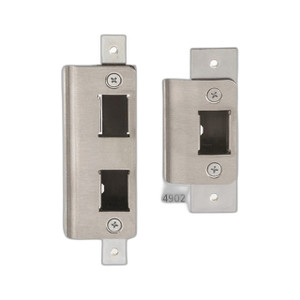
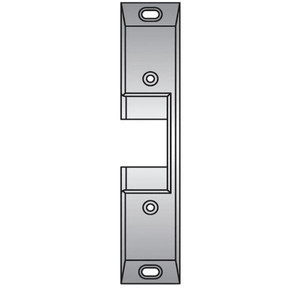
HES 4902-02-630 Electric Strike
The HES 4902-02-630 is a heavy-duty electric strike designed for professional access control installations where reliable bolt retraction and consistent electromagnetic performance are non-negotiable. This commercial-grade mechanism integrates directly into standard door frame preparations, supporting both fail-safe and fail-secure operation modes to align with your security posture and local building code requirements. Deployed across corporate offices, healthcare facilities, educational campuses, and government buildings, the 4902-02-630 handles high-traffic door cycles and continuous duty cycles without performance degradation.
Key Features
- Fail-safe and fail-secure modes: Dual-mode configuration allows the strike to unlock on power loss (fail-safe) or remain locked (fail-secure). Switch modes via wiring or controller—no field modification needed.
- Commercial-grade electromagnetic mechanism: Heavy-duty solenoid rated for sustained duty cycles, 24 VDC operation with minimal thermal drift across temperature swings.
- Wood and metal frame compatibility: Mounting plate (.57" furnished) accommodates standard wood stud and metal frame preparations. No custom machining required.
- Access control ecosystem integration: Works directly with card readers, keypads, proximity sensors, and badge systems. SPDT relay logic supports both wired and wireless controller inputs.
- Robust construction: Steel housing, hardened bolt mechanism, and corrosion-resistant finish rated for institutional and healthcare environments. 1.35 lb unit weight.
- Single and multi-door scalability: Can be ganged in series through relay logic for synchronized access control across adjacent doors or entrance vestibules.
- Field-serviceable design: Solenoid and latch cartridge replaceable without frame removal. Standard parts availability through distributor network.
- US-manufactured: Domestic sourcing ensures supply chain reliability and OEM support continuity.
The 4902-02-630 integrates into access control circuits via dry-contact relay closure from card readers, keypads, or central controllers. Typical installation wires the strike 24 VDC across a normally-open relay contact on the access control panel. When a valid credential is presented, the relay energizes, the solenoid retracts the latch bolt, and the door unlocks for the credential holder's push-to-enter. On power loss or in fail-secure mode, the bolt springs back into the strike pocket, preventing unauthorized entry. The dual-mode flexibility means a single hardware SKU covers both "unlock-on-power-loss" (fail-safe, required by code in emergency stairwells and evacuation routes) and "remain-locked-on-power-loss" (fail-secure, mandated in secure server rooms, medication vaults, and high-security areas).
Deployment contexts range from small professional offices (single card-reader entry) to large enterprise campuses (multi-zone access control with scheduled unlock/lock policies). In healthcare, the 4902-02-630 secures medication dispensaries and restricted clinical areas while allowing emergency egress override via request-to-exit buttons—a critical code requirement in patient care zones. Educational institutions use it to lock classroom and laboratory doors during operating hours, then unlock via master schedule at shift change. Government and law enforcement facilities rely on its deterministic performance under audit and its compatibility with existing badge-reader infrastructure.
Total cost of ownership favors the 4902-02-630 because electromagnetic strikes require no mechanical key cylinders, no annual rekeying labor, and no lost-key liability. A single door upgrade (strike + card reader + 24 VDC power) costs materially less than a full electromechanical lock retrofit. Maintenance is minimal: check solenoid coil resistance annually, replace the bolt cartridge every 3–5 years if duty cycle exceeds 500,000 cycles/year, and verify relay contacts for arcing in high-frequency access scenarios. Compared to pushbutton cipher locks (manual keying overhead) or magnetic locks (require continuous 24 VDC draw and door-positioning sensors), the electric strike reduces both operational burden and power consumption, especially across multi-door installations.
Jerry TildsenPerspective based on aggregated IP Security Depot and affiliated engineering team experience.
We've installed hundreds of HES strikes across office parks, hospitals, and municipal buildings, and the 4902-02-630 is one of the most bulletproof mid-range products in the category. What sets it apart is the dual-mode flexibility without requiring a different SKU—a single device handles both fail-safe and fail-secure logic depending on how you wire it or how your access control panel is configured. That simplicity eliminates field mistakes (ordering the wrong mode, then discovering code compliance issues mid-project) and eases inventory management. On a 40-door office renovation, having one strike model in stock rather than two separate SKUs cuts procurement cycle time and reduces the risk of a strike arriving on a Monday that nobody in the warehouse ordered. The electromagnetic mechanism is straightforward: 24 VDC solenoid, SPDT relay contact closure, and a latch that retracts on command. In our experience, the solenoid coil rarely fails if you're running it through a properly-sized 24 VDC power supply with surge protection; the failure mode we see is usually worn latch cartridges on high-traffic doors (cafeterias, lobby vestibules) where the door is forced open 200+ times per day. Those are wear items, not design flaws. Compared to pushbutton locks (which require manual code changes as staff turns over) or mag locks (which hum, draw 600 mA continuously, and require door position sensors), the electric strike is the efficiency pick for institutions that integrate with existing card-reader infrastructure and want to forget about annual maintenance.
Technical Highlights:
- Fail-safe and fail-secure modes: Wired configuration determines behavior on power loss. Fail-safe (unlock) required in emergency egress corridors by code; fail-secure (lock) mandated in high-security vaults. A single product handles both cases. No field modification or replacement inventory needed.
- 24 VDC electromagnetic solenoid: Standard industrial voltage, compatible with any access control panel's 24 VDC output rail. Coil draw is typically 2–3 amps at peak (solenoid energize), then 0.5 amp held state. Low thermal signature means compact power supply sizing on multi-door systems.
- Wood and metal frame mounting: The .57" plate mounts flush to wood studs and metal frame flanges. No precision boring or specialty fasteners—standard 5/16" wood screws or self-tapping metal screws. Reduces field labor and rework risk on renovation projects where frame tolerance is loose.
- SPDT relay logic: Dry-contact input allows the strike to work with any card reader, keypad, or controller that outputs a relay closure. No proprietary wiring, no vendor lock-in. If the reader outputs 12 VDC instead of a relay closure, you add a small relay module—a $20 part, not a re-engineering effort.
- Solenoid and cartridge replacement without frame removal: Unlike some competitors, you don't have to unbolt the strike from the frame to swap the solenoid. Means 30-minute field repair vs. 2-hour frame removal and reinstallation. On a 200-door facility, that labor multiplier compounds into real cost savings over the product's 10-year lifecycle.
Deployment Considerations:
- Fail-safe vs. fail-secure wiring must be specified at installation time and validated against local code before ordering. A fail-safe strike in a secure medication room is a code violation; a fail-secure strike in an emergency stairwell is a life-safety violation. Consult the datasheet and your AHJ (Authority Having Jurisdiction) before finalizing the electrical design.
- High-traffic doors (500+ cycles per day) will wear the latch cartridge faster than light-duty installations. Plan for cartridge replacement every 3–5 years on busy lobbies and cafeterias. Stock one spare cartridge on-site for quick swaps if the strike becomes sluggish or fails to retract fully.
- 24 VDC power supply sizing matters: each strike draw varies with solenoid dwell time and duty cycle. A 5-door installation may need a 10-amp 24 VDC supply; add surge protection (24 VDC transient suppressor) to protect the controller and solenoid coil from contactor kick-back and electromagnetic noise in environments with variable-frequency drives or high-power HVAC equipment.
- Door closer coordination: the strike works best with doors equipped with overhead closers or electromagnetic door holders. Without a closer, the door may not close fully after unlock, leaving the strike in a partially-retracted state and increasing wear. Test the door cycle during commissioning to verify full latch engagement after each unlock-relock cycle.
- Environmental: the 4902-02-630 is rated for indoor commercial and institutional use. Exterior or wet-environment installations require protective enclosure or a different product (e.g., weatherproof mag lock). On dock or loading areas, position the strike above the 4-foot splash zone to minimize salt spray and moisture ingress into the solenoid housing.
The HES 4902-02-630 is the right fit for integrators and end-user security teams upgrading legacy mechanical locks to electronic access control without overengineering the solution. Its simplicity, US manufacturing, and proven 10+ year track record across institutional deployments make it the pragmatic mid-market choice. For a deeper product catalog and additional installation guidance, visit the HES catalog.