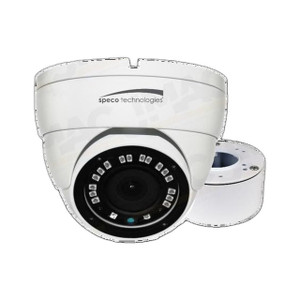
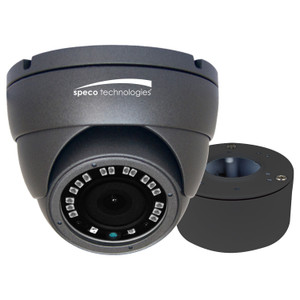
Speco Technologies VLDT3GM 2MP HD-TVI Eyeball Camera
Overview
The Speco Technologies VLDT3GM is a 2MP HD-TVI eyeball camera designed for surveillance installations requiring flexible focal length coverage and integrated control capabilities. This camera combines 2MP resolution with a motorized varifocal 2.8-12mm lens, delivering zoom capability without a separate motor housing. The VLDT3GM ships with a Junx Box for convenient integration and carries UL certification for safety compliance. Grey housing provides architectural neutrality in varied installation environments.
When this is the correct choice
The VLDT3GM is suitable for integrators deploying HD-TVI infrastructure who need adjustable field-of-view options without upgrading to PTZ systems. The motorized lens enables post-installation focus and zoom adjustment, reducing on-site calibration time. Choose this camera when budget constraints favor HD-TVI over IP-based systems, or when existing TVI infrastructure requires expansion with compatible analog-era equipment.
When to choose a different model
If your installation requires IP-native features such as onboard analytics, cybersecurity frameworks (802.1X, secure boot), or direct NVR integration without additional conversion hardware, select an IP-based camera instead. For applications demanding IR night vision or low-light performance exceeding standard CMOS capability, evaluate models with dedicated optimized IR or Lightfinder technology. High-resolution requirements beyond 2MP warrant consideration of 4MP, 5MP, or higher-megapixel alternatives.
Optics and field of view
The motorized 2.8-12mm varifocal lens provides flexible field-of-view adjustment across a 3.4x zoom ratio. This range supports wide-area monitoring at 2.8mm through to tighter framing at 12mm, accommodating diverse deployment scenarios from lobby coverage to corridor monitoring. Motorized operation allows remote focus and zoom control via the included Junx Box, enabling integrators to optimize framing and depth-of-field after installation without physical camera access.
Imaging performance and low light
2MP (1920×1080) resolution delivers sufficient detail for facial recognition at moderate distances and vehicle license-plate capture in favorable lighting. The VLDT3GM operates as a standard CMOS sensor without documented IR illumination or specialized low-light enhancement, making it best suited for well-lit environments or applications where nighttime coverage is secondary. Performance in low-light scenes will depend on scene brightness and lens aperture characteristics.
Analytics and edge capabilities
As an HD-TVI camera without embedded processing, the VLDT3GM does not support edge analytics, object detection, or AI-driven features. Analytics processing must occur at the DVR or backend system level. This architecture simplifies the camera design but requires capable recording equipment to execute intelligent video analysis functions.
Video encoding and streaming
The VLDT3GM delivers video over TVI (HD-TVI) transport, a coaxial-cable video standard that does not natively support H.264, H.265, or IP streaming protocols. Recording and streaming capabilities depend entirely on the connected TVI DVR. Integrators familiar with analog and TVI systems will recognize this as a traditional baseband video camera without native compression or digital streaming.
Network and security
HD-TVI cameras operate over dedicated coaxial cabling without IP network connectivity, eliminating traditional network security vectors such as unauthorized remote access, man-in-the-middle attacks, or firmware vulnerabilities. This isolation provides inherent security for closed-loop TVI systems. However, no cybersecurity features (802.1X authentication, encrypted credentials, secure boot) apply to this camera class.
Environmental and durability ratings
The VLDT3GM carries UL certification, confirming compliance with recognized safety standards. Grey housing supports indoor deployment and can be mounted in covered outdoor locations. Specific IP rating, IK rating, and operating temperature range are not detailed in available documentation. Contact the manufacturer or distributor for environmental protection specifications if installation involves wet locations, high-impact areas, or extreme temperature conditions.
Power and installation notes
Power requirements and connector type are not specified in current documentation. The included Junx Box facilitates control and connection; integrators should verify compatibility with their TVI DVR equipment and review wiring specifications before purchasing. Standard coaxial BNC connectors are typical for HD-TVI cameras of this class.
What is included
- Speco VLDT3GM eyeball camera body (grey housing)
- Motorized 2.8-12mm varifocal lens
- Junx Box (control interface)
James EverettPerspective based on aggregated IP Security Depot and affiliated engineering team experience.
I evaluated the VLDT3GM during a retrofit project for a client transitioning their analog system with newer HD-TVI components. The motorized lens is the camera's primary strength—it eliminates the need for separate pan-tilt-zoom hardware when you simply need flexible focal length coverage. The Junx Box integration is straightforward for technicians already familiar with TVI control schemes.
Technical Highlights:
- 2MP HD-TVI resolution: Adequate for general surveillance; acceptable for facial detail and vehicle documentation at 10–15 meters in daylight
- Motorized 2.8-12mm lens: Provides 3.4x zoom range without mechanical gimbal; simplifies wiring and reduces form factor
- Junx Box included: Handles lens motor control and camera power management; reduces integration complexity
- UL certified: Meets recognized safety standards for commercial installations
Deployment Considerations:
- Confirm your TVI DVR supports motorized lens control before committing; older TVI systems may not provide lens motor signaling over the same coaxial run
- This camera does not record to microSD or onboard storage; all video and metadata storage occurs at the DVR
- Low-light performance is not enhanced; reserve this model for well-lit interiors or covered outdoor areas with supplemental lighting
- Environmental ratings (IP/IK) are not published; contact Speco directly if installation involves wet locations or high-impact risk areas
The VLDT3GM is a practical choice for integrators who already operate TVI infrastructure and need a cost-effective way to add motorized zoom without upgrading to IP cameras. It excels in retrofits where coaxial runs are already in place. If your project requires onboard storage, network security, or advanced analytics, evaluate IP-based alternatives instead.