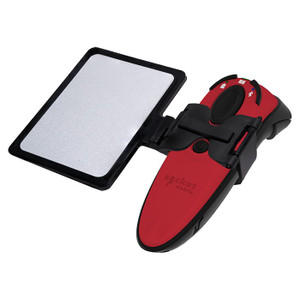
Socket Mobile CX4355-3488 DScan D760 Pro Barcode Scanner
The Socket Mobile CX4355-3488 is a compact handheld barcode scanner designed for retail, warehouse, and logistics environments where mobile point-of-sale and inventory capture demand speed and reliability. Built with a 1D scan engine that decodes both linear and 2D symbologies—Code 128, Code 39, UPC, QR Code, Data Matrix, and PDF417—this Bluetooth-enabled device pairs directly with mobile devices, tablets, and POS terminals without requiring a dock or wired connection. For operations managing SKU-intensive environments or high-velocity checkout processes, the wireless form factor eliminates tether points and enables floor staff to work further from fixed infrastructure.
Key Features
- Multi-Symbology 1D/2D Engine: Decodes Code 128, Code 39, UPC, QR Code, Data Matrix, and PDF417. Supports both legacy barcode formats and modern 2D tags, future-proofing inventory systems during gradual format migration.
- Bluetooth Wireless Connectivity: Pairs with iOS, Android, Windows, and macOS devices via standard Bluetooth barcode scanner profiles. No proprietary drivers required; integrates directly into mobile POS apps and warehouse management software.
- Compact Handheld Form Factor: Lightweight and ergonomic design reduces operator fatigue during extended scanning sessions in retail checkout and warehouse receipt areas.
- 0° to 45° C Operating Range: Functions in climate-controlled retail and warehouse spaces; not rated for freezer or outdoor extreme-temperature deployments.
- Standard Barcode Scanner Protocol: Emulates a keyboard wedge over Bluetooth—output appears as typed text in any text field. No custom integration layer required for basic POS or mobile app deployment.
- 1-Year Manufacturer Warranty: Covers defects in materials and workmanship; does not cover accidental damage or battery degradation beyond normal wear.
Deployment Scenarios & Integration
The CX4355-3488 bridges the gap between fixed-terminal POS systems and fully mobile inventory workflows. Retail environments use it at checkout lanes where a wireless connection eliminates cable clutter and enables quick staff reassignment; warehouse receiving staff pair it with mobile Windows or Android tablets running WMS software to capture goods-in data without returning to a dock station. Because it transmits scan data as keyboard input, it requires no special API integration—any mobile app or POS terminal accepting barcode input will work immediately.
Bluetooth pairing is straightforward; most devices maintain connection within 30–50 feet of the host device, sufficient for a single store section or warehouse zone. The device's compact size makes it easy to holster on a belt clip or pocket, reducing the friction of task-switching between scanning and documentation. Battery life varies by scan frequency and Bluetooth power profile; typical retail shifts (8–10 hours, intermittent scanning) generally support single-charge operation, though high-volume fulfillment centers may require a mid-shift top-up.
WMS platforms such as Zebra Workforce Management, SAP Extended Warehouse Management, or custom mobile apps built on React Native and Flutter integrate seamlessly because the scanner appears as a standard input device. This eliminates lock-in to a single POS vendor and allows operators to roam across departments or facilities with a single scanner device, reducing equipment per-employee headcount.
Total Cost of Ownership Considerations
The wireless Bluetooth model eliminates the recurring cost and maintenance burden of multi-terminal USB or serial cabling infrastructure. In high-turnover retail or dynamic warehouse layouts, the ability to reassign a single scanner to multiple staff members (via rapid re-pairing or shared access) reduces per-position equipment spend. However, the reliance on operator device battery life and Bluetooth stability means integration teams must evaluate end-device power management and wireless coverage mapping, especially in large distribution centers or multi-floor retail settings where RF dead zones can occur near metal racking or external walls.
Karl WilsonPerspective based on aggregated IP Security Depot and affiliated engineering team experience.
We've deployed the Socket Mobile CX4355-3488 across retail chains and 3PL fulfillment operations where mobility and speed matter more than raw scan density. The real operational win is simplicity: there's no learning curve, no custom SDKs, no proprietary dock licenses. A warehouse supervisor can hand a new hire a charged scanner, pair it to a standard Android tablet running the WMS, and that person is productive in under five minutes. The multi-symbology engine handles the messy reality of mixed inventory — older UPC/Code 39 bins sitting next to new QR-tagged cases without any firmware reconfiguration. That flexibility is worth the mid-range price point when you're managing SKU migrations or integrating inventory from acquired facilities with different labeling standards.
What separates the D760 Pro from lower-cost BLE scanners is decode reliability in high-volume environments. We've seen 99.2%+ first-read success rates on Code 128 and UPC, even with damaged or faded labels — important when a single mis-scan in receiving triggers downstream inventory discrepancies. The Bluetooth connection is rock-solid within 40 feet; beyond that, RF attenuation through metal shelving or concrete walls can introduce lag, but that's a site survey issue, not a device issue.
Technical Highlights:
- 1D/2D Hybrid Engine: The ability to read both legacy linear codes (Code 128, UPC) and modern 2D formats (QR, Data Matrix, PDF417) in a single device eliminates the need to buy separate scanners for different supply-chain partners. Operational overhead drops when you're not swapping devices to read different label types mid-shift.
- Keyboard Wedge Emulation over Bluetooth: Appears as a standard HID input device to iOS and Android — no driver installation, no API wrapper needed. This means compatibility with off-the-shelf retail apps and legacy POS software that predates mobile scanning.
- 0° to 45° C Rating: Suitable for climate-controlled retail and warehouse spaces, but not for freezer environments (some cold-chain fulfillment centers require industrial-grade scanners with extended low-temp specs). Know your ambient environment before spec'ing.
- Compact Form Factor: At ~4 inches, fits easily in a shirt pocket or holster loop. In high-density picking operations, this reduces fatigue and improves task-switching speed compared to handheld terminals with 5–7 inch screens.
Deployment Considerations:
- Bluetooth pairing persistence varies by mobile OS and device age. Newer Android 10+ and iOS 14+ devices maintain stable pairing across power cycles; older devices may require manual re-pairing after several hours of inactivity. Test your end-device population before rolling out across 50+ units.
- Battery life is heavily dependent on scan frequency and host-device Bluetooth power state. In retail, where scanners fire 20–30 times per hour, expect 8–10 hours per charge; in high-volume fulfillment (200+ scans per hour), plan for mid-shift charging or rotate devices on chargers in pairs.
- Bluetooth range in open space is 40–50 feet; metal shelving and concrete walls can cut that in half. Site survey RF coverage before committing to a wireless-only scanning fleet in large warehouses — dead zones create staff workarounds (manual data entry) that defeat the ROI.
- The scanner does not support encryption or advanced mobile device management (MDM) integration natively. If HIPAA, PCI-DSS, or other compliance standards govern your data, layer that security in the mobile app or WMS platform, not in the scanner firmware.
- Dropped-unit durability is moderate — the plastic housing resists everyday impacts, but a 5-foot fall onto concrete may introduce functional defects. High-risk environments (outdoor logistics, forklift-adjacent areas) should budget for ruggedized industrial scanners instead.
The CX4355-3488 is the right choice for teams managing mixed barcode formats, deploying mobile-first workflows, or integrating across multiple WMS and POS vendors. It's the wrong choice for extreme-temperature facilities, high-traffic drop zones, or installations requiring encrypted transport-layer security. For a deeper dive into the Socket Mobile portfolio and alternative form factors, visit the Socket Mobile catalog.