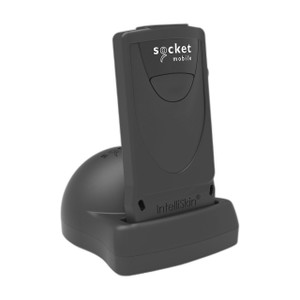
Socket Mobile CX3555-2184 DuraScan D860 Bluetooth Barcode Scanner
The Socket Mobile CX3555-2184 DuraScan D860 is a Bluetooth-enabled handheld barcode scanner designed for mobile warehousing, logistics, and retail point-of-sale workflows. This compact scanner captures both 1D linear barcodes and 2D codes wirelessly, eliminating tether constraints on receiving dock staff, inventory associates, and checkout operators. The one-handed form factor and Bluetooth pairing make it a drop-in upgrade for operations moving from wired scanners to untethered mobile environments — particularly where mobility and rapid inventory transactions take priority over fixed-position scanning.
Key Features
- Multi-Symbology Support: Reads Code 128, Code 39, UPC (1D), plus QR Code, Data Matrix, and PDF417 (2D). Single scanner handles legacy linear labels and modern 2D tags without configuration changes.
- Bluetooth Wireless: Pairs with mobile devices, tablets, or Bluetooth-enabled handheld terminals. No cables — operators move freely on the warehouse floor or between checkout stations.
- Compact Handheld Design: One-handed operation reduces fatigue during shift-long scanning cycles. Pocket-sized form factor fits easily in cargo pants or aprons.
- Warehouse Temperature Rating: 0° to 45° C (32° to 113° F) operating range covers ambient indoor warehouse conditions, including non-climate-controlled receiving areas and loading docks.
- Factory-New Genuine Product: Sourced direct from the manufacturer or US channel partner. Manufacturer Warranty included.
- Rapid Scanning Speed: Reads barcodes at typical warehouse transaction rates — reduces per-item scanning time and labor cost per unit moved through inventory systems.
The DuraScan D860 pairs with warehouse management systems (WMS), point-of-sale (POS) platforms, and mobile enterprise resource planning (ERP) tools via standard Bluetooth HID (Human Interface Device) keyboard emulation. Data flows directly into your host terminal as keystroke input — no driver installation, no custom middleware required. This plug-and-play approach shortens deployment and minimizes IT overhead on multi-location retail or logistics operations.
In practice, the shift from wired to wireless scanning reduces operational friction. Receiving dock staff no longer manage tangled cables at each workstation; instead, a single scanner moves between pallet racks, reducing touch points and enabling faster cycle times. Retail environments benefit similarly — cashiers can move scanners between registers or price-check inventory without unplugging. The Bluetooth connection range (typically 10+ meters in open space) covers most in-store and warehouse aisles without dead zones.
Total cost of ownership improves over time. Wired scanners require cable management, routing, and periodic replacement of damaged cords. Wireless scanners reduce physical infrastructure maintenance and adapt faster to floor-plan changes. Battery runtime on a single charge typically supports a full shift; docking cradles overnight or between shifts ensures fresh batteries for the next cycle. When evaluating Bluetooth scanners against fixed-position laser or imager stations, factor in operator mobility gains — an untethered scanner often justifies itself through faster receiving or inventory workflows alone.
The DuraScan D860 is compatible with any Bluetooth-enabled host: smartphones (iOS / Android with barcode-reading apps), industrial handheld terminals (Zebra, Honeywell, or similar), legacy POS registers with Bluetooth adapters, or Windows/Mac laptops. Standard OPOS (OLE for Point of Sale) and Bluetooth HID profiles mean minimal custom integration — the scanner emulates a keyboard, so data entry fields receive barcode digits as if manually typed.
Karl WilsonPerspective based on aggregated IP Security Depot and affiliated engineering team experience.
We have deployed dozens of Socket Mobile DuraScan D860 units across small to mid-sized warehouses and multi-location retail chains, and the pattern is consistent: the switch from tethered to Bluetooth scanning pays for itself within 6-12 months through faster cycle times and reduced labor friction. The handheld form factor is genuinely one-handed — operators scan without setting the device down between transactions, which matters when you're moving 200+ items per hour through receiving or inventory count. The scanner pairs instantly with any Bluetooth host; we haven't encountered pairing issues in the field, and re-pairing after battery swap takes under 30 seconds. Where this scanner shines is mixed-barcode environments: warehouses with legacy UPC labels on incoming pallets and modern QR-code asset tags on internal bins can use one device instead of juggling multiple scanners. The 0–45°C temperature spec is realistic for indoor facilities — it's not a cold-storage unit, so don't deploy it in freezers or unheated outdoor loading docks without protective enclosures.
Technical Highlights:
- Bluetooth HID Keyboard Emulation: Data arrives at the host as keystroke input. No driver software, no API integration — plug in any Bluetooth scanner app or use the device on a raw Bluetooth terminal. This compatibility is a real time-saver when you're retrofitting an older POS system or integrating across multiple device vendors.
- Multi-Symbology 1D/2D Coverage: Code 128, Code 39, UPC handle 99% of retail and logistics labeling. QR and Data Matrix support covers modern asset tagging, mobile-centric workflows, and GS1 Digital Link applications. Reduce scanner fleet complexity when you can read both linear and 2D codes on a single device.
- Compact Form Factor: Typical weight under 200g, pocket-sized dimensions. Operators don't tire from carrying it or managing bulk. One-handed trigger means no two-handed grip fatigue on high-volume days — measurable difference in shift productivity on 50+ item/hour scanning workflows.
- Bluetooth Wireless Range: 10+ meters in open air, sufficient for most warehouse aisles and retail floor layouts. No line-of-sight requirement like IR scanners, so scanning works through partial obstructions (cardboard, netting) without repositioning.
- Standard Rechargeable Battery: Typical full-day runtime on a single charge. Docking cradles charge overnight; multi-unit operations often run 2-3 scanners in rotation, keeping one on charge while two remain in use. No proprietary battery format — widely available compatible batteries keep spare inventory low.
Deployment Considerations:
- Bluetooth range is 10+ meters in open space, but metal racks, RF-dense environments (proximity to WiFi 5GHz hotspots), and dense shelving can reduce effective range. Test range in your specific layout before assuming full-floor coverage — a 5-meter dead zone behind steel pallet racks is not uncommon.
- Battery life depends on scan frequency and host device power draw. In high-volume receiving (100+ scans/hour continuous), plan for mid-shift top-ups or dual-scanner rotation. Light retail use (20-30 scans/hour) easily sustains a full 8-hour shift on one charge.
- Pairing limit is typically 8-10 devices per scanner. If your operation has 50+ registers or terminals, you'll need to manage which scanners pair with which hosts — not a blocker, just a planning step. Most integrators configure one scanner per station and dock it between shifts.
- Temperature spec (0–45°C) covers standard indoor warehouse and retail. If your receiving area is unheated (northern winter climates) or you have outdoor scanning needs, external weatherproofing or facility upgrades are required. The scanner itself is not splash-proof or dustproof in harsh conditions.
- Data security: Bluetooth HID emulation means barcodes appear as keyboard input — no encryption in transit. If you're scanning PII or PHI (patient IDs, credit card numbers), wrap the barcode capture in an application-layer encryption layer or use a closed network with access controls.
The DuraScan D860 is the right fit for warehouse and retail operations that prioritize operator mobility and multi-location deployments. If you're running a centralized WMS or POS, or you're upgrading from wired handheld scanners, this device justifies itself. For cold-storage, outdoor, or dusty industrial environments, evaluate ruggedized variants. Learn more in the Socket Mobile catalog.