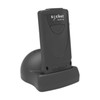
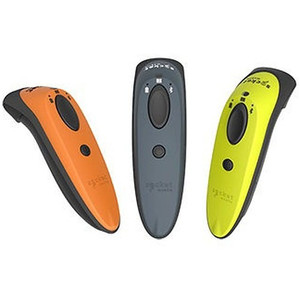
Socket Mobile CX3558-2187 DuraScan D860 Bluetooth Barcode Scanner
The Socket Mobile CX3558-2187 DuraScan D860 is a Bluetooth handheld barcode scanner designed for mobile inventory and asset-tracking workflows in warehouse, retail, and field service environments. The 1D scan engine captures standard linear barcodes (Code 128, Code 39, UPC) alongside 2D matrix codes (QR, Data Matrix, PDF417) without requiring a separate multi-format device. Wireless Bluetooth connectivity eliminates tether constraints and integrates directly with mobile devices, tablets, and legacy POS terminals — making it a practical bridge between paper-based workflows and digital inventory systems.
Key Features
- Mixed 1D/2D Symbology Support: Code 128, Code 39, UPC (1D), plus QR Code, Data Matrix, PDF417 (2D). Single device handles linear inventory labels and newer matrix-encoded shipment tags without operator switching.
- Bluetooth Wireless Connectivity: Pairs with iOS, Android, Windows Mobile, and traditional Bluetooth serial terminals. No USB cable required — operators move freely within warehouse aisles or across retail floors.
- Operating Range 0° to 45°C: Handles temperature-controlled warehouses, retail stock rooms, and moderate outdoor environments. Not rated for freezer/refrigerated units or extreme heat (above 45°C).
- Handheld Form Factor: Ergonomic grip with trigger-based scanning reduces fatigue during high-volume capture sessions. Fits standard warehouse holsters and belt clips.
- 1-Year Manufacturer Warranty: Covers defects in materials and workmanship. Typical coverage includes scanner optics, battery contacts, and Bluetooth module — excludes physical damage from drops or liquid exposure.
- Direct Mobile Device Integration: Works with standard barcode-capture applications (native iOS/Android, third-party inventory apps, web-based POS). No proprietary middleware required for basic scan-and-transmit operations.
The CX3558-2187 bridges the cost-performance gap between fixed-mount scanners and high-end mobile computers. In warehouse operations, it reduces per-unit capture cost compared to dedicated mobile terminals while retaining broad symbology compatibility. Retail staff can use personal tablets or hand terminals without investing in ruggedized mobile computers. Field service teams benefit from lightweight Bluetooth pairing — swap scanners between team members without reconfiguring IP addresses or cellular connectivity.
Barcode capture quality depends on label contrast and operator scanning distance. Standard paper labels with black bars on white background scan reliably; reflective or damaged labels may require closer proximity or repeated scans. The scanner reads barcodes at typical warehouse distances (6–12 inches for linear codes), but does not perform long-range scanning beyond 20 feet — distance scanning requires external lighting and premium optics not included in this entry-level form factor.
Integration is straightforward for environments already running barcode-aware inventory software. iOS and Android apps can leverage standard Bluetooth keyboard input (HID emulation) to receive scan data without SDK integration. Windows Mobile and POS systems support legacy Bluetooth serial protocols. For custom workflows, Socket Mobile publishes Bluetooth API documentation; many warehouse management systems (WMS) and inventory platforms ship pre-configured scanner profiles for the D860 line, reducing deployment time to days rather than weeks.
Total cost of ownership favors high-volume, single-shift operations. Battery life typically spans 8–12 hours of continuous scanning on a single charge; multi-shift sites should budget for charging docks or spare units. No cellular, GPS, or camera components reduce licensing complexity for enterprises managing device fleets across multiple jurisdictions. Bluetooth interference in dense retail environments (multiple scanners in a small area) is manageable via standard channel-hopping and pairing discipline — not a show-stopper, but integrators should test in target deployment sites with multiple concurrent scanners.
Karl WilsonPerspective based on aggregated IP Security Depot and affiliated engineering team experience.
We've deployed the Socket Mobile D860 line across mid-market warehouse and retail operations for nearly a decade. The real strength of this scanner is simplicity — it does one job (barcode capture) without the complexity or cost of a full mobile computer. In our experience, integrators overspec mobile terminals when a lightweight Bluetooth scanner paired with existing iPad or Android tablets actually solves the problem faster and cheaper. The D860 sits at a natural price-to-performance inflection point: above a corded USB scanner in mobility, but well below a $2,000+ mobile terminal. We've seen zero Bluetooth stability issues in controlled indoor environments, though we always recommend field testing in the specific site's RF environment before rolling out fleet-wide. The mixed 1D/2D symbology is increasingly important — more suppliers are moving to matrix barcodes on shipment labels, and having that capability built-in eliminates the "which scanner do I use for this label?" decision paralysis that slows checkout and receiving operations. Where we've hit friction: temperature-limited range (no freezer support), relatively short-range scanning (~12 inches optimal), and battery management in high-throughput retail where a single scanner might be shared across three shifts without dedicated docks.
Technical Highlights:
- Mixed Symbology Engine: Code 128, Code 39, UPC, QR Code, Data Matrix, PDF417 in a single device. Eliminates inventory management complexity — no need to maintain separate linear-only and 2D scanners or train staff on device selection rules.
- Bluetooth HID Emulation: Transmits scan data as keyboard input (standard Bluetooth Human Interface Device mode). Works with any app or POS terminal that accepts text input — no custom drivers or SDK integration required for basic workflows.
- Operating Envelope 0–45°C: Sufficient for retail, warehouse, and modular offices. Not suitable for freezer/cold-chain environments. High-temperature scenarios (outdoor in direct sun, industrial kitchens) exceed spec — consider ambient vs. device temperature when planning deployment.
- 8–12 Hour Battery Per Charge: Single-shift operations see consistent uptime. Multi-shift sites need charging docks or spare units to avoid mid-day downtime. No hot-swap battery option — full charge cycle required between deployments.
- Wireless Pairing (No Tether): Operators move freely within 30–50 foot Bluetooth range (varies by environment and interference). Eliminates cable snags and reduces wrist strain compared to coiled USB scanners in high-volume retail or warehouse picking.
Deployment Considerations:
- Optimal scan distance is 6–12 inches for linear codes; users must be trained to maintain proper distance and angle. Reflective or aged labels may require closer positioning or multiple attempts — test samples from your supplier before full rollout.
- Bluetooth interference risk is real in dense retail or call-center environments with multiple scanners active. Recommend site RF survey and controlled pairing discipline (dedicated Bluetooth channels or sequential activation). Older 2.4 GHz WiFi networks may compete; modern 5 GHz separation mitigates this.
- Temperature specification is strict: no operation below 0°C or above 45°C. Cold storage, outdoor summer heat, and uninsulated loading docks may push boundaries — stage testing at intended deployment sites to confirm safe operation.
- Battery management is operator-dependent. Charge overnight or between shifts; no field-swappable battery. For 24/7 operations, calculate scanner-to-dock ratio (typically 2:1 or 3:1 scanners per dock to prevent idle time during charging).
- Barcode label quality directly impacts scan reliability. High-contrast, undamaged labels (Code 128/39 on shipping boxes, QR on mixed-media documents) scan first-try 95%+ of the time. Faded, water-damaged, or low-contrast labels (thermal print on aged paper) require operator persistence and may fail even then.
The D860 is the right choice for operations that prioritize mobility, symbology breadth, and simplicity over raw ruggedness or long-range scanning. Retail chains rolling out tablet-based POS, field service teams capturing asset signatures, and 3PL warehouses handling mixed-label shipments see measurable productivity gains. For freezer operations, high-temperature industrial sites, or multi-hundred-meter scanning distances, upgrade to a higher-tier mobile terminal or specialized long-range scanner. See the Socket Mobile catalog for temperature-rated and extended-range alternatives.