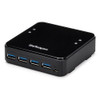
StarTech HBS304A24A 4x4 USB 3.2 Gen 1 Peripheral Sharing Switch
Overview
The StarTech HBS304A24A is a 4-host, 4-peripheral USB 3.2 Gen 1 sharing switch built for workstation clusters, shared-device environments, and lab setups where multiple operators need access to the same USB peripherals without physically swapping cables. At 5 Gbps per connection, it handles high-bandwidth devices — external drives, high-res scanners, industrial cameras — without the throughput ceiling that makes older 2.0 switches a bottleneck. If you manage shared USB peripherals across a small workgroup and cable-swapping is already a daily frustration, this is the category of device to evaluate. Explore the full StarTech connectivity catalog for complementary infrastructure options.
Key Features
- 5 Gbps USB 3.2 Gen 1 Interface: Full USB 3.2 Gen 1 bandwidth on all eight ports means high-speed peripherals — external SSDs, industrial cameras, high-volume document scanners — operate at rated speed rather than being choked down to USB 2.0's 480 Mbps ceiling. For imaging workflows or large file transfers, that difference is tangible.
- 4 Host Ports + 4 Peripheral Ports: Four USB Type-B upstream ports connect to four separate computers; four USB-A downstream ports serve four peripherals simultaneously. Each host can access any attached peripheral through software switching — no physical reconnection required. This is the right architecture for small broadcast booths, engineering labs, or production cells where two to four operators share a common device pool.
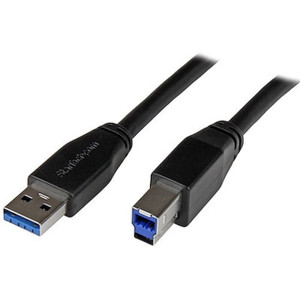
- USB Type-B Host Connections: Standard USB Type-B upstream connectors on all four host ports mean compatibility with the USB-A-to-B cables already in most rack or desktop environments. No proprietary cabling required.
- USB-Powered Operation with Optional 5V 2A Input: The switch draws power directly from the host USB connection — no dedicated power brick needed for basic operation. For deployments running high-draw peripherals or to guarantee stable power regardless of host port output, a 5V 2A external supply (optional) can be connected. Plan accordingly if you're running bus-powered drives on every downstream port simultaneously.
- Compact 3.7 × 3.7 × 1.0 in Footprint: At under 4.4 oz and roughly the size of a deck of cards, the HBS304A24A sits on a desk, mounts behind a monitor, or tucks into a drawer without dedicated rack space. This matters in dense operator stations or kiosk environments where device real estate is limited.
- 0°C to 40°C Operating Range: Rated for standard indoor office and light industrial environments. Not intended for outdoor enclosures or unheated server rooms — keep this in mind if your environment swings below freezing.
- -20°C to 60°C Storage Range: Wide enough to handle warehouse storage or shipping in most climates without concern for thermal shock to the device before deployment.
- Up to 80% RH (Non-Condensing): Humidity tolerance covers most climate-controlled indoor environments, though condensing humidity situations — near HVAC vents or in humid coastal facilities — should be avoided.
- 2-Year Manufacturer Warranty: Two years of coverage provides reasonable assurance for a shared-infrastructure device that will see daily use across multiple workstations.
Integration and Compatibility
The HBS304A24A connects via standard USB Type-B to USB-A cables to any host with a USB 3.2 Gen 1 (USB 3.0) or later port. It is backward-compatible with USB 2.0 hosts, though throughput will drop to USB 2.0 speeds on those connections. Peripheral-side USB-A ports accept any USB 3.x or USB 2.0 device. Because the switch operates at the hardware level with software-controlled host switching, verify that your OS and any connected peripheral drivers support shared-device arbitration in your specific workflow — some peripherals (particularly those requiring exclusive device lock, like hardware security tokens or certain industrial instruments) may not behave correctly when switched between hosts mid-session. For environments running USB peripheral sharing switches alongside KVM infrastructure, note that this device handles USB peripherals only — video switching requires a separate KVM layer. Pair with a KVM switch if you need full workstation sharing including display output. If your deployment involves USB-connected IP cameras or capture devices feeding multiple workstations, this switch provides the shared-access layer without requiring redundant hardware per host.
Frequently Asked Questions
Q: Can the HBS304A24A be used without an external power supply?
A: Yes. The switch is USB-powered from the connected host, so no external power brick is required for standard operation. An optional 5V 2A power input is available for deployments with high-draw peripherals or where consistent power independent of host USB output is preferred.
Q: Does the HBS304A24A support USB 2.0 hosts and peripherals?
A: The switch is built on USB 3.2 Gen 1 (5 Gbps) but is backward-compatible with USB 2.0 devices. Connections negotiated at USB 2.0 will operate at USB 2.0 speeds (up to 480 Mbps) rather than 5 Gbps.
Q: What cable types are needed to connect hosts to the HBS304A24A?
A: Host connections use standard USB Type-B ports (the square-style connector common on printers and hard drives). You need a USB-A to USB-B cable for each host — these are widely available and likely already in your inventory.
Q: What is the warranty on the HBS304A24A?
A: The HBS304A24A carries a 2-year manufacturer warranty.
Q: Can all four hosts access all four peripherals simultaneously?
A: Switching is managed at the host level — one host accesses a given peripheral at a time. The switch allows any of the four hosts to be assigned to any of the four peripherals, but simultaneous multi-host access to a single peripheral is not supported. Check your switching software for session management capabilities.
Q: Is the HBS304A24A suitable for outdoor or industrial environments?
A: No. The operating temperature range is 0°C to 40°C and humidity tolerance is up to 80% RH non-condensing. This is an indoor, climate-controlled device and is not rated for outdoor or harsh industrial enclosure use.
The spec that drives most purchase decisions on the HBS304A24A is the 5 Gbps USB 3.2 Gen 1 throughput across all eight ports — that's not a shared bus total, it's the rated interface speed per connection. In workgroups where USB 2.0 switches were creating a 480 Mbps ceiling on things like external storage or USB-connected capture devices, this switch removes that constraint entirely for up to four hosts simultaneously.
Technical Highlights:
- 5 Gbps per port: USB 3.2 Gen 1 on all host and peripheral ports keeps high-bandwidth devices — external drives, video capture hardware, industrial scanners — running at full rated speed rather than being bottlenecked by the switch itself.
- USB-powered with 5V 2A fallback: The ability to run bus-powered simplifies deployment in most scenarios, but the optional 5V 2A external input is worth knowing about before you start attaching multiple bus-powered drives — you may need it.
- 3.7 × 3.7 × 1.0 in, 4.4 oz: Small enough to live behind a monitor or under a desk. No rack unit, no dedicated shelf — this installs wherever the cables reach.
Deployment Considerations:
- Plan your cable runs before committing to a mounting location — you need USB-A-to-B runs to each of four hosts, plus USB-A runs to each peripheral. In a spread-out workstation cluster, cable management becomes the real installation challenge.
- Watch out for peripherals that require exclusive device lock (hardware security tokens, certain instruments, some industrial cameras). These device classes may not switch cleanly between hosts mid-session — test before deploying in a production workflow.
The HBS304A24A is a practical fit for small production cells or engineering labs where two to four operators rotate access to shared USB peripherals — external storage arrays, label printers, or USB-connected test instruments — and cable-swapping is the current solution. It is not the right device for environments requiring simultaneous multi-host access to the same peripheral or for deployments outside 0°C to 40°C operating conditions.