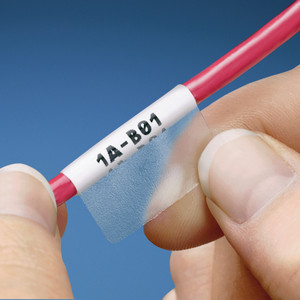
Panduit S100X225YFJ Self-Laminating Cable Label
The Panduit S100X225YFJ delivers permanent cable identification for Category 6 and 6a installations where color-coded labeling is part of your documentation standard. Each 1" × 2.25" label combines an orange polyester print area with a clear overlaminate that wraps around conductors from 8 AWG down to 4 AWG, sealing printed text against abrasion, solvents, and UV exposure. Supplied on standard 8.5" × 11" sheets with 32 labels per sheet, this format works with existing laser and inkjet printers, eliminating dedicated label hardware for moves, adds, and changes across enterprise structured cabling, data center cross-connects, and telecom punch-down fields.
Key Features
- Self-laminating construction — 0.75" orange print area plus clear overlaminate for wraparound protection
- Laser and inkjet compatible — standard office printers, no specialized hardware required
- Polyester substrate — resists oils, solvents, and temperature extremes common in plenum and cable tray environments
- 8.5" × 11" sheet format — 32 labels per sheet, 1000 labels per package for efficient batch printing
- Orange color coding — aligns with TIA-606-C and custom standards for Category 6 FTP, Category 6a UTP/FTP identification
- RoHS compliant — suitable for international deployments and environmentally regulated facilities
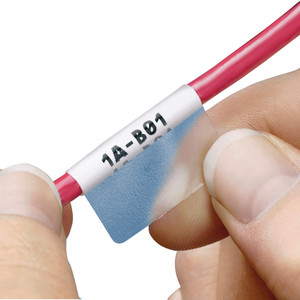
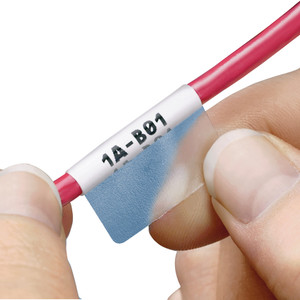
Self-laminating labels solve a fundamental problem in permanent cable ID: how to protect human-readable text from the mechanical wear and chemical exposure that erases ink within months of installation. The S100X225YFJ uses a split construction — the bottom 0.75" is an orange polyester film optimized for toner and ink adhesion, while the top 1.5" is a clear overlaminate with aggressive adhesive on both sides. After printing, you wrap the label around the cable jacket; the overlaminate folds over the printed area and bonds to itself, creating a sealed capsule around the text. Polyester's dimensional stability means the label won't shrink, stretch, or degrade under the temperature swings typical in ceiling plenums (up to 90°C intermittent) or outdoor cable entrances. The clear overlaminate is thick enough to resist scrapes from cable tray edges and tie-wrap tools but thin enough to avoid interference with high-density patch panels where every millimeter of bend radius matters.
In structured cabling installs, the S100X225YFJ typically appears during two phases: initial deployment, where installers print full runs of sequential IDs from a numbering plan before pulling cable, and post-occupancy MAC work, where you're adding drops to an existing infrastructure and need labels that match the facility's established color scheme. The 8.5" × 11" sheet format means you can print a floor's worth of labels in a single pass, then distribute them to pull crews who apply them at both ends of each homerun before termination. For retrofit work in occupied spaces, the ability to print labels on-demand from a laptop and portable inkjet eliminates the wait for pre-made label orders and the error-prone handwriting that fails inspections. The 1" width accommodates Cat6a's larger jacket diameter without overlapping text, and the 2.25" length provides enough wraparound to grab firmly on 23 AWG solid conductors through 4 AWG power feeds in hybrid telecom cabinets.
Panduit's label construction meets RoHS material restrictions, making the S100X225YFJ compliant for EU and California installations where PVC-based films are prohibited. The orange print area specifically addresses TIA-606-C Appendix B recommendations for Category 6a horizontal cabling in multi-tier networks, where color differentiation between copper speeds prevents cross-patching errors during failover events. For integrators managing long-term service contracts, self-laminating polyester labels eliminate the callback cost of re-labeling runs where handwritten tags have faded or peeled — the overlaminate bond is permanent enough to outlast the cable's service life in HVAC plenums, underfloor ducts, and outdoor conduit transitions.