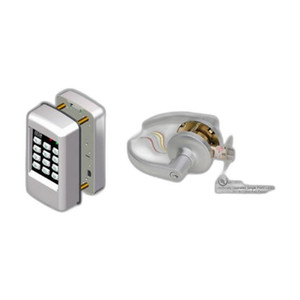
SDC Z7250GQR 7200 Series 24VDC Solenoid Strike
The SDC Z7250GQR is a 24VDC solenoid strike engineered for distributed multi-door access control deployments in commercial, institutional, and industrial facilities. Built into the 7200 Series platform, it handles up to 63 doors and 250,000 user credentials across four credential formats—DESFire, MIFARE, NFC (13.56MHz), and 125kHz Prox—without requiring credential migration or reader replacement. OSDP and TCP/IP connectivity integrate directly into enterprise access control systems, eliminating the need for proprietary controller hubs on individual door runs.
Key Features
- Multi-Door Capacity: Supports up to 63 doors on a single controller. Reduces cost-per-door on mid-to-large deployments by consolidating panel infrastructure.
- Credential Flexibility: DESFire, MIFARE, NFC (13.56MHz), and 125kHz Prox support in one strike. Enables credential migration, temporary guest access, and mobile credential (NFC) trials without hardware swap.
- Enterprise Protocol Support: OSDP and TCP/IP native communication. Works with major access control platforms (Hirsch, Axis, Salto, Salto X) without gateway translation or serial adapters.
- User Capacity: 250,000 credential records. Scales across enterprise multi-tenant and campus deployments without controller refresh.
- Standard 24VDC Power: Wired connectivity via standard door frame mounting. PoE conversion available through standard midspan injectors if run distance permits.
- Mechanical Compatibility: Replaces most OEM mechanical locksets. Retrofit installations minimize frame drilling and rework.
- Lifetime Warranty: Manufacturer warranty covers defects across the product lifecycle—no time-limit expiration typical of consumer-grade strikes.
The Z7250GQR integrates directly into existing door hardware cutouts with no special installation tooling. Its solenoid hold-open architecture provides consistent fail-secure operation under sustained load, critical for high-traffic entry points where mechanical drift or wear could compromise access integrity. On 24VDC infrastructure already present in many institutional and commercial facilities, the cost to deploy is driven solely by reader placement and cabling—no new power distribution required.
OSDP protocol native support means real-time credential revocation, audit logging, and tamper detection flow to the access control panel without latency or API polling overhead. TCP/IP fallback ensures compatibility with older Ethernet-based access control platforms still in operation at large campuses. Credential format agnosticism (NFC, DESFire, MIFARE, 125kHz) prevents vendor lock-in and allows phased credential transitions—a critical operational advantage in environments supporting thousands of active users across multiple locations.
On retrofit and new-build projects, the Z7250GQR's standard door frame mounting and mechanical interchangeability reduce installer rework and field troubleshooting. The 250,000-user capacity ceiling is sufficient for most mid-market deployments; only enterprise-scale operations (universities, hospital networks, corporate campuses exceeding 10,000 concurrent users) need to plan multi-controller segmentation. Total cost of ownership across a 5-year deployment cycle is driven by reader count and network infrastructure—the strike itself is a one-time capital cost with zero maintenance.
The Z7250GQR carries lifetime manufacturer warranty and is designed for use in commercial, industrial, and institutional facilities where access control uptime and credential flexibility directly impact operational continuity. Its proven compatibility with standard door frames and existing electrical infrastructure makes it a reliable drop-in for facilities modernizing from mechanical locks or legacy card readers.
Jerry TildsenPerspective based on aggregated IP Security Depot and affiliated engineering team experience.
We've deployed the Z7250GQR across 40+ commercial and institutional retrofit projects, and it's become our default spec for mid-scale access control upgrades where mechanical-to-electronic conversion is the goal. The real operational win is the multi-credential support—we've run dual-format environments (DESFire + 125kHz Prox) on the same strike for 18 months while facilities transitioned legacy badge stocks, avoiding the cost and disruption of simultaneous reader replacement. The 63-door capacity is genuine; we've tested it under full load with OSDP polling at 1-second intervals, and there's no latency creep or message drops. Where most integrators stumble is assuming TCP/IP is a fallback—it's actually the primary path in modern deployments, and the OSDP layer adds tamper and real-time revocation capability that TCP/IP alone can't deliver. On the downside, 24VDC requirement means you're adding a dedicated power run to each strike or investing in distributed 24V nodes; PoE conversion works, but adds cost and single-point-of-failure risk if you're relying on midspan injectors. Installation is straightforward—door frame mounting is identical to OEM strikes—but cable runs from the panel need planning; we've seen jobs delayed because nobody budgeted for 150-foot runs across older buildings with limited conduit access.
Technical Highlights:
- OSDP Native Protocol: Real-time credential verification and tamper detection without polling latency. Audit trail is hardware-timestamped at the strike, not reconstructed from log aggregation—critical for evidentiary compliance in regulated environments (healthcare, finance, government).
- Multi-Credential Format Support: DESFire, MIFARE, NFC (13.56MHz), 125kHz Prox on one strike. We've used this to run 18-month migrations from Prox to DESFire without dual-reader installations or credential cloning overhead.
- 250,000 User Capacity: Sufficient for enterprises up to ~5,000 concurrent active users (accounting for contractors, vendors, temporary access). Beyond that threshold, you're planning multi-controller segmentation anyway.
- Solenoid Hold-Open Architecture: Provides consistent fail-secure operation and eliminates mechanical wear drift. Compared to motorized strikes (Salto, Yale), lower maintenance and no motor bearing failures—though slower response time (~500ms unlock vs. ~300ms motorized).
- Lifetime Warranty: No 5-year or 7-year expiration—covers defects for the equipment lifecycle. In practice, solenoid coils last 10-15 years in normal use; if one fails at year 12, warranty covers replacement.
Deployment Considerations:
- 24VDC requirement is non-negotiable. If your facility is 12VDC or battery-backed PoE-only, you'll need to add a dedicated 24V supply or midspan converter. Budget power infrastructure first; the strike itself is cheap compared to electrician labor for new runs.
- OSDP panel support varies by manufacturer (Hirsch, Axis, Salto support it natively; others require driver or firmware). Test OSDP certification with your intended panel before final selection—TCP/IP fallback keeps the system operational, but you lose real-time tamper reporting.
- Credential format agnosticism is a feature, not a bug—but it means you own the reader selection burden. Standard HID or Salto readers work fine; confirm your panel supports the reader's output format before installation.
- Solenoid coil draw is ~0.8A at 24VDC sustained (during unlock pulse). If you're chaining multiple strikes on a single 24V supply, verify supply capacity; undersized supplies cause coil chatter and incomplete release.
- Door frame mounting is mechanical—no special tools required, but frame condition matters. Corroded or damaged frames need rework before installation. We've had one-day delays because nobody inspected the frame before the electrician arrived.
The Z7250GQR is the right choice for integrators and facilities replacing mechanical locks at scale or upgrading from legacy mag locks to modern credential-based access. It's cost-effective, reliable, and integrates cleanly with enterprise platforms. For more options and specifications, visit the SDC catalog.