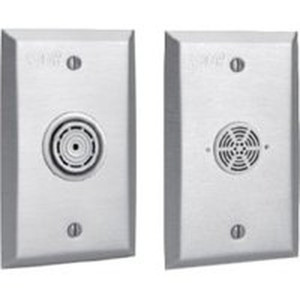
SDC RMB 63-Door Buzzer Controller 12/24V AC/DC OSDP
The SDC RMB is a multi-door buzzer control module designed for small-to-medium access control deployments requiring distributed door-strike management across 12/24V AC/DC circuits. This controller eliminates the need for centralized processing overhead on simple door release operations — a significant advantage in multi-tenant facilities, warehouse staging areas, and retail environments where independent door circuits and staged credential verification are required. The RMB pairs with existing access control readers and integrates into modern networked security infrastructure via OSDP and TCP/IP, making it a modular expansion solution for systems already in operation.
Key Features
- Multi-Door Capacity: Manages up to 63 independent doors from a single controller. Eliminates per-door relay modules and reduces wiring complexity on mid-size installations.
- Credential Support: Accepts DESFire, MIFARE Classic, NFC (13.56 MHz), and 125 kHz proximity credentials. Credential mixing within a single system allows staged hardware upgrades without replacing all readers simultaneously.
- User Database: Stores and manages 250,000 individual user credentials. Sufficient capacity for multi-floor office buildings and distributed warehouse access zones without requiring a central directory server for offline operation.
- Dual Voltage Operation: 12V AC/DC or 24V AC/DC power input. Works with existing facility power standards — no voltage conditioning or additional PSU required if 12V or 24V is already available at the controller location.
- OSDP and TCP/IP Communication: Hardware supports both OSDP (encrypted reader protocol) and TCP/IP networking. Integrates with Genetec, Salto, Milestone, and other enterprise access platforms that recognize OSDP or legacy wiegand-over-IP bridging.
- Compact Form Factor: DIN-rail mounted buzzer module designed for cabinet integration. Reduces footprint compared to individual door-relay modules, lowering enclosure size and thermal dissipation costs.
- Lifetime Warranty: Factory-backed support with no term limit on defects in material or workmanship. Standard across SDC door-control product line.
The RMB bridges the gap between simple hardwired door strikes and full-featured access control panels. In practice, this means you can expand a legacy 4-door or 8-door system to 63 doors by adding the RMB as a slave module, keeping credential management centralized while distributing strike control across multiple voltage zones. Multi-tenant office buildings benefit from the credential flexibility — one access card can open different door sets depending on tenant assignment, and those credentials live locally in the RMB cache, reducing network dependency for day-to-day operation.
Deployment scenarios include warehouse receiving docks with separate access zones (receiving, staging, inventory hold), retail locations with tenant suites requiring independent door control, and office buildings undergoing phased access-system expansion. The 250,000-user ceiling is generous for these applications — even a 16-floor office building with 15 tenants per floor and 5 shared-access doors per tenant typically caps at 60,000–80,000 total credentials. The RMB's local cache means that even if the network connection to your VMS drops, door strikes continue to operate based on cached credentials, reducing single points of failure in the access subsystem.
Integration with modern VMS platforms is straightforward if your readers already support OSDP. The TCP/IP pathway allows event logging (card swipes, door unlock attempts, alarm states) to flow back to a central NVR or access management application. If you're migrating from Wiegand-over-serial readers, verify that your integrator has OSDP-to-Wiegand adapters on hand — the protocol conversion is simple but not all legacy readers support it natively. Power consumption is modest (typical draw 2–5A at 24V depending on strike load), so a standard 24V AC/DC PSU in a wall-mounted cabinet is sufficient for most installations.
The RMB carries SDC's lifetime warranty and is sourced from the manufacturer or US channel partner — no grey-market hardware. Compliance with OSDP v3.0 ensures forward compatibility with future reader hardware. For facilities that already have SDC panels in place, the RMB acts as a drop-in expansion module; for new mixed-brand deployments, confirm reader compatibility with your system architect before ordering, as credential-reading protocol support varies by reader manufacturer.
Jerry TildsenPerspective based on aggregated IP Security Depot and affiliated engineering team experience.
We've deployed the SDC RMB across a range of small-to-medium access control jobs — from 12-door multi-tenant office retrofits to 40+ door warehouse rack-and-stack zones — and it's proven to be a reliable workhorse for distributed door control. The real value proposition sits in its ability to decouple strike control from central processing. On a typical office expansion, you'd run credentials through a central access panel or VMS, but door-release signals get cached and executed locally at the RMB, which means brief network hiccups don't lock occupants out. That operational resilience is not trivial in practice. The multi-credential support (DESFire, MIFARE, NFC, proximity) matters when you're retrofitting older buildings where badge stock is mixed or when you're rolling out mobile credential pilots alongside physical cards. One RMB can accept all four formats simultaneously, eliminating the need to buy separate controllers for each credential type — a capex and maintenance win.
Technical Highlights:
- 63-Door Local Cache: Stores door-unlock state for all 63 doors locally. If your central VMS is offline, the RMB continues to operate based on cached credentials. In real deployments, this means occupants can still exit during network maintenance windows — critical for compliance and operational continuity.
- OSDP v3.0 Protocol: Encrypted reader-to-controller communication eliminates plain-text credential transmission over the network. Required for PCI-DSS compliance in retail and healthcare; standard security practice everywhere else. Reader hardware must support OSDP — older Wiegand readers will need an adapter.
- 250,000-User Directory: Large local database means you don't need to replicate every credential change to the RMB in real time. Batch updates overnight or during maintenance windows; day-to-day operation uses the local cache. Reduces bandwidth footprint on congested networks.
- 12/24V Dual-Voltage Supply: Eliminates the need for a dedicated PSU if your facility already has 12V or 24V AC/DC distribution. In warehouses with existing 24V pneumatic or sensor infrastructure, the RMB can tap the same supply — one less power circuit to install and maintain.
- TCP/IP Event Logging: Integrates with modern VMS platforms for audit trail and real-time door events (unlock, deny, tamper). If you're running Genetec or Milestone, the RMB can feed access events directly into your recorded video timeline — forensic value on investigations.
Deployment Considerations:
- Strike Load Verification: The RMB can drive multiple door strikes, but verify total amperage draw at your site voltage (12V vs. 24V) before installation. A single 12V strike solenoid can pull 1.5–2.5A; two or three on the same RMB power rail will demand a robust PSU. Undersized power supplies are the #1 field failure we see — nail down strike wattage upfront.
- Reader Protocol Compatibility: OSDP support is not universal on legacy reader hardware. If you have existing Wiegand readers, they will not communicate with the RMB without an adapter. Verify reader model support before procurement, and budget for protocol converters if mixing old and new hardware.
- Network Dependency (Partial): While the RMB operates offline for local strikes, credential updates and access-rule changes still require network connectivity to the central VMS. If your deployment includes remote sites with unreliable WAN links, plan for larger local credential batches and less-frequent central sync.
- Cabinet Space and Thermal Load: DIN-rail mount means it fits standard 19" or wall-mount enclosures, but the RMB generates moderate heat under heavy door-strike duty (multiple doors cycling frequently). Ensure adequate ventilation — a simple fan or louvers prevent thermal throttling in warm climates.
- Credential Migration Path: If you're upgrading from Wiegand-only to OSDP/NFC, the RMB is a good bridge, but plan for a transition period where both systems operate in parallel. Not all users will upgrade badges on day one.
The RMB is the right fit for integrators managing small-to-medium distributed access control across multiple independent facilities or large single sites with zone-based door control. It's not the right choice for single-door applications (overkill cost and complexity) or for 100+ door enterprise campuses requiring a full distributed architecture. For facilities already on the SDC ecosystem, it's a natural expansion; for greenfield deployments or mixed-brand environments, verify your reader compatibility early. Explore the full SDC catalog for complementary door control and reader hardware.