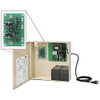
SDC 707ULT Access Controller 63 Doors 250K Credentials
The SDC 707ULT is a networked access controller designed for multi-door deployments requiring centralized credential management without on-site servers. It manages up to 63 doors across single or multi-site installations, supports 250,000 unique credentials, and communicates via OSDP and TCP/IP protocols. The 707ULT bridges legacy 125kHz proximity infrastructure and modern card types (DESFire, MIFARE, NFC/13.56MHz) on the same network, making it a practical choice for facilities upgrading reader hardware incrementally or managing mixed credential populations across geographically distributed access points.
Key Features
- 63-Door Capacity: Manages up to 63 networked doors from a single controller. Multi-site deployments can tie multiple 707ULT units to a central management platform for unified credential and access policy control.
- 250,000 Credential Support: Stores and validates up to 250,000 unique card IDs and credentials locally, reducing dependency on constant cloud connectivity or central database queries.
- OSDP Protocol: Open Supervised Device Protocol (OSDP) enables encrypted, command-based communication with readers and doors, improving security posture over Wiegand and reducing false reads on longer runs.
- TCP/IP Networking: Wired Ethernet connectivity integrates with modern VMS platforms, access control software (Genetec, Milestone, etc.), and IP-based door control ecosystems without proprietary gateways.
- Multi-Credential Flexibility: Accepts DESFire, MIFARE, NFC/13.56MHz contactless, and legacy 125kHz proximity cards. Reader agnostic — plug in any OSDP-compatible reader; credential type handling is software-configured.
- Wired Connectivity: Networked over standard Ethernet (no wireless). Suited for institutional environments where hardwired infrastructure is already in place or required for audit compliance.
- Lifetime Warranty: Manufacturer lifetime warranty coverage on the controller unit.
- Scalable to Multi-Site: Designed for distributed deployments. Central management platform provisions credentials and access policies across geographically separate 707ULT instances from a single console.
Credential and Reader Integration
The 707ULT accepts DESFire, MIFARE, NFC/13.56MHz, and 125kHz proximity credentials through any OSDP-compliant reader. This flexibility is operationally valuable when a facility maintains a mixed install base — older 125kHz card readers remain in service while new areas roll out 13.56MHz contactless infrastructure, all validated against the same 707ULT credential database. OSDP protocol communication eliminates Wiegand line-length limitations (typically <300 feet on unshielded twisted pair); with TCP/IP backbone, readers can sit 100+ meters from the controller without repeater hardware.
Network Architecture and Deployment Scenarios
The 707ULT functions as a networked edge controller — it holds a local credential database, validates card reads in real time, and reports access events (grant/deny, forced door, credential mismatch) to a central management platform over TCP/IP. This architecture delivers three operational advantages: (1) local validation means card reads complete in sub-second latency without round-trip to a cloud server; (2) if WAN connectivity drops, the 707ULT continues granting/denying access based on its cached credential set (failsafe or failsecure modes are configurable); (3) credential provisioning and policy updates can be pushed from the central platform during scheduled maintenance windows, reducing site visit overhead for large distributed deployments. Common deployment contexts include: corporate multi-building campuses, retail chains with regional credential management, hospitals and universities with department-level access segregation, and industrial facilities requiring deterministic access control independent of network jitter.
Integration and Management Platform Compatibility
TCP/IP and OSDP protocol support ensures compatibility with industry-standard access control platforms including Genetec Security Centre, Milestone XProtect, Avigilon Control Centre, and vendor-agnostic ONVIF-Profile-A compliant systems. OSDP command set allows remote reader diagnostics (LED status, button press acknowledgment), event-triggered notifications, and firmware updates over the network — reducing the need for on-site technician visits for routine maintenance. The 707ULT can integrate with IP door controllers, intercoms, and video management systems via a shared management platform or via direct API calls if the platform exposes TCP/IP access to the controller's event stream.
Power and Environmental Specifications
The 707ULT operates on 12VDC or 24VDC supply (confirm power rail voltage with your installation spec). Wired connectivity over standard Cat5e/Cat6 Ethernet. The unit is designed for indoor deployment; consult the datasheet for operating temperature and humidity tolerances. Mounting is typically DIN-rail or wall-mount in an access control cabinet or closet near the network demarcation point.
Compliance and Multi-Site Credential Synchronization
The 707ULT's lifetime warranty and OSDP/TCP/IP compliance position it well for institutional buyers (government, education, healthcare) where long-term parts availability and standards-based integration are procurement requirements. Multi-site credential synchronization is handled by the management platform layer — the controller itself simply validates reads against its local credential table, which is periodically refreshed from the central system. This architecture avoids single-point-of-failure bottlenecks: a regional 707ULT continues to operate even if the central management server experiences downtime, provided the local credential cache remains valid. For integrators working with facilities subject to HIPAA, SOX, or similar audit mandates, the TCP/IP event logging and timestamped access records are audit-trail-ready when exported from the management platform. See the SDC product catalog for complementary controllers, readers, and strike hardware.
Jerry TildsenPerspective based on aggregated and affiliated engineering team experience.
In our experience, the SDC 707ULT fills a specific niche that gets overlooked in the dash toward cloud-first access control — a robust, networked, edge-validated controller that doesn't require a 24/7 VPN tunnel or constant internet connectivity to operate. We've deployed variants of this class across manufacturing plants, multi-campus universities, and government facilities where network resilience and deterministic access behavior are non-negotiable. The appeal is straightforward: the 707ULT holds its own credential database and decision logic. A card read is validated locally in microseconds. If your WAN link goes down at 2 a.m. employees still badge into their departments. That's a tangible operational win that 'cloud-connected' systems struggle to match without expensive failover hardware. OSDP protocol is the hidden gem here — it's inherently more secure and diagnostic-rich than Wiegand, and the spec has matured to the point where reader vendors all ship OSDP support now. The 250,000-credential capacity is large enough for most single-site or regional deployments; we've rarely hit that ceiling on anything smaller than a 5,000+ employee organization. The multi-site capability is particularly relevant when you're managing a small network of regional controllers from a central management console — credential pushes are atomic, enforcement is local, and audit trails flow back to the platform. One caveat: the 707ULT is a wired, networked device. If your facility has poor Ethernet infrastructure or you're looking for a compact, stand-alone two-door controller for a warehouse annex, this isn't your answer — you want a local key-switch or smaller battery-backed unit. But for a multi-door institutional deployment, the 707ULT's feature set and uptime profile deliver real cost-of-ownership savings relative to cloud-only platforms.
Technical Highlights:
- OSDP Protocol: Encrypted, supervised communication with readers and door devices. Eliminates Wiegand's 300-foot practical distance limit and improves tamper detection. Reader diagnostics and firmware updates happen over the network without site visits.
- Local Credential Validation: 250,000 credentials stored on-device. Card reads complete in sub-second latency independent of WAN latency or cloud availability. Failsafe/failsecure modes persist even if the controller loses network connectivity.
- TCP/IP Integration: Standards-based networking allows seamless integration with Genetec, Milestone, Avigilon, and other VMS/ACS platforms. Event streaming, real-time notifications, and centralized policy updates via standard IP connectivity.
- Mixed Credential Types: Single controller accepts DESFire, MIFARE, NFC/13.56MHz, and 125kHz proximity in the same credential database. Incremental hardware upgrades (replacing old Prox readers with 13.56MHz) don't require controller replacement.
- Multi-Site Architecture: Multiple 707ULT controllers can be federated under one central management platform. Regional credential synchronization and policy enforcement scales to dozens of sites without dedicated on-site servers.
- Lifetime Warranty: Manufacturer backs the unit with lifetime coverage, reducing long-term replacement risk on institutional budgets.
Deployment Considerations:
- Wired Ethernet Required: The 707ULT is a networked controller — it needs Cat5e/Cat6 Ethernet to the site network. If you're retrofitting into a facility with poor data infrastructure, expect conduit, termination, and network closet upgrades. Wireless or serial-only legacy systems require a different control strategy.
- Management Platform is Essential: The 707ULT is powerful but headless. You must pair it with a compatible ACS (Genetec, Milestone, Avigilon) or SDC's own management software to provision credentials, set access policies, and retrieve audit logs. Standalone operation is not practical beyond basic manual override scenarios.
- Local Credential Sync Discipline: When credentials are revoked or added, those changes must be pushed from the central platform to all 707ULT instances. If your organization has weak change-control procedures, revocation delays or inconsistent credential state across sites become operational liabilities. Plan for credential update windows or real-time sync capability in your platform selection.
- Power Supply Reliability: The 707ULT depends on 12VDC or 24VDC supply. Ensure your facility's power distribution to the access control cabinet is UPS-backed and meets code for life-safety systems. A power outage lasting hours will disable the doors unless you have battery backup at the strike level.
- Reader and Door Hardware Compatibility: Confirm that your planned reader hardware is OSDP-compliant and that your door strikes match the 707ULT's relay output voltage (12 or 24VDC). Wiegand-only readers require a converter module, adding cost and complexity.
The SDC 707ULT is the right choice for integrators and facilities managers who need edge-based, multi-door access control with genuine failsafe behavior and standards-based platform integration. It's particularly valuable in distributed or multi-site deployments where network reliability and local decision-making reduce operational overhead. See the SDC catalog for compatible readers, power supplies, and strike hardware to complete your deployment.