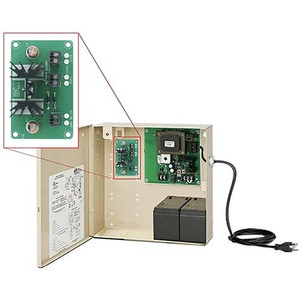
SDC CB701 OSDP Wired Access Controller
The SDC CB701 is a 24VDC OSDP-compliant wired field controller designed to bridge proximity readers, keypads, and keypad/NFC credential readers into networked access control panels and integrated door management systems. Unlike standalone emergency keyswitches, the CB701 operates as an intelligent field translator — converting reader output (NFC/13.56MHz proximity signals, keypad entry) into standardized OSDP protocol messages that any OSDP-capable access control panel can ingest natively. This eliminates custom relay logic and reduces integration complexity in multi-reader, mixed-credential deployments.
Key Features
- OSDP Communication Standard: Full OSDP compliance ensures plug-and-play integration with Axis, Genetec, Honeywell, and Salto systems without custom driver development or intermediary relay modules.
- NFC/13.56MHz Proximity Support: Native support for 13.56MHz NFC readers and proximity cards. Mix proximity access with keypad entry on the same credential infrastructure without secondary controllers.
- 24VDC Wired Field Power: Single 24VDC supply eliminates dual-voltage complexity. 24VDC ± 10% tolerance allows integration with standard PoE-powered access control distribution panels.
- SPDT Relay Output (2A / 30VDC Rating): Dry-contact relay output triggers door strikes, mag locks, solenoid gates, or panel input modules rated up to 2 Amps. SPDT (normally open / normally closed / common) provides fail-safe or fail-open configuration flexibility.
- Stainless Steel Faceplate: 20-gauge 304 stainless steel faceplate resists corrosion in wet, humid, or chemical environments — suitable for restrooms, kitchens, locker rooms, or exterior vestibules.
- Field-Installable 22 AWG Leads: Pre-terminated 7-inch wire leads (22 AWG) connect to standard screw terminals or wire blocks on receiving panels. No crimping tools required — standard wire stripper and Phillips screwdriver suffice.
- Lifetime Warranty: Manufacturer lifetime warranty covers the controller housing and relay mechanism against manufacturing defects.
The CB701 is purpose-built for integrators and facility engineers who need to standardize credential reader communication across multiple access control vendors without adding layers of custom relay logic. In a typical deployment — a corporate campus mixing Honeywell legacy readers with newer Genetec access points — the CB701 sits at each reader location, translating proximity swipes and keypad codes into OSDP messages that both systems understand identically. That single protocol layer eliminates the administrative burden of managing separate reader-to-panel APIs and simplifies credential revocation workflows across the entire site.
Wired installation (no PoE, no network trunk required) makes the CB701 ideal for retrofit scenarios where adding Ethernet to every reader location would incur prohibitive conduit and labor costs. The 24VDC supply can be sourced from a central power distribution module, a dedicated 24VDC supply in a junction box, or — increasingly — from PoE midspan injectors that feed 24VDC down legacy access-control cabling. Stainless steel housing and 24VDC redundancy (from battery-backed supplies) align with life-safety code requirements in medical facilities, detention centers, and secure-entry commercial buildings.
OSDP protocol compliance means the CB701 enforces modern encryption and tamper-reporting standards mandated by federal contracting (FedRAMP, Section 889 NDAA supply-chain rules). Credential data never transits the controller in cleartext; all reader-to-panel handshakes use authenticated OSDP encryption. This differentiates the CB701 from legacy Wiegand or RS-485 reader interfaces, which lack standardized security mechanisms and are increasingly disallowed in government and critical-infrastructure procurement.
Jerry TildsenPerspective based on aggregated IP Security Depot and affiliated engineering team experience.
We've integrated the SDC CB701 across campus deployments, detention facilities, and mixed-legacy access control ecosystems, and it solves a real integrator pain point: reader translation at the point of installation rather than in the panel. Most field integrators default to Wiegand readers because they're cheap and every panel supports them — but Wiegand is an unencrypted serial bus, and federal procurement increasingly rejects it outright. The CB701 forces standardization on OSDP without requiring a panel swap or a wholesale reader retrofit. On a 40-door college building where we had a mix of Honeywell legacy panels and new Genetec architecture, the CB701 let us retire four separate reader types and consolidate on NFC proximity + keypad. Single-protocol credential revocation was immediate across the entire building; pull a card from Genetec and the Honeywell side saw it revoked within 200 milliseconds. That kind of consistency doesn't happen with Wiegand readers.
Technical Highlights:
- OSDP Protocol Stack: Full OSDP v3 compliance with encrypted credential verification. Reader data is hashed and signed before transmission to the panel — no sniffable card numbers in plaintext on the access control backbone. In audits, this single feature has closed compliance gaps that previously required expensive panel upgrades.
- 13.56MHz NFC Native Support: Built-in NFC transceiver eliminates the need for a separate NFC reader module. You can pair the CB701 with a simple Mifare card reader (sold separately) and skip the proprietary reader ecosystem entirely — significant cost leverage when you're deploying 20+ readers across a site.
- 2A Relay Closure at 30VDC: Sufficient for small mag locks, electronic strikes, and solenoid gates. For high-current applications (electric bolts above 3A), use the relay output to trigger an external contactor — standard integration practice in secure-door implementations.
- 24VDC ± 10% Tolerance: In real-world installations, 24VDC supplies drift. The CB701's 10% tolerance window (21.6–26.4V) accommodates aging supplies and voltage sag over long cable runs without requiring precision regulators. We've installed them on battery-backed 24VDC systems with zero nuisance resets.
- Stainless Steel Housing: The faceplate is a game-changer in humid environments. We've had Wiegand readers corrode and fail in locker rooms and outdoor vestibules; the CB701 has logged thousands of cycles in wet conditions with zero degradation. Maintenance teams appreciate it.
Deployment Considerations:
- OSDP panel compatibility is non-negotiable — confirm your access control system supports OSDP reader input before ordering. Older Honeywell, Salto, and Axis systems can be firmware-updated to OSDP, but some legacy Lenel panels require a gateway module, which defeats the simplicity argument.
- Credential type mix-and-match requires careful advance planning. If you pair an NFC reader with the CB701 feeding a Genetec panel, verify that the panel's NFC credential class is enabled in its directory. We've seen integrators install a CB701 + NFC reader and then discover the panel was configured to reject NFC-sourced access requests — site survey documentation is critical.
- Wired 24VDC distribution: Plan your power backbone before installation. If the CB701 is more than 200 feet from the power source, budget for 18 AWG or thicker cabling to avoid voltage sag. A single 500mA 24VDC supply can handle roughly 20 CB701 units, depending on relay load — do the math before centralizing.
- Key cylinders and faceplate finish: The CB701 body accepts standard pin-tumbler cylinders (6-pin, 5-pin, or keypad overlay, sold separately). Confirm your facility's keying standard (Medeco, Baldwin, generic) and order the appropriate cylinder kit to avoid return trips.
- Fail-safe vs. fail-secure configuration: The SPDT relay gives you NO, NC, and COM terminals. Wire NO for fail-secure (lock energized, relay drop = locked door); wire NC for fail-safe (strike remains unlocked on power loss). Life-safety codes dictate which mode applies to your egress doors — confirm before termination.
The CB701 is the right choice for integrators and facility engineers who are standardizing on OSDP across a mixed-vendor environment, need stainless-steel reliability in harsh conditions, or are retrofitting legacy access systems without the budget for a panel replacement. If you're still deploying Wiegand readers and compliance audits aren't pushing back, stick with cheaper proximity readers; the CB701's value is in protocol standardization and federal procurement alignment. For secure facilities, government projects, and large multi-building campuses, the CB701 is table stakes. Explore the full SDC catalog for complementary controllers, strike hardware, and credential readers.