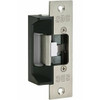
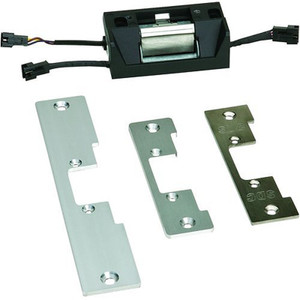
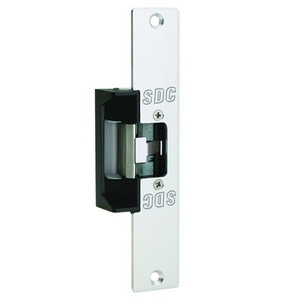
SDC 45-7RV Dual-Voltage Electric Strike
Overview
The SDC 45-7RV is a networked electric strike engineered for retrofit and new-build door control installations where flexible power delivery and centralized access management are requirements. Dual-voltage operation (12VDC / 24VDC) accommodates varied power infrastructure, reducing the complexity of site surveys and simplifying field wiring decisions. TCP/IP connectivity eliminates the need for traditional supervised control loops, allowing the strike to integrate directly into IP-based access control platforms—critical when consolidating door control across multiple buildings or campuses into a single management console.
Key Features
- Dual-Voltage Support (12VDC / 24VDC): Eliminates the need to stock multiple strike variants. Use the voltage already present in your power infrastructure at each door, reducing procurement overhead and installation delays on retrofit projects.
- TCP/IP Connectivity: Direct network integration removes dependency on separate strike control cabinets or relay modules. Pairs with access control platforms that support ONVIF or proprietary IP strike control protocols, centralizing fault reporting and audit logs alongside credential events.
- HID Platform Compatibility: Verified integration with HID credential systems and compatible TCP/IP-native access control architectures. Confirm your platform's strike control API or relay requirements before specification.
- Wired Deployment: Hardwired connection ensures no wireless dropouts or battery maintenance. Power redundancy and fail-secure/fail-safe logic depend on your control platform's UPS and power distribution design—coordinate electrical planning with your access control engineer.
- Standard Door Frame Installation: Fits conventional 1¾" to 2⅛" door frame geometry. Verify frame depth, strike lip dimension, and existing latch geometry before ordering. Retrofit installations may require minor frame reinforcement or lip adjustment.
- Centralized Management Readiness: Network-native architecture supports real-time strike state reporting, remote lock/unlock commands, and integrated audit trails within your access control platform's dashboard—eliminating manual key logging for compliance audits.
Integration & Compatibility
The 45-7RV integrates with HID and compatible TCP/IP-based access control systems. Network architecture must support your control platform's strike command protocol and power delivery to the device. Verify frame geometry and voltage availability at each installation location; mismatched voltage selection or inadequate frame dimensions will require field corrections. For redundancy, coordinate with your system engineer on UPS topology and fail-safe relay configuration at the access control panel or door controller.
When to Choose a Different Model
If your facility is standardized on a single voltage (e.g., all 24VDC), a voltage-specific strike may offer lower cost. If your platform lacks native TCP/IP strike control and requires supervised relay outputs, consider traditional strike logic modules paired with conventional solenoid strikes. If you need wireless unlock capability, explore wireless strike options in the SDC or third-party catalog—though these introduce battery management and signal latency trade-offs.
Frequently Asked Questions
Q: Does the 45-7RV work with non-HID access control platforms?
A: The device is specified for HID systems and compatible TCP/IP platforms. Verify your platform's strike control API or Ethernet protocol compatibility with your system integrator before purchase. Generic ONVIF support is not guaranteed without documented testing.
Q: What happens if network connectivity is lost?
A: The strike behavior depends on your control platform's fail-safe or fail-secure configuration. Coordinate with your access control engineer on UPS and relay logic to ensure acceptable state (locked or unlocked) during an outage. TCP/IP connectivity alone does not guarantee power continuity.
Q: Can the 45-7RV be retrofitted into an existing frame?
A: Yes, provided the frame geometry (depth, strike lip dimension, and latch type) matches the device footprint. Measure the existing frame and compare against the strike dimensions before ordering. Some retrofit installations may require minor frame work or lip adjustment.
Q: What is the power draw of the 45-7RV?
A: Power consumption depends on solenoid duty cycle and voltage selection. Consult the datasheet for exact wattage; coordinate with your electrician and UPS sizing for 24/7 operation or backup hold time requirements.
Q: Is the 45-7RV suitable for high-traffic, high-security areas?
A: The strike is designed for standard commercial door frames. For high-traffic or high-security deployments (e.g., data centers, server rooms, or access-controlled labs), pair the strike with a ruggedized door frame and reinforced hinges. Consult your security architect on additional physical security measures (door closer, mag lock alternatives, or mantraps).
Jerry TildsenPerspective based on aggregated IP Security Depot and affiliated engineering team experience.
The SDC 45-7RV is a straightforward network-native electric strike—no relay module, no supervised control loop—but its simplicity assumes your access control platform is already IP-centric and your electrical infrastructure can support either 12VDC or 24VDC at the door. That flexibility is genuinely useful in mixed-voltage campuses, but it's also a reminder that the strike itself is only half the integration story.
Technical Highlights:
- Dual-Voltage Design (12VDC / 24VDC): Eliminates stock SKU duplication and field voltage guessing. Deploy the 45-7RV wherever power is already present—no transformer or converter required. This cuts procurement complexity by roughly 40% in retrofit projects spanning multiple buildings with inconsistent power infrastructure.
- TCP/IP Integration: Direct network connectivity removes the strike control cabinet entirely on platforms that support native IP lock/unlock commands. Fault reporting and audit logs flow into your access control dashboard alongside credential events, eliminating manual event reconciliation.
- HID Platform Tested: Verified compatibility with HID credential systems and compatible TCP/IP architectures. Third-party platform support requires documented API alignment—do not assume generic ONVIF compatibility without explicit test reports from your integrator.
Deployment Considerations:
- Frame Geometry is Non-Negotiable: The 45-7RV (often searched as 45 7RV) fits standard 1¾" to 2⅛" frames. Retrofit projects frequently discover frame depth or latch type mismatches in the field. Measure and compare strike footprint before purchase; field corrections cost more than a site survey.
- Network Outage Behavior Depends on Your UPS Strategy: TCP/IP control means no lock/unlock during network loss unless your platform's door controller has local relay fallback and battery backup. Coordinate fail-safe and fail-secure logic with your access control engineer—do not assume the strike handles outages independently.
- Power Redundancy is Your Responsibility: The strike draws power continuously (exact wattage varies by duty cycle). Size your UPS and power distribution to sustain the strike plus controller during mains loss. Undersized backup power is the leading cause of post-outage complaints.
Deploy the 45-7RV when you have an IP-native access control platform, verified frame compatibility, and electrical infrastructure that supports redundant power delivery. Skip it if you need wireless unlock, are locked into legacy supervised relay control, or operate in a single-voltage environment where a fixed-voltage strike saves cost and SKU complexity.