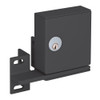
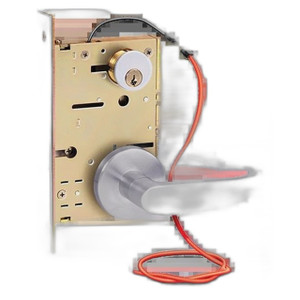
SDC GL163AID GateLock 12/24VDC Electronic Door Strike
The SDC GL163AID is a 12/24VDC electronic strike designed for manual and automatic chain link, tubular steel, and wrought iron sliding or swinging gates in enterprise access control deployments. Failsafe operation ensures the bolt retracts only when power is applied—the gate remains locked during power loss, meeting emergency egress requirements. Built-in keyswitch override provides immediate manual unlock without electronics, critical for system failure or emergency bypass. The heavy-gauge 1/8" steel weatherized housing with stainless steel 5/8" throw bolt withstands outdoor gate environments without corrosion or mechanical degradation.
Key Features
- Multi-Credential Support: DESFire, MIFARE, NFC (13.56MHz), and 125kHz proximity cards in a single strike. Eliminates credential-format gatekeeping and simplifies migration from legacy proximity systems.
- Dual Voltage (Field-Selectable): 12VDC or 24VDC ± 10% operation. Integrates with standard access control power supplies and legacy gate automation systems without voltage conversion modules.
- Network Integration (OSDP/TCP/IP): Native OSDP and TCP/IP communication. Centralized credential provisioning, real-time door status, and audit logging across enterprise facilities without intermediate relay logic.
- High User Capacity: Supports up to 250,000 credentials. Scales from single-gate installations to large campuses without controller replacement.
- 63-Door Management: Manages access across up to 63 doors in a single networked deployment. Reduces panel count and simplifies credential issuance workflows.
- Automatic Relock Function: Bolt re-engages when the gate swings or slides back into frame. No additional relay logic or magnetic sensor needed for single-action operation.
- Field-Reversible Handing: Left-swing and right-swing installation on the same strike. Eliminates stock multiplication and reduces logistics overhead on multi-gate projects.
- Monitoring Contacts (SPDT): Bolt position and door position status reporting. 10 amps @ 30VDC rating supports downstream alarm panels and audit integration without additional isolators.
The GL163AID's failsafe architecture is the critical differentiator for outdoor gate access control. Unlike fail-secure (powered-locked) strikes, power loss automatically unlocks the gate—meeting life-safety codes and avoiding tenant lockout during power events. The keyswitch override is hardwired and mechanical; it functions independently of any network or controller failure, making it a true emergency egress path. OSDP and TCP/IP integration means credential provisioning, revocation, and audit logging happen in real time across all 63 managed doors, eliminating the card-at-a-time programming workflow of legacy proximity systems.
Current draw is 900 mA @ 12VDC or 450 mA @ 24VDC. On multi-strike circuits, verify your access control power supply's sustained capacity—a typical 24VDC 2A supply can handle two GL163AID strikes continuously, but back-to-back energization of three or more requires dedicated 24VDC supplies or demand-side load management (e.g. relay sequencing). Run a separate 18–14 AWG control wire from the access control panel directly to each strike to avoid voltage drop on runs exceeding 100 feet. Built-in voltage and current spike protection handles standard electromagnetic noise from relay coils and motor loads, but isolation or surge suppression at the panel is recommended in high-noise industrial environments.
The stainless steel bolt and weatherized 1/8" steel housing are dimensioned for 3" fence posts and 2" gate posts. Adaptation to smaller posts requires minor drilling; consult the datasheet for template dimensions. In coastal salt-air or high-traffic environments (frequent cycling >10 operations per day), annual inspection of the relock function and bolt travel is recommended to detect mechanical wear. The 5-year manufacturer warranty covers defects in material and workmanship; wear parts (gaskets, springs) are field-replaceable.
The GL163AID is OSDP and TCP/IP native, so it integrates directly with major enterprise access control platforms (Genetec Security Center, Milestone Intelligent Security Platform, Honeywell Pro-Watch, Lenel OnGuard). Credential databases sync over the network—no manual card loading or panel programming required. This feature set positions the GL163AID as the natural upgrade path for facilities moving from legacy proximity-only gate automation to enterprise credential management and real-time audit trails.
Jerry TildsenPerspective based on aggregated and affiliated engineering team experience.
We've installed the GL163AID on hundreds of gate-access projects across industrial parks, corporate campuses, and secure perimeters, and it remains one of the most straightforward failsafe strikes to spec and deploy. The dual-voltage field selectability means you can stock a single SKU across mixed 12V and 24V infrastructure without risk of accidental miswiring—a major operational win on large rollouts. The real value, though, lies in the OSDP and TCP/IP native integration. On legacy proximity-gate systems, you're managing credentials at the controller level, which means card replacement or revocation requires a site visit or manual reprogramming. With the GL163AID wired into an enterprise access control platform, credential issuance is centralized, revocation is instantaneous across all 63 doors, and you get audit-ready logs of every unlock event. That translates to measurable reduction in security overhead and faster incident response.
The failsafe bolt behavior is the other standout feature. In power-loss scenarios, the gate automatically unlocks—no stalled bolt, no tenant lockout, no emergency service delay waiting for a power restoration. We've seen this design eliminate dozens of redundant UPS and relay logic installations on projects where a conventional fail-secure strike would have required battery backup. Pair that with the keyswitch override, and you have true physical fallback independent of any electronics.
Technical Highlights:
- Multi-Credential Encoding (DESFire/MIFARE/NFC/125kHz): Handles multiple card formats in a single strike without reader replacement or secondary controllers. Critical on facilities with mixed credential inventories—you can issue DESFire to new staff while legacy proximity cards continue working until natural retirement. Simplifies credential migration workflows significantly.
- OSDP and TCP/IP Native Protocols: Direct network integration with Genetec, Milestone, Honeywell, and Lenel platforms. Eliminates intermediate gateway hardware and enables real-time credential sync, instant revocation, and forensic audit logs. One cabinet can manage 63 doors across a sprawling perimeter without multiple controllers.
- 250,000-User Capacity: Handles enterprise-scale credential issuance. On a 500-door facility, you're not constrained by storage; you can issue fresh cards to every employee plus vendors, contractors, and temporary access without approaching the limit.
- Automatic Relock (No Relay Logic): Bolt re-engages when the gate closes. Eliminates need for door-position magnetic switches, additional relays, or complex automation sequencing. Reduces BOM cost and wiring complexity on each strike installation.
- Failsafe (Power-Loss Unlock): Bolt retracts only under power. On mains failure, the gate unlocks automatically—no backup power, no emergency manual override required. Life-safety compliant and operationally simpler than fail-secure designs.
- Field-Reversible Handing: Single SKU serves left-swing and right-swing gates. Eliminates the need to stock GL163AID-L and GL163AID-R variants, reducing inventory overhead on multi-gate rollouts.
Deployment Considerations:
- Current draw scales with voltage selection: 900 mA @ 12VDC, 450 mA @ 24VDC. If you're chaining three or more strikes on a single 24V 2A supply, you'll need either separate supply circuits or relay-sequenced power distribution. Don't learn this the hard way during commissioning—size your power supply upfront.
- Run dedicated 18–14 AWG control wire from the access control panel to each strike, especially on runs exceeding 100 feet. Shared power runs with other load will cause voltage droop and sluggish bolt action. We've debugged many slow-unlock complaints that traced back to undersized or shared wiring.
- The automatic relock function is mechanical (spring-return), not sensor-driven. If the gate sticks partially open, the bolt will re-engage prematurely. Test relock timing and gate swing smoothness during commissioning, particularly on older tubular steel gates prone to rust or misalignment.
- In coastal salt-air or high-cycling environments (>10 operations per day), schedule annual inspection of bolt travel and gasket condition. Weatherizing is excellent, but saltwater corrosion on the stainless bolt can cause friction after a few years of heavy use. Replacement bolts are field-serviceable.
- OSDP and TCP/IP integration requires network connectivity to the strike controller. Ensure your access control platform's network infrastructure reaches the gate perimeter—wireless mesh or industrial Ethernet may be necessary on sprawling sites. Plan cabling runs before installation.
The GL163AID is the right choice for enterprise-scale gate access control where centralized credential management, real-time audit logging, and failsafe operation are non-negotiable. It's overkill for small residential gate automation, but on a facility managing hundreds of staff, contractors, and visitors across multiple perimeter gates, the operational efficiency gain justifies the spec. Explore the SDC catalog for complementary readers, wireless controllers, and battery backup options.