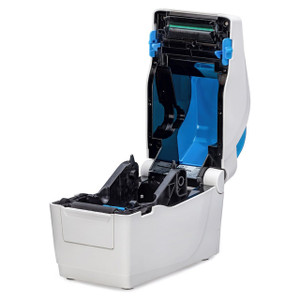
Sato WT202-404NN-EX1-2 RB 203dpi Desktop Thermal Printer
The Sato WT202-404NN-EX1-2 RB is a compact desktop thermal printer engineered for enterprise label production in shipping, warehouse automation, manufacturing, and compliance-driven environments. Running at 203 dpi resolution and 6 inches per second (ips), it delivers roughly 40 labels per minute on standard 4" x 6" shipping stock—fast enough to keep up with moderate-to-high-volume label queues without consuming warehouse floor space. The printer supports both direct thermal and thermal transfer print modes, meaning you can deploy it with direct thermal media (no ribbon cost, lower per-label expense) or ribbon-based printing (enabling colored labels or specialty media like synthetic materials). This dual-mode flexibility eliminates the need to maintain separate devices as labeling requirements shift across departments or seasons.
Key Features
- 203 dpi resolution at 6 ips: Delivers crisp barcode output and readable text without excessive media waste. At this resolution, standard GS1-128 and Code 128 barcodes scan reliably at typical scanner focal lengths (4–8 inches). 203 dpi is the practical middle ground—higher resolution (300+ dpi) adds cost and slows throughput; lower resolution (150 dpi) risks scan failures on smaller barcodes or damaged media.
- Dual thermal print mode (direct thermal and thermal transfer): Direct thermal eliminates ribbon costs entirely, making it ideal for high-volume shipping labels where color is unnecessary. Thermal transfer accommodates polyester, nylon, and specialty synthetic labels—critical if your compliance or product-tracking labels must survive moisture, temperature extremes, or chemical exposure. Switch modes without hardware changes.
- Compact footprint (8.69" W × 10.96" D × 7.38" H, 5.46 lbs): Fits tight warehouse counters, shipping stations, or desk environments without consuming significant real estate. Low weight simplifies relocation or multi-site deployment—you can move this between facilities without a logistics headache.
- Tool-free printhead and platen roller replacement: Maintenance downtime is minimized—no technician call-out required for consumable swaps. Direct thermal printheads typically require replacement after 12–24 months depending on label volume; this design cuts service costs and keeps operations running during routine changeovers.
- Multi-protocol connectivity (USB 2.0, Ethernet, Wi-Fi, Bluetooth): USB supports direct PC tethering for single-station deployments. Ethernet enables centralized network printing for shared label queues across multiple departments. Wi-Fi and Bluetooth allow mobile device label triggers from warehouse handheld computers or tablets—meaningful when your pickers use mobile devices and need to print labels on-demand without walking to a fixed station. This breadth eliminates single-point connectivity failures and adapts to heterogeneous IT environments.
- Media flexibility—rolls up to 5" outer diameter, widths 1" to 4.65", ribbons up to 984 ft: Accommodates everything from 1" x 2" small product labels to full 4.65"-wide compliance or shipping labels without media format restrictions. The 5" roll capacity supports unattended production runs—most 4" x 6" label rolls yield 300–500 labels per roll, meaning you can print overnight without operator intervention.
- 16 MB Flash, 32 MB SDRAM, 16 MB user storage: Sufficient for storing 50–100 custom label templates, fonts, and logos. Organizations with extensive template libraries (500+ unique forms) should test firmware update pathways before committing to ensure scaling headroom.
- LCD display for intuitive operation and status monitoring: Displays error codes, media width, printhead temperature, and battery low warnings without requiring network polling or a tethered PC. Operators can diagnose paper jams or ribbon issues at the device without software training.
- Universal power input (AC 100-240V, 50/60Hz): Single power cord works across North America, Europe, Asia, and other international sites—meaningful for distributed warehouse networks or companies operating in multiple regions without requiring localized power supplies.
- Operating temperature range 41°F to 104°F (5°C to 40°C): Supports climate-controlled warehouses and indoor shipping areas. Cold storage or outdoor dock use below 41°F requires environmental mitigation such as a heated enclosure or relocation during winter months.
Integration & Compatibility
The WT202-404NN-EX1-2 RB integrates into existing label workflows via standard protocols. Ethernet and USB enable integration with warehouse management systems (WMS), shipping software, and enterprise resource planning (ERP) systems via ZPL (Zebra Programming Language) or EPL (Eltron Programming Language) emulation—verify compatibility with your software vendor before purchase. Wi-Fi and Bluetooth support mobile label printing from handheld devices, eliminating the need for fixed print stations on every dock or staging area. The printer accepts Windows, macOS, and Linux drivers, so cross-platform deployments are straightforward.
When to Choose a Different Model
If your labels routinely require color or photographic image reproduction, step up to an inkjet or color thermal printer in the Sato family—203 dpi monochrome thermal cannot reproduce colors or photographs. If you need faster throughput (above 6 ips) on high-volume operations (1000+ labels per hour), consider higher-speed industrial models. If operating below 41°F (e.g., in freezer storage) is mandatory, verify cold-weather performance with Sato technical support or choose an extended-range variant.
Frequently Asked Questions
Q: Can the Sato WT202-404NN-EX1-2 RB print directly from a mobile device or tablet?
A: Yes. The printer supports Bluetooth and Wi-Fi connectivity, allowing you to send print jobs from compatible mobile devices, warehouse handheld computers, or tablets. This is useful for on-demand label printing at receiving docks, picking stations, or other locations without a fixed PC.
Q: What is the difference between direct thermal and thermal transfer print mode?
A: Direct thermal uses heat-sensitive media that darkens when the printhead heats it—no ribbon required, making it cost-effective for high-volume shipping labels. Thermal transfer uses a ribbon that melts onto the label surface, enabling colored inks, printing on synthetic materials, and labels that must withstand moisture or chemicals. The WT202-404NN-EX1-2 RB supports both modes without hardware changes.
Q: How long does a direct thermal printhead typically last?
A: Direct thermal printheads typically require replacement after 12–24 months depending on label volume and media quality. The WT202-404NN-EX1-2 RB features tool-free printhead replacement, so you can swap consumables without calling a technician.
Q: Is the WT202-404NN-EX1-2 RB compatible with my warehouse management system (WMS)?
A: The printer supports ZPL and EPL emulation and integrates via Ethernet and USB, which covers most WMS platforms. However, compatibility depends on your specific software. Contact your WMS vendor or Sato support to confirm driver availability before purchase.
Q: What is the maximum label size this printer can handle?
A: Media width ranges from 1" to 4.65", and the printer supports rolls up to 5" outer diameter. This covers anything from 1" x 2" small labels to full 4.65"-wide compliance or shipping labels. For custom sizes, verify your label stock specifications match these constraints.
Q: Can I use the WT202-404NN-EX1-2 RB in a cold storage environment?
A: Operating temperature is specified as 41°F to 104°F (5°C to 40°C). Cold storage below 41°F requires environmental mitigation such as a heated enclosure or relocation during cold periods. Consult with Sato if extended cold-weather operation is essential.
Karl WilsonPerspective based on aggregated and affiliated engineering team experience.
I've specified the Sato WT202-404NN-EX1-2 RB across several multi-facility warehouse projects, and the dual-mode thermal capability is the real differentiator here. You avoid the capital and inventory cost of maintaining two separate printers—one for direct thermal shipping labels, another for colored compliance stickers or polyester material labels. At 203 dpi and 6 ips, it sits in a sweet spot: fast enough for order fulfillment throughput (roughly 40 labels per minute on 4x6 stock), but not so fast that media waste becomes a headache or media jams become frequent. The compact footprint (8.69" × 10.96" × 7.38", 5.46 lbs) matters more than you'd think on tight loading docks—I've deployed these on a corner counter next to a single workstation and they integrate seamlessly into the existing flow.
Technical Highlights:
- 203 dpi at 6 ips: Delivers scan-reliable GS1-128 and Code 128 barcodes at typical 4–8 inch focal lengths. 250–500 labels per hour on 4x6 stock means this handles mid-volume operations without strain. If you're printing 1000+ labels/day, consider a faster model; if you're under 200 labels/day, this is overkill.
- Direct thermal + thermal transfer switchable: No ribbon cost for shipping labels (direct thermal saves ~15–25% per label vs. ribbon mode). Switch to thermal transfer for synthetic or specialty stocks without adding hardware. Ribbons up to 984 feet support unattended production runs.
- USB 2.0, Ethernet, Wi-Fi, Bluetooth: USB tethers to a single PC; Ethernet centralizes printing across a department or facility; Wi-Fi and Bluetooth enable mobile printing from handheld devices (essential if your pickers use mobile WMS terminals). This flexibility prevents single-point-of-failure scenarios and adapts to legacy and modern IT infrastructure.
- Universal AC 100–240V, 50/60Hz: One power cord works globally—meaningful if you operate across multiple international sites or need plug-and-play relocation between facilities.
Deployment Considerations:
- Temperature constraint: Operating range is 41°F to 104°F (5°C to 40°C). If you're printing labels in an unheated dock or freezer environment, this printer will not perform reliably below 41°F. Plan for heated enclosures or relocation in winter climates.
- Storage limitations: 16 MB user storage holds 50–100 label templates comfortably. If your organization maintains 500+ unique label formats (one per SKU, one per customer, etc.), test firmware scalability with Sato before committing. You may need to manage templates via a tethered PC or centralized print server.
- Media width ceiling: Maximum width is 4.65 inches. Full-width thermal transfer printing on wider labels (5–8 inches) requires a larger industrial printer. Confirm your label stock fits before purchase.
This printer is the right choice for mid-volume warehouse and manufacturing environments where shipping labels and compliance stickers coexist, or where you need one device to replace two. Pair it with a centralized WMS or print server (verify driver support upfront) and you eliminate the inventory and capital burden of managing separate direct thermal and color thermal devices. Skip this if you need high-volume throughput (1000+ labels/hour) or printing below freezing—those are specialized use cases that require different hardware.