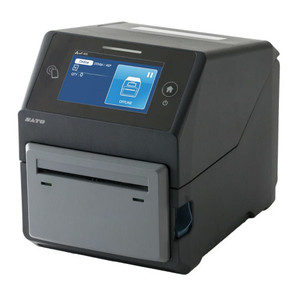
Sato WWCT04041-WAN 305dpi Thermal Label Printer
The Sato WWCT04041-WAN is a compact desktop thermal printer engineered for enterprises running high-volume label production across warehouse, logistics, and manufacturing environments. At 305 dpi and 8 inches per second, this device delivers crisp, scannable barcodes and readable text without consuming significant floor space—the 7.0" × 9.375" × 8.4375" footprint fits easily into space-constrained shipping areas or retail back offices.
Key Capabilities
- Dual Thermal Modes (Direct Thermal + Thermal Transfer): Eliminates the need to maintain separate devices. Direct thermal works for temporary labels and receipts; thermal transfer handles durable asset tags and compliance labels that must survive moisture, temperature swings, or chemical exposure. One printer covers both workflows, reducing capital expense and simplifying inventory management.
- 305 dpi Resolution at 8 ips: Higher density than entry-level thermal printers means barcode scanners capture data on first pass—reducing checkout friction and inventory lookup errors. Eight inches per second is sufficient for 500–2,000 labels daily across multiple SKUs without becoming a bottleneck in typical warehouse operations.
- 4.3" Full-Color Touchscreen: Intuitive interface for job selection, font management, and error diagnostics. No separate control panel or PC required for routine operations. Operators unfamiliar with enterprise printers can still queue jobs and check print status without IT involvement, lowering support overhead.
- 4 GB Flash + 1 GB DDR3 RAM, 2 GB User Storage: Ample memory for complex label templates with barcodes, QR codes, logos, and variable data fields. Stores dozens of custom forms and fonts locally, so print jobs don't depend on network latency or server availability—critical during WMS outages or peak season.
- Multi-Protocol Connectivity (Ethernet, Wi-Fi, Bluetooth, USB 2.0): Integrates into existing warehouse LANs via Ethernet or 802.11 Wi-Fi without dedicated print servers. Bluetooth and USB support mobile device printing for on-demand labeling workflows. The WWCT04041-WAN (often searched as WWCT04041 WAN) supports parallel printing across multiple clients without congestion or dropped jobs.
- Tool-Free Printhead and Platen Roller Replacement: Scheduled maintenance takes minutes, not hours. Reduces unplanned downtime when printheads reach end-of-life or when platen rollers require cleaning after extended use—a real cost factor in 24/5 warehouse operations.
- Media Handling: Accepts rolls up to 5" outer diameter on a 1.5" core, with label widths from 1" to 4.09". Ribbon capacity extends to 300 meters, supporting multi-thousand-label production runs before ribbon reload becomes necessary. This minimizes changeovers during peak shipping periods.
- Compact Weight (7.3 lbs): Portable enough to relocate between departments or temporary staging areas if warehouse layouts shift, yet stable enough on standard shelving or work benches without tipping risk.
Integration & Deployment Considerations
The WWCT04041-WAN operates across a 0°C to 40°C temperature range, making it suitable for climate-controlled warehouses and indoor manufacturing floors. AC 100–240V power input (50/60 Hz) accommodates global facilities without requiring step-down transformers. Connectivity via Ethernet or Wi-Fi integrates with existing label management software and warehouse management systems (WMS) using standard printing protocols—proprietary drivers are not required, reducing IT complexity.
For operations requiring frequent label design changes—such as compliance relabeling, SKU swaps, or seasonal inventory adjustments—the local 2 GB user storage and onboard 4.3" touchscreen enable quick edits and reprints without server round trips. This is particularly valuable in pharmaceutical, food service, and retail environments where regulatory updates demand rapid label changes and audit trails.
Frequently Asked Questions
Q: What media types does the WWCT04041-WAN support?
A: The printer handles both direct thermal and thermal transfer media. Direct thermal labels work for temporary applications (receipts, shipping labels with short shelf life). Thermal transfer media—paired with ribbon—produces durable output suitable for asset tags, compliance labels, and outdoor inventory tracking.
Q: Can I print from mobile devices to the WWCT04041-WAN?
A: Yes. The printer supports Bluetooth and USB 2.0 connectivity in addition to Ethernet and Wi-Fi, enabling on-demand label printing directly from tablets or smartphones without connecting to a central server.
Q: What happens if the network goes down?
A: With 2 GB of onboard user storage and pre-loaded label templates, the WWCT04041-WAN can continue printing stored jobs even if network connectivity is lost. This is essential during WMS outages or peak periods when network congestion might otherwise halt label production.
Q: How often does the printhead require replacement?
A: Printhead lifespan depends on volume and media type. The tool-free replacement mechanism means maintenance staff can swap the head in minutes without specialized equipment, minimizing labor cost and downtime relative to models requiring calibration or technician visits.
Q: Is the WWCT04041-WAN compatible with our existing WMS?
A: The printer supports standard printing protocols over Ethernet and Wi-Fi, so it integrates with most modern WMS platforms without custom drivers. Confirm your specific WMS documentation to verify label format compatibility, but connectivity is standard.
Q: What is the maximum label width the printer can handle?
A: Maximum label width is 4.09 inches (104 mm). If you need wider labels, a larger model in the Sato thermal printer family may be required—contact your vendor for alternative specifications.
Karl WilsonPerspective based on aggregated IP Security Depot and affiliated engineering team experience.
The Sato WWCT04041-WAN hits a solid middle ground for mid-volume warehouse environments: fast enough at 8 ips to avoid becoming a production bottleneck, compact enough to fit into tight shipping areas, and flexible enough to handle both temporary and durable label workflows in a single device. The dual thermal modes eliminate the capital and floor-space cost of running separate printers, which matters in distributed fulfillment centers.
Technical Highlights:
- 305 dpi at 8 ips: Delivers barcode density that scanners read reliably on first pass. Eight inches per second is adequate for roughly 500–2,000 labels daily depending on template complexity—don't expect this to match high-speed industrial roll-fed systems, but it won't starve a typical mid-tier warehouse operation either.
- 4 GB Flash + 2 GB user storage: Stores dozens of label templates and custom fonts locally. Network outages won't halt print jobs, and you can push changes to the touchscreen without round-tripping to a print server. Real operational resilience, not just convenience.
- Multi-protocol connectivity (Ethernet, Wi-Fi, Bluetooth, USB): Integrates into existing warehouse LANs without proprietary infrastructure. Bluetooth and USB support ad-hoc mobile printing for receiving, put-away, and cycle-count workflows—common in WMS-driven environments.
- Tool-free printhead and platen replacement: Maintenance becomes a 5-minute task. On a 24/5 warehouse operation, that translates to real downtime savings—no technician callout, no 8-hour service window, just operator-level upkeep.
Deployment Considerations:
- The 4.09" maximum label width is a hard ceiling. If you run wider labels (shipping cartons, compliance posters), you need a different model. Verify your label widths up front.
- Operating temperature range (0°C to 40°C) assumes climate-controlled space. Shipping docks, outdoor staging areas, or unheated warehouses will push this unit beyond spec during winter months.
- Media roll capacity (5" outer diameter, 1.5" core) supports extended runs, but you'll still need ribbon swaps and supply logistics. Don't assume this eliminates supply-chain friction—it just delays it.
Best fit: mid-size retail fulfillment, third-party logistics (3PL), pharmaceutical receiving, and light manufacturing where label mix changes frequently and you can't justify dedicated thermal-transfer equipment. Pass on this if you're doing 5,000+ labels daily or need label widths beyond 4 inches—step up to an industrial roll-fed system.