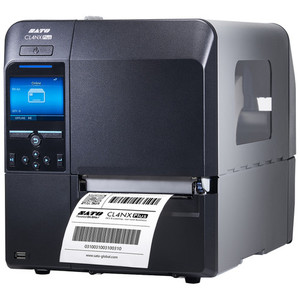
Sato WWCLP1001 CL4NX Plus 203dpi Industrial Thermal Printer
The Sato WWCLP1001 is a production-class thermal label printer built for high-volume warehouse, logistics, manufacturing, and healthcare environments where label throughput and barcode compliance directly impact operational cost. Rated at 203 dpi resolution and 14 inches per second (ips) print speed, the CL4NX Plus delivers sharp barcode and text output on media up to 4.09" wide—sufficient for standard 4x6 shipping labels, bin tags, healthcare specimen IDs, and work-in-progress tracking without requiring a larger footprint or higher per-unit cost.
Key Features
- 203 dpi at 14 ips throughput: This combination is the workhorse standard for industrial label printing. 203 dpi is sufficient for GS1 compliance and standard logistics barcodes (EAN-128, Code 128, QR); it avoids the storage licensing overhead, ribbon cost, and slower speeds of 300+ dpi systems unless photographic detail is required. At 14 ips, you print roughly 840 labels per hour on a 4x6 form—meaningful in multi-shift parcel or manufacturing operations.
- Dual thermal modes (Direct Thermal + Thermal Transfer): Eliminates the need for two separate printers. Deploy one WWCLP1001 for both permanent labels (transfer with ribbon) and temporary inventory tags (direct thermal, no ribbon). This reduces capital expenditure, electrical draw, and floor space—a direct cost advantage in facilities running parallel label types.
- 4.09" maximum print width: Covers standard 4x6 shipping labels, warehouse rack location tags, and healthcare specimen labels without oversizing. Media range accommodates 0.87" to 5.04" widths on 1" or 3" cores, so you're not locked into a single label format.
- 2 GB Flash, 256 MB SDRAM, 100 MB user storage: Store multiple label templates, fonts, and graphics locally. Form switching happens instantly without network round-trips—critical in multi-shift operations where changing between parcel, pallet, and hazmat labels must not stall production lines.
- 3.5" Full-Color LCD display: Real-time visibility of print status, supply levels, queue depth, and error codes. Eliminates guesswork and reduces paper waste from troubleshooting configuration errors on the fly.
- Tool-free printhead and platen roller replacement: Consumable swaps take seconds without wrenches or technician dispatch. Meaningful downtime reduction in 24/7 facilities where every minute of press idle time adds to shift labor cost.
- Media roll capacity up to 10" outer diameter; ribbon up to 1,968 ft: Longer intervals between roll changes reduce labor frequency and boost unattended press uptime in multi-shift operations.
- Multiple connectivity: USB 2.0, Ethernet, Wi-Fi, RS-232C, Parallel, Bluetooth 3.0, NFC: Integrates with legacy warehouse management systems (WMS) via serial or parallel, modern cloud-based systems via Ethernet or Wi-Fi, and mobile devices via Bluetooth or NFC for barcode-driven label pulling. No rip-and-replace required when migrating systems.
- Universal AC 100–240V, 50/60Hz power supply: Single power cord works across regions and facilities. No step-up transformer burden on warehouse circuit distribution.
Integration & Compatibility
The WWCLP1001 supports industry-standard printer control languages (ESC/P, ZPL emulation) and integrates with popular warehouse automation platforms via Ethernet and USB. Local form storage and NFC capability allow mobile device label triggers without network latency—useful in picking and packing workflows where label generation must respond in real time. Parallel and RS-232C ports ensure backward compatibility with legacy label-generation endpoints in manufacturing and healthcare settings.
When to Choose a Different Model
If your labels require photographic detail, barcode density beyond GS1 logistics standards, or print widths exceeding 5.04", consider a higher-resolution Sato variant in the CL4NX series. If you need slower speeds (under 10 ips) in a compact desktop form, explore the Sato FX or M-series alternatives. The WWCLP1001 is optimized for 203 dpi + 14 ips throughput; deviating from that combination typically means a different printer architecture is more cost-effective.
Frequently Asked Questions
Q: Does the Sato WWCLP1001 support mobile label generation?
A: Yes. Bluetooth 3.0 and NFC allow pairing with smartphones or tablets for barcode-driven label pulling. Store label templates locally on the printer, and mobile devices trigger prints without network round-trips.
Q: Can I use the WWCLP1001 in a legacy warehouse system?
A: Yes. RS-232C and Parallel ports ensure compatibility with older WMS endpoints. USB, Ethernet, and Wi-Fi support modern systems. No single upgrade path required.
Q: What is the typical lifespan of thermal printheads and platen rollers on the WWCLP1001?
A: Printhead life depends on media type and thermal transfer ribbon quality; typical replacement intervals are 500 million to 1 billion pixels. Platen roller replacement is routine maintenance and varies with label volume. Both are user-replaceable without tools.
Q: Does the WWCLP1001 work with popular cloud-based shipping platforms?
A: Yes. Ethernet and Wi-Fi connectivity, combined with ZPL emulation support, allow integration with ShipStation, Pitney Bowes, and similar cloud WMS platforms. ESC/P and standard printer control languages ensure compatibility.
Q: What media types and thicknesses does the WWCLP1001 support?
A: The WWCLP1001 supports paper, synthetic film, and fabric labels on 1" or 3" cores, up to 10" outer diameter. Both direct thermal and thermal transfer modes are supported. Consult the material compatibility datasheet for specific synthetic or specialty media.
Q: Is there a warranty or support plan available for the WWCLP1001?
A: Warranty details vary by region and reseller. Contact your supplier or authorized Sato distributor for specific support plans and coverage options.
Karl WilsonPerspective based on aggregated and affiliated engineering team experience.
The Sato WWCLP1001 is a solid choice if your operation needs to print both permanent (transfer-ribbon) and temporary (direct-thermal) labels from a single printer. The 203 dpi at 14 ips combination is neither fast nor fine-resolution—it's practical. For typical logistics and warehouse barcode work, 203 dpi is sufficient to clear GS1 scanners, and 14 ips means you're not waiting around for prints to finish. The dual thermal modes are the real win here: you avoid the capital and floor-space cost of running two separate printers.
Technical Highlights:
- 14 ips at 203 dpi: Rough throughput is 840 4x6 labels per hour. Acceptable for mid-volume parcel, pallet, or work-order labeling. If you're printing more than 2,000 labels per shift, you're in the right ballpark; beyond that, consider clustering multiple units or stepping up to a faster model.
- Dual thermal modes (Direct + Transfer): This eliminates a separate printer purchase and the operational complexity of managing two devices. One WWCLP1001 handles both permanent labels (with ribbon) and temporary tags (direct thermal, no ribbon cost). Real cost advantage in warehouses and manufacturing floors running mixed label types.
- 10" roll capacity and 1,968 ft ribbon: Longer intervals between roll and ribbon changes reduce labor frequency. In a 24/7 facility, even one fewer roll change per shift is a meaningful uptime gain.
- Multiple connectivity ports (USB, Ethernet, Wi-Fi, RS-232C, Parallel, Bluetooth, NFC): This flexibility is practical. Legacy WMS systems can use serial or parallel; new cloud platforms connect via Ethernet or Wi-Fi. Bluetooth and NFC allow mobile devices to trigger prints. No forced platform migration.
Deployment Considerations:
- Resolution ceiling: 203 dpi is a hard limit. If you ever need to print fine detail, photographic elements, or ultra-dense barcodes (Data Matrix 6mil or smaller), this printer won't deliver. Plan ahead—downgrading resolution is rare, upgrading is common.
- Print speed is moderate: 14 ips sounds fast until you're in a high-volume parcel center printing 5,000+ labels per shift. At that scale, you'll likely need multiple WWCLP1001 units or a faster model (Sato CL6NX or CL8NX). Do the math on label volume before committing.
- Ribbon and media cost: Dual thermal is flexible, but thermal transfer operations consume ribbon—track consumable spend in your TCO model. Direct thermal is cheaper per label but produces temporary output.
The WWCLP1001 is well-suited for mid-to-large 3PLs, parcel handlers, manufacturing work-order tracking, and healthcare specimen labeling where you need reasonable speed, dual thermal capability, and straightforward integration into existing warehouse systems. If you're a single-printer operation printing fewer than 500 labels per shift, a desktop model is likely more economical. If you're printing 10,000+ per shift, cluster multiple WWCLP1001 units or evaluate faster Sato variants in the CL-series.