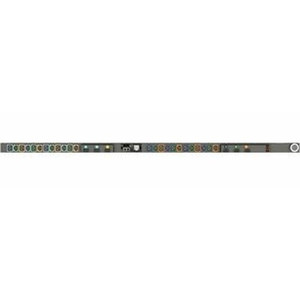
Vertiv VP7N50A1 Switched Outlet-Level Monitoring PDU, 50A 208V Three-Phase Vertical
Overview
The Vertiv VP7N50A1 is a 0U vertical rack PDU engineered for high-density data center deployments where per-outlet switching control and real-time power monitoring are non-negotiable. Rated at 50A / 208V delta three-phase and capable of delivering up to 14.4kW, this unit fits natively in standard cabinet side channels, keeping valuable rack units free for active equipment. With 36 C13 outlets and dual RJ-45 network ports, the VP7N50A1 is built for environments where uptime management, remote reboot capability, and granular energy data must coexist on a single managed network appliance.
Key Features
- Switched Outlet-Level Control (36 x C13): Every C13 outlet can be individually switched on, off, or sequenced remotely — critical for rebooting hung servers or networking gear without a physical hands-and-feet dispatch. In a 40+ cabinet row, that translates directly to reduced MTTR and lower after-hours labor costs.
- 50A / 208V Delta Three-Phase, 14.4kW Capacity: Three-phase input at 50A distributes load across phases, reducing the risk of single-phase overload that plagues single-phase designs in blade and high-density compute environments. At 14.4kW usable, this handles full-population high-density cabinets without stranding capacity.
- Current, Voltage, Power, and Temperature Monitoring: Real-time per-outlet and per-phase metering gives operations teams the data needed to balance loads proactively, catch trending overloads before they trip a breaker, and validate PUE calculations — functions that require separate hardware on non-monitored PDUs.
- Dual RJ-45 Ethernet Ports: Two network ports support daisy-chain or dual-path network connectivity. Daisy-chaining multiple PDUs through a single network drop reduces switch port consumption in densely populated rows.
- Enterprise Protocol Stack: SNMP v1/v2c/v3, HTTPS, SSH, LDAP, RADIUS, TACACS+, Modbus TCP, Syslog, and NTP are all supported natively. This means the PDU drops cleanly into existing DCIM, BMS, and SIEM workflows without middleware or protocol translators — a meaningful integration advantage over PDUs limited to SNMP v2 only.
- IPv4 and IPv6 Dual-Stack: Native IPv6 support future-proofs the management plane for organizations in the process of data center network modernization, where IPv4 management VLANs are being retired.
- 0U Vertical Form Factor with 3m Cable: The vertical orientation and 3-meter input cord give installers flexibility in cabinet positioning and input feed routing, reducing the need for expensive custom-length whips in most standard cabinet configurations.
- LED Display and Indicators: On-unit LED display surfaces circuit-level readings locally — useful during initial commissioning or when network access is unavailable during a maintenance window.
- USB Port: The onboard USB port supports firmware updates and local configuration tasks without requiring network access, simplifying maintenance in air-gapped or restricted-network environments.
- Reset Button: A hardware reset button provides a deterministic recovery path if the management firmware enters an unresponsive state — a practical failsafe that avoids a full power cycle of connected equipment just to recover the PDU controller.
Integration and Compatibility
The VP7N50A1 supports a broad network protocol set that aligns with enterprise DCIM and infrastructure management platforms. SNMP v3 with encryption satisfies most security operations requirements, while TACACS+ and RADIUS integration means authentication can be centrally managed through existing AAA infrastructure rather than per-device local accounts. Modbus TCP support enables integration with building management systems (BMS) and energy monitoring platforms that operate outside the traditional IT stack. The RSTP support prevents network loops in multi-PDU daisy-chain topologies. For organizations running NTP-synchronized event logging, the built-in NTP client ensures PDU timestamps align with SIEM and Syslog infrastructure — which matters when correlating a PDU event with a server alarm in post-incident analysis.
Frequently Asked Questions
Q: What input voltage does the VP7N50A1 require?
A: The VP7N50A1 accepts 200–240V AC input at 50/60 Hz, configured as 208V delta three-phase in this model. Verify your cabinet feed is three-phase 50A before installation.
Q: How many outlets does the VP7N50A1 provide, and what connector type?
A: It provides 36 C13 outlets. These are standard IEC 60320 C13 receptacles, compatible with C14 power cords used on most 1U/2U servers, network switches, and similar rack equipment.
Q: Can outlets be individually switched and scheduled remotely?
A: Yes. The VP7N50A1 is a switched outlet-level monitoring PDU, meaning each of the 36 outlets can be individually controlled (on/off/reboot/sequence) via the network management interface over HTTPS, SSH, or SNMP.
Q: What monitoring parameters are available per outlet?
A: The unit monitors current, voltage, power, and temperature. These readings are accessible via the onboard LED display locally and remotely via the dual RJ-45 network ports using supported protocols including SNMP v1/v2c/v3 and HTTPS.
Q: Does the VP7N50A1 support daisy-chaining multiple PDUs?
A: Yes. The dual RJ-45 Ethernet ports and built-in daisy-chain capability allow multiple PDUs to be networked together, reducing the number of switch ports required when managing a full cabinet row.
Q: What authentication and security protocols are supported?
A: The VP7N50A1 supports LDAP, RADIUS, and TACACS+ for centralized authentication, along with HTTPS and SSH for encrypted management sessions, and SNMP v3 for encrypted and authenticated SNMP communication.
The VP7N50A1 is one of the units I recommend when an operations team has outgrown basic monitored PDUs and needs genuine outlet-level switching at 50A three-phase scale. The 14.4kW capacity on a 208V delta feed means this handles a fully loaded high-density cabinet without load-balancing gymnastics, and having current, voltage, power, and temperature metering on the same appliance as the outlet switching eliminates a separate monitoring device from the BOM.
Technical Highlights:
- 36 Switched C13 Outlets: Per-outlet switching at this outlet count means one PDU can serve an entire high-density cabinet with individual reboot control — eliminating the need to split control between two PDUs or accept group-switched compromises.
- Dual RJ-45 with Daisy-Chain: In a 10-cabinet row, daisy-chaining cuts network switch port consumption from 10 to 2 or 3 — a real infrastructure simplification that matters when you're already at port density limits on your OOB management switch.
- Protocol Depth (TACACS+, RADIUS, SNMP v3, Modbus TCP): The combination of AAA protocol support and Modbus TCP is unusual at this price tier — it means the PDU can authenticate against your existing identity infrastructure AND feed energy data to a BMS without a separate integration layer.
Deployment Considerations:
- The 3m input cord covers most standard cabinet-to-PDU overhead busway or floor-mounted distribution configurations, but measure your run before ordering — custom-length input whips add lead time and cost if the 3m doesn't reach your feed point.
- The 36 outlets are all C13, which suits 1U/2U server and networking equipment well but won't directly serve C19-only high-current devices like some high-end storage arrays or large UPS bypass outputs — factor this into your outlet mix planning if the cabinet contains C19-only loads.
This unit is a strong fit for enterprise colocation build-outs and hyperscale edge deployments where the network operations team needs remote reboot capability, DCIM-ready metering, and AAA-integrated access control across every PDU in the row — all without deploying separate monitoring hardware per cabinet.