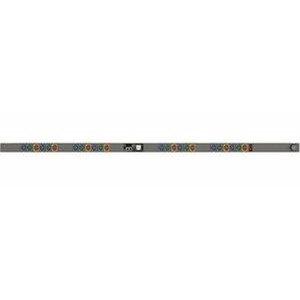
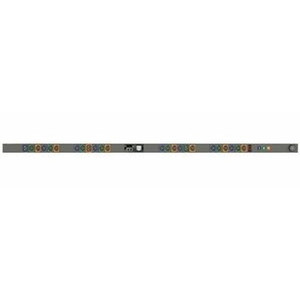
Vertiv VP7N20A1 Switched Outlet-Level Monitoring 3-Phase Vertical PDU
Overview
The Vertiv VP7N20A1 is a switched, outlet-level monitoring vertical PDU built for high-density data center and network room deployments where per-outlet visibility and remote control are operational requirements — not nice-to-haves. At 0U vertical form factor with a NEMA L21-20P three-phase input, the VP7N20A1 fits neatly into the rear of a standard rack without consuming rack unit space. It delivers 20A at 120/208V WYE (5.7kW total capacity) across 24 IEC C13 outlets, with dual Ethernet ports and a broad protocol stack that integrates cleanly into enterprise DCIM and BMS environments. If you're managing power density across a multi-rack row or deploying edge infrastructure that must stay up when you're not physically present, this is the class of PDU worth specifying.
Browse the full Vertiv power and infrastructure catalog or explore the broader selection of intelligent rack PDUs to compare models.
Key Features
- Switched Outlet-Level Control (24 × C13): Each of the 24 C13 outlets can be switched on, off, or rebooted independently via network — essential for remotely recovering locked-up 1U servers or cycling VoIP gateways without dispatching a tech. C13 covers virtually every standard 10A/15A IEC device: 1U servers, network switches, KVM units, and surveillance NVRs.
- Three-Phase 20A WYE Input (5.7kW): The L21-20P three-phase input balances load across all three legs, giving you up to 5.7kW total capacity without the neutral current buildup that plagues single-phase deployments at high load. For a rack loaded with dense 1U compute, this input topology is cleaner under real-world mixed loads than a single-phase 30A feed of equivalent wattage.
- Outlet-Level Current, Power, Voltage, and Temperature Monitoring: The VP7N20A1 monitors current, power, voltage, and temperature at the outlet level — not just the inlet. That granularity means you can identify which specific outlet is approaching its rated current before a breaker trips, rather than troubleshooting a dead rack after the fact. Temperature monitoring adds environmental awareness without requiring a separate sensor module on most configurations.
- Dual Ethernet (RJ-45) with Daisy Chain: Two RJ-45 network ports allow daisy-chaining multiple PDUs across a row with a single upstream network connection. This matters when you're running PDU network cabling to 10+ units in a dense deployment — you reduce switch port consumption and cable runs. Dual-port also supports failover-style topologies depending on firmware configuration.
- Protocol Depth — SNMP v1/v2c/v3, Modbus TCP, LDAP, RADIUS, TACACS+, and More: The VP7N20A1 speaks SNMP v1/v2c/v3 for integration into standard NMS platforms, Modbus TCP for BMS and SCADA environments, and enterprise auth protocols including LDAP, RADIUS, and TACACS+. IPv4 and IPv6 dual-stack support means it fits current-gen and legacy network segments without configuration gymnastics. HTTPS and SSH ensure management traffic stays encrypted in transit.
- Vertical 0U Mounting: The vertical form factor occupies zero rack units — it mounts in the rack's vertical rear channel, preserving every rack unit for revenue-generating compute and networking gear. For fully populated 42U racks, this distinction is the difference between fitting everything and needing another rack.
- LED Display and Indicators: An onboard LED display provides at-a-glance status without requiring a laptop or network connection — useful during initial provisioning or post-maintenance verification when the network may not yet be active. LED indicators supplement the display for quick pass/fail visual checks per outlet.
- USB Port for Local Management: The single USB port supports local access or firmware update paths depending on firmware capability — a small but meaningful option during commissioning or network-outage recovery scenarios where the in-band management interface is unavailable.
- 3-Meter Cord: The 3m (approximately 10-foot) power cord provides enough reach to route cleanly from the rack to a floor-level PDU tap or overhead busway without forcing unmanaged slack coils near live equipment.
Integration and Compatibility
The VP7N20A1 integrates into enterprise DCIM platforms via SNMP v1/v2c/v3 and Modbus TCP — the two dominant polling protocols in Vertiv's Trellis, Schneider EcoStruxure, and third-party DCIM environments. The protocol stack also includes Syslog for event forwarding to SIEM platforms, NTP for synchronized timestamps across PDU logs, and SMTP for direct alert emails without requiring an external management gateway. RSTP support on the dual Ethernet ports allows integration into ring-topology managed networks. Authentication integrates with LDAP directory services, RADIUS, and TACACS+ — which means you can enforce role-based access on outlet switching without maintaining a local credential database on each PDU unit. For network infrastructure environments that require auditable power events, the combination of SNMP traps, Syslog, and TACACS+ auth logging provides a defensible audit trail per NIST and SOC 2 control frameworks. Pair with compatible rack accessories for a complete power management stack. If you are planning a multi-PDU row deployment, review our rack power planning guide to size circuits and plan branch circuit protection correctly.
Frequently Asked Questions
Q: What input plug does the VP7N20A1 use, and what panel circuit does it require?
A: The VP7N20A1 uses a NEMA L21-20P plug, which is a three-phase locking connector rated for 20A at 120/208V WYE. It requires a dedicated three-phase 20A branch circuit from a WYE-configured distribution panel. Confirm your panel has a three-phase WYE output — not a delta configuration — before ordering.
Q: Can I control individual outlets remotely, or only the entire PDU?
A: Individual outlet-level control is a core feature of the VP7N20A1. Each of the 24 C13 outlets can be switched on, off, or power-cycled independently over the network via SNMP, HTTP/HTTPS, or SSH management interfaces.
Q: Does the VP7N20A1 support SNMP v3?
A: Yes. The VP7N20A1 supports SNMP v1, v2c, and v3. SNMP v3 adds authentication and encryption — relevant if your security policy requires encrypted SNMP polling rather than community-string-only v1/v2c access.
Q: What does the daisy chain feature actually mean for my rack row deployment?
A: Daisy chaining allows you to pass network connectivity from one VP7N20A1 to the next PDU in the row using the second Ethernet port, reducing the number of upstream switch ports and network patch cables required. In a 10-unit row, you could potentially run a single network drop to the first PDU and chain the rest, though actual topology depends on your network switch configuration and redundancy requirements.
Q: What authentication protocols are supported for PDU management access?
A: The VP7N20A1 supports LDAP, RADIUS, and TACACS+ for centralized authentication, allowing you to integrate PDU management access into your existing enterprise identity infrastructure rather than managing local credentials per device.
Q: What types of devices can plug into the 24 C13 outlets?
A: IEC C13 is the standard power inlet found on virtually all 1U rack servers, managed network switches, KVM extenders, and surveillance NVRs with external power bricks. Devices requiring C19 inlets (typically 16A+ high-draw servers) are not compatible — verify your device inlet type before specifying this PDU.
The VP7N20A1 is one of the configurations I recommend when a project calls for a fully switched three-phase vertical PDU with real outlet-level telemetry — specifically because the monitoring covers current, power, voltage, AND temperature per outlet rather than just inlet-level current, which is the limitation you run into with lower-tier monitored-only units. For dense rack deployments where you need both remote switching capability and granular load data, that distinction matters more than most buyers realize until they're troubleshooting an unexplained breaker trip at 2AM.
Technical Highlights:
- 24 × C13 Switched Outlets: Each outlet individually controllable — remote reboot of a locked server or cycling a malfunctioning NVR takes seconds from the management interface rather than a truck roll.
- Three-Phase WYE Input (L21-20P, 5.7kW): Balanced three-phase load distribution avoids the neutral current saturation that single-phase PDUs accumulate when loaded above 60-70% on mixed inductive/capacitive loads — a real-world problem in dense 1U server rows.
- Enterprise Auth Stack — LDAP, RADIUS, TACACS+: PDU management access plugs directly into your existing directory service; no per-unit local user management, and access events are loggable for audit compliance without a separate management overlay.
Deployment Considerations:
- Confirm your facility's distribution panel provides a three-phase WYE configuration before ordering — the L21-20P plug requires it, and a delta-configured panel is not compatible without a transformer.
- All 24 outlets are C13 (rated to 10A/15A per IEC standard). If any devices in the rack require C19 inlets — common on high-draw storage arrays or dual-PSU servers with 16A+ draw per supply — this PDU does not support those devices without a C19-to-C13 adapter, which introduces a derating risk.
This PDU is well-suited for colocation edge deployments and enterprise network rooms where three-phase power is available and the operations team needs per-outlet switching control integrated into an SNMP-based NMS or DCIM platform — not for single-phase PDU environments or deployments where C19 outlet density is a requirement.