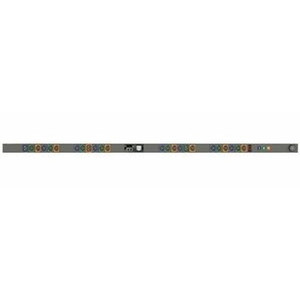
Vertiv VP7N20A0 Switched Outlet-Level Monitoring PDU, 20A 120/208V, 24-Outlet Vertical
Overview
The Vertiv VP7N20A0 is a 0U vertical rack PDU engineered for data center and server room environments where outlet-level power control and real-time monitoring are non-negotiable. Drawing up to 20A from a NEMA L21-20P three-phase input at 120/208V WYE, it delivers up to 5.7kW across 24 C13 outlets — giving you enough capacity for a fully loaded standard rack without a panel upgrade in most two-post or four-post deployments. The VP7N20A0 sits in the vertical 0U position along the rack rail, preserving every usable rack unit for revenue-generating equipment.
This is a switched PDU, meaning each outlet is independently controllable: you can power-cycle a hung server, sequentially power on equipment to limit inrush, or lock out outlets to prevent unauthorized connections — all remotely, without dispatching a technician to the floor. Pair that with outlet-level current, voltage, power, and temperature monitoring, and you have the data you need to catch overloads before they become outages.
Key Features
- 24 C13 Outlets with Per-Outlet Switching: 24 individually switched IEC C13 outlets cover the typical server, switch, and 1U appliance load. Per-outlet switching means a single stuck VM host doesn't require a cabinet visit — trigger the power cycle from your NMS or browser. C13 is the near-universal connector for 1U rack equipment, so no adapter chains cluttering your cable management.
- 20A / 5.7kW Three-Phase Input (NEMA L21-20P): The L21-20P plug connects to a standard 20A three-phase WYE circuit. At 5.7kW capacity, this unit handles a well-loaded 42U rack. If you're running blade chassis or high-density GPU nodes that push beyond 5.7kW, plan for a higher-amperage PDU instead — this model is sized for general-purpose compute density, not ultra-high-density HPC.
- Outlet-Level Current, Voltage, Power, and Temperature Monitoring: Monitoring at the outlet level — not just the input — lets you see exactly which load is drawing what. Catching a rogue process spinning up a server from 150W to 400W is straightforward when the data is per-outlet. Temperature monitoring at the unit helps correlate thermal events with load spikes during post-incident analysis.
- Dual RJ-45 Ethernet Ports for Network Redundancy or Daisy-Chaining: Two Ethernet ports let you either connect to two separate network segments for redundancy or daisy-chain multiple PDUs under a single IP address, reducing switch port consumption in large deployments. Daisy-chain support is confirmed, which matters when you're managing 10–20 PDUs per row.
- SNMP v1/v2c/v3 + Full Enterprise Protocol Stack: The protocol list here is genuinely comprehensive for a PDU: SNMP v1/v2c/v3, HTTPS, SSH, LDAP, RADIUS, TACACS+, Modbus TCP, Syslog, NTP, IPv4/IPv6, RSTP, and SMTP. SNMP v3 with auth/priv means this unit integrates cleanly into enterprise NMS platforms (SolarWinds, PRTG, Nagios, Zabbix) with encrypted, authenticated polling. LDAP/RADIUS/TACACS+ integration means you can enforce corporate directory credentials rather than managing local PDU accounts — critical for SOC 2 or PCI-DSS environments.
- LED Display for Local Status: The onboard LED display gives technicians immediate visual confirmation of operational status during physical inspections or cable work, without requiring a laptop or phone to check unit health on the floor.
- USB Port for Local Management or Firmware Updates: The single USB port supports local management access or firmware updates without requiring network connectivity — useful when commissioning a new rack before the network is live, or during an incident where network access to the PDU is unavailable.
- 3-Meter Power Cord: The 3m (approximately 10 ft) input cord provides enough reach from the PDU's vertical mounting position to the floor-level PDU or panel without requiring an extension or custom cord, covering standard 42U and 47U rack heights with room to route cleanly.
- IPv6 Native Support: Native IPv6 alongside IPv4 means the VP7N20A0 won't be a dead-end device when your data center transitions network addressing. No secondary proxy or adapter required — it participates directly in dual-stack environments today.
- Reset Button for Recovery: A hardware reset button provides a last-resort recovery path if the management firmware becomes unreachable over the network — avoids the need for a serial console connection or physical swap during recovery scenarios.
Integration and Compatibility
The VP7N20A0 integrates into standard data center infrastructure management (DCIM) and NMS platforms via SNMP v3 and Modbus TCP. SNMP v3 traps and polling work with any RFC-compliant NMS. Modbus TCP opens integration with building management systems (BMS) and SCADA environments — relevant if you're managing colocated or edge deployments that report into a facility-level monitoring layer.
Security integration via LDAP, RADIUS, and TACACS+ means this PDU fits inside an existing AAA framework without requiring standalone credential management. For organizations under PCI-DSS or HIPAA, TACACS+ logging of every administrative action satisfies audit trail requirements at the device level.
The dual Ethernet ports with RSTP support protect against network loops when daisy-chaining units, and the IPv4/IPv6 dual-stack removes addressing constraints in modern flat or segmented data center networks. Browse the full Vertiv power distribution lineup for higher-amperage and three-phase variants that complement this unit in mixed-density rows. For rack and enclosure pairing, vertical PDUs like the VP7N20A0 are designed to mount in the dedicated 0U side channels of open-frame and enclosed cabinets — confirm your rack's vertical PDU mounting kit compatibility before ordering.
Frequently Asked Questions
Q: What input plug does the VP7N20A0 use, and what circuit is required?
A: The VP7N20A0 uses a NEMA L21-20P input plug. It requires a 20A three-phase WYE circuit at 120/208V. Ensure your panel or floor PDU has a matching L21-20R receptacle before installation.
Q: Can the VP7N20A0 be managed via SNMP v3 with authentication and encryption?
A: Yes. The VP7N20A0 supports SNMP v1, v2c, and v3. SNMP v3 includes authentication and privacy (encryption) modes, making it suitable for enterprise NMS integration where secure, authenticated polling is required.
Q: Does the VP7N20A0 support integration with Active Directory or RADIUS for user authentication?
A: Yes. The unit supports LDAP, RADIUS, and TACACS+ for centralized authentication, allowing you to enforce corporate directory credentials and audit administrative access without managing local PDU accounts.
Q: How many PDUs can be daisy-chained together on the VP7N20A0?
A: The VP7N20A0 supports daisy-chaining via its dual RJ-45 Ethernet ports. Consult the Vertiv configuration guide for the maximum daisy-chain depth supported by the firmware version on your units.
Q: What outlet type does the VP7N20A0 provide, and is it compatible with standard 1U servers?
A: All 24 outlets are IEC C13 (the standard 3-pin receptacle used by virtually all 1U servers, switches, and rack appliances). Standard C14 power cords — shipped with most rack-mount equipment — plug directly into C13 outlets with no adapters required.
Q: Where does the VP7N20A0 mount in the rack?
A: The VP7N20A0 is a 0U vertical PDU, meaning it mounts in the side rail channel of the rack rather than occupying any rack units. This preserves all usable rack unit space for IT equipment. Verify that your rack cabinet includes vertical PDU mounting brackets or a 0U side channel before purchasing.
When I spec a PDU for a mixed-density data center row, the protocol stack is the first thing I look at — and the VP7N20A0 covers the full enterprise checklist. SNMP v3 with auth/priv, TACACS+, LDAP, RADIUS, Modbus TCP, Syslog: this unit integrates into a properly governed data center environment without requiring workarounds or protocol bridges. The outlet-level current, voltage, power, and temperature monitoring means your NMS gets granular load data per outlet, not just aggregate input readings.
Technical Highlights:
- Three-Phase 20A / 5.7kW Input: The NEMA L21-20P three-phase WYE input at 120/208V delivers 5.7kW total — appropriate for a standard-density 42U compute rack. The three-phase distribution flattens per-leg loading compared to single-phase alternatives at the same amperage.
- 24 Switched C13 Outlets: Per-outlet switching via the VP7N20A0 eliminates technician dispatches for power cycles and enables sequenced power-on to control inrush current during rack restart events — a real operational benefit in lights-out or remotely managed facilities.
- Dual Ethernet with Daisy-Chain + RSTP: Two RJ-45 ports with daisy-chain support and RSTP loop protection let you manage multiple PDUs under a single IP while keeping the management network topology clean. This directly reduces switch port consumption in high-PDU-count environments.
Deployment Considerations:
- The NEMA L21-20P plug requires a matching 20A three-phase WYE receptacle at the panel or floor PDU — confirm circuit availability before the rack ships. Mismatched receptacles are the most common pre-installation oversight on three-phase PDU deployments.
- All 24 outlets are C13, which handles up to 10A per outlet. If your rack includes any C19-input devices (high-draw PDUs, some UPS battery modules, or larger server PSUs rated above 10A per feed), you will need a separate PDU with C19 outlets for those loads — this unit does not provide C19 outlets.
The VP7N20A0 is the right specification for standard-density compute rows in enterprise data centers and colocation environments where TACACS+/RADIUS authentication, SNMP v3 polling, and per-outlet power control are required by security policy or compliance frameworks. It is not the right unit for ultra-high-density GPU or blade chassis rows that exceed 5.7kW per rack — step up to a higher-amperage three-phase Vertiv model for those deployments.