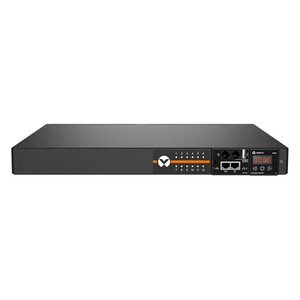
Vertiv VP4N20A1 Monitored 3-Phase Vertical PDU — 20A, 120/208V WYE, 5.7kW
The Vertiv VP4N20A1 is a vertical, rack-mount monitored power distribution unit built for dense data center and server room deployments where three-phase power delivery, per-outlet locking, and enterprise-grade remote monitoring all need to coexist in a single 0U chassis. Running on a NEMA L21-20P input plug at up to 20A across a 120/208V WYE configuration, it delivers 5.7kW of usable power — enough headroom for a fully populated 42U rack without pushing into derating territory on most three-phase panels. If you're speccing PDUs for a new cage build or refreshing aging strips in an existing deployment, the VP4N20A1 belongs on the short list.
Key Features
- 41 AC Outlets with 33 Locking C13 Positions: The locking C13 format physically secures power cords to the outlet — no accidental disconnects during cable management work or vibration in high-density environments. With 41 total outlet positions on a vertical chassis, a single VP4N20A1 can serve an entire rack column without requiring horizontal PDU shelves that eat valuable U-space.
- Three-Phase Input via NEMA L21-20P: Three-phase WYE distribution across the outlet bank balances load naturally across phases A, B, and C. Compared to single-phase PDUs at equivalent amperage ratings, you get more usable capacity before hitting breaker limits — important in high-density compute rows where per-rack power draw routinely exceeds 8–10kW.
- Unit-Level Monitoring — Current, Power, and Voltage: The VP4N20A1 reports real-time current (amps), true power (watts), and voltage at the unit level. This isn't outlet-level granularity, but for racks where you need aggregate load visibility without the cost of switched/metered-at-outlet models, it hits the right balance. DCIM tools polling via SNMP get actionable capacity data without per-outlet overhead.
- SNMP v1/v2c/v3 Plus Full Enterprise Protocol Stack: The protocol list — SNMP (all three versions), HTTPS, SSH, LDAP, RADIUS, TACACS+, NTP, Syslog, Modbus TCP, RSTP, SMTP — means the VP4N20A1 integrates cleanly into enterprise monitoring stacks (SolarWinds, Nagios, PRTG, Vertiv's own Trellis) without custom middleware. TACACS+ and RADIUS handle AAA centrally so you're not managing local credentials on every PDU in the cage.
- Dual RJ-45 Ethernet Ports: Two network ports support daisy-chain networking across multiple PDUs on a single network drop, reducing switch port consumption in the cabinet. A single structured cable from the top-of-rack switch can serve the entire PDU chain rather than home-running individual drops to each unit.
- Daisy Chain Support: Confirmed daisy chain capability means you can string multiple VP4N20A1 units together and manage them as a logical group — critical for multi-PDU-per-rack topologies common in high-density GPU or storage arrays.
- LED Display and Indicators: The onboard LED display gives local at-a-glance load readings without needing a laptop or console connection. In a colocation environment where remote-hands staff need to read power draw without touching the management network, this matters.
- 3-Meter Input Cord: The 3m (approximately 10-foot) power cord reaches floor-mounted or overhead busway connections typical in raised-floor data centers without requiring cord extensions or custom lengths on most standard rack layouts.
- Reset Button: A hardware reset button lets facilities staff recover a locked-up controller without cycling the entire PDU's power — maintaining uptime on connected equipment while restoring management access.
- IPv4 and IPv6 Dual-Stack: Native IPv6 support future-proofs the management plane for environments already transitioning away from IPv4-only infrastructure, or for co-location facilities operating dual-stack networks.
- USB Port: The single USB port supports firmware updates or local configuration uploads without requiring network access — useful during initial commissioning in facilities that lock down management VLANs until after the PDU is baselined.
- 50/60 Hz Input Frequency: Wide frequency acceptance covers both North American 60 Hz and international 50 Hz grid inputs — relevant for deployments in edge sites or international facilities using the same PDU SKU across regions.
Integration and Compatibility
The VP4N20A1 integrates with standard DCIM and infrastructure management platforms via SNMP (v1/v2c/v3) and Modbus TCP. SNMP traps can be directed to any network management system supporting those versions — no proprietary agent required. The SMTP and Syslog support routes alerts directly into existing event management workflows. LDAP integration connects user authentication to Active Directory or OpenLDAP, while RADIUS and TACACS+ provide AAA for environments with centralized access control policies. RSTP (Rapid Spanning Tree Protocol) on the network interface prevents loops in daisy-chain topologies. For Vertiv-native management, the unit is compatible with the Vertiv Trellis platform and the Geist Watchdog infrastructure monitoring ecosystem.
The NEMA L21-20P input requires a matching three-phase 20A receptacle or PDU whip at the power source — confirm your panel or busway termination before ordering. C13 locking outlets are compatible with standard IEC C14 power supply plugs; the locking mechanism engages with cords that have a compatible latch tab. Standard IEC C14 cords without locking tabs will plug in but won't lock mechanically.
Frequently Asked Questions
Q: What input plug type does the VP4N20A1 use, and what panel or busway connection does it require?
A: The VP4N20A1 uses a NEMA L21-20P input plug — a three-phase 20A locking connector. Your power source (PDU whip, floor PDU, or busway tap) must provide a matching L21-20R receptacle at 120/208V WYE, 20A.
Q: Does the VP4N20A1 provide outlet-level power monitoring, or only unit-level?
A: The VP4N20A1 monitors at the unit level — reporting aggregate current, power, and voltage for the entire PDU. It does not provide per-outlet metering. If per-outlet load visibility is required, consider a switched or metered-at-outlet model in the Vertiv Geist lineup.
Q: Can multiple VP4N20A1 units share a single network port on my rack switch?
A: Yes. The VP4N20A1 has two RJ-45 Ethernet ports and supports daisy chaining, allowing multiple units to share a single upstream network connection. Each PDU in the chain maintains its own management address and is independently accessible.
Q: Which authentication protocols does the VP4N20A1 support for user access control?
A: The VP4N20A1 supports LDAP, RADIUS, and TACACS+ for centralized authentication and authorization — all three are enterprise-standard AAA protocols. Local user accounts are also supported, managed via HTTPS or SSH CLI.
Q: Are the C13 outlets compatible with standard IEC C14 server power cords?
A: Yes, standard IEC C14 plugs fit the C13 outlets. The locking mechanism on the 33 locking positions engages with power cords that have a compatible locking tab; cords without locking tabs will seat normally but will not lock mechanically.
Q: Does the VP4N20A1 support firmware updates in the field?
A: Yes. The USB port on the unit supports local firmware updates and configuration uploads, allowing you to update or recover the controller without requiring management network access — useful during initial commissioning or recovery scenarios.
The VP4N20A1 is the PDU I'd specify for a high-density three-phase rack deployment where you need enterprise AAA integration but don't want to pay for per-outlet switching you won't use. The NEMA L21-20P input and 120/208V WYE, 5.7kW rating are the right match for standard three-phase whip distributions in raised-floor colo and enterprise data centers — and 41 outlets on a vertical 0U form factor means you're not burning U-space on horizontal power strips.
Technical Highlights:
- 33 Locking C13 Outlets: Locking connectors eliminate the most common cause of unplanned outages in dense racks — accidental cord pull. In any environment where multiple technicians work the same cabinet, this is worth the small cord-compatibility check upfront.
- SNMP v1/v2c/v3 + Modbus TCP: You can poll this unit from any major NMS (SolarWinds, PRTG, Nagios) or BMS without an intermediate gateway. Modbus TCP is increasingly relevant for facilities teams integrating PDU data into building automation systems alongside CRAC and UPS telemetry.
- Dual RJ-45 with Daisy Chain: Two Ethernet ports mean one network drop from your TOR switch can serve a multi-PDU column. In a 48-port TOR environment serving 20+ racks, this cuts structured cabling runs and switch port allocation meaningfully.
Deployment Considerations:
- Confirm L21-20R receptacle availability at your power source before deployment — NEMA L21-20P is standard in three-phase colo but not universal in all enterprise data center builds. Some facilities still run L6-30 or CS8265C whips and will need a new circuit or adapter.
- Unit-level monitoring only: if your capacity planning requires per-server or per-blade power draw, this model won't give you that — step up to a metered-at-outlet variant. The VP4N20A1 is the right pick when you're tracking rack-level load, not per-device billing.
The VP4N20A1 is well-suited for three-phase colocation cage buildouts and enterprise raised-floor data centers where per-rack aggregate monitoring, enterprise AAA, and locking outlet security are the primary requirements — and where budget discipline argues against per-outlet metering overhead you don't actually need.