Vertiv VP6N30AE Monitored Outlet-Level 3-Phase Vertical PDU
Overview
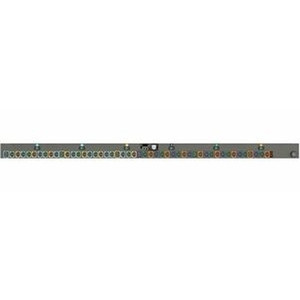
The Vertiv VP6N30AE is a 0U vertical rack PDU engineered for high-density data center and server room deployments where three-phase power distribution and per-outlet-level monitoring are non-negotiable. Running on a 30A NEMA L22-30P input at 200–240V / 346–415V WYE, it delivers up to 17.2KW of capacity across 36 C13 outlets — enough headroom to feed a fully loaded high-density compute rack without provisioning a second PDU. If you're sizing power infrastructure for rack power distribution, the VP6N30AE sits squarely in the monitored, outlet-level tier of the Vertiv power catalog.
Key Features
- Three-Phase 30A Input at 17.2KW: The NEMA L22-30P plug feeds a 200–240 / 346–415V WYE circuit, distributing load across three phases. That phase-balancing means you can fill a rack with GPU nodes or storage arrays without spiking a single leg — a real benefit when your facility's breakers are already near capacity.
- 36 C13 Outlets with Outlet-Level Monitoring: Each outlet is individually monitored for current, power, voltage, and temperature. Outlet-level visibility lets you pinpoint which device is drawing abnormal current without pulling cabling or guessing — particularly useful during incident response in a live rack.
- Dual RJ-45 Ethernet Ports: Two 10/100 Ethernet ports support daisy-chaining multiple PDUs on a single network drop. In a multi-PDU cabinet row, this keeps switch port consumption manageable and simplifies topology for facilities teams.
- Daisy-Chain Capable: The onboard daisy-chain support means you can network several PDUs together rather than running dedicated infrastructure to each unit — reduces both switch port count and cable runs in high-PDU-density deployments.
- Comprehensive Protocol Stack: SNMP v1/v2c/v3, HTTPS, SSH, LDAP, RADIUS, TACACS+, Modbus TCP, SMTP, Syslog, NTP, RSTP, IPv4/IPv6, and DHCP are all supported. That breadth covers integration with virtually any DCIM platform, SIEM system, or enterprise authentication infrastructure without custom middleware.
- SNMP v3 and RADIUS/TACACS+ Authentication: Enterprise authentication protocols mean the PDU slots into existing AAA infrastructure rather than requiring a parallel credential silo — important for SOC 2 and ISO 27001 environments where access governance audits cover every networked device.
- LED Display and Indicators: The onboard LED display provides at-a-glance load and status readout without requiring a network connection or laptop — useful during commissioning and physical audits when you need immediate local confirmation.
- USB Port for Local Management: The single USB port enables local firmware updates and configuration without needing network access — reduces the risk window during maintenance by keeping management off-band.
- 0U Vertical Form Factor with 3m Power Cord: Zero rack unit consumption means the PDU mounts vertically in the cabinet's side channel, preserving all rack U space for compute. The 3-meter cord reaches most standard floor-to-cabinet power runs without requiring an extension.
- Reset Button: Hardware reset capability without requiring physical PDU removal or remote access — essential for recovery scenarios where the management network itself is unavailable.
Integration and Compatibility
The VP6N30AE's protocol stack is deliberately broad. Modbus TCP integration supports DCIM platforms and BMS systems that don't natively speak SNMP. RSTP (Rapid Spanning Tree Protocol) handles network loop prevention when PDUs are daisy-chained across a cabinet row. IPv6 support future-proofs the unit for networks that have already migrated or are mid-transition. LDAP, RADIUS, and TACACS+ integration means user authentication can be centrally managed rather than locally maintained on each PDU — a meaningful operational simplification when you're managing dozens of units across multiple racks.
For facilities running a managed network infrastructure, the dual Ethernet ports and daisy-chain support reduce switch port consumption across multi-PDU cabinet deployments. Pair with a compatible UPS system upstream to complete the power chain from utility to outlet. For guidance on sizing PDU capacity against rack load requirements, consult a PDU selection guide before specifying input circuit capacity.
Frequently Asked Questions
Q: What input plug type does the VP6N30AE use?
A: The VP6N30AE uses a NEMA L22-30P input plug, rated for 30A at 200–240V / 346–415V WYE three-phase.
Q: How many outlets does the VP6N30AE have, and what type are they?
A: It has 36 outlets, all IEC C13 type — standard for 1U and 2U servers, storage arrays, and networking gear.
Q: Does the VP6N30AE support per-outlet monitoring or only inlet-level monitoring?
A: The VP6N30AE provides outlet-level monitoring, tracking current, power, voltage, and temperature at each individual outlet — not just at the inlet.
Q: Can multiple VP6N30AE units be networked together without using multiple switch ports?
A: Yes. The dual RJ-45 Ethernet ports support daisy-chaining, so multiple PDUs in a cabinet row can share a single upstream switch port.
Q: What network protocols does the VP6N30AE support for DCIM and enterprise integration?
A: Supported protocols include SNMP v1/v2c/v3, HTTPS, SSH, HTTP, LDAP, RADIUS, TACACS+, Modbus TCP, SMTP, Syslog, NTP, RSTP, IPv4, IPv6, and DHCP.
Q: What is the rack mounting orientation of the VP6N30AE?
A: The VP6N30AE is a 0U vertical PDU, designed to mount in the side channel of a standard rack cabinet, consuming no rack unit space.
The VP6N30AE is a unit I'd specify specifically for high-density three-phase deployments where outlet-level accountability matters — think GPU compute rows, hyperconverged clusters, or any rack where you're tracking individual device power consumption for chargeback or capacity planning. The 30A / 17.2KW input with 36 C13 outlets at 200–415V WYE is a strong match for international data centers or US facilities running 415V three-phase distribution.
Technical Highlights:
- Outlet-Level Monitoring (Current, Power, Voltage, Temp): Four parameters per outlet means you can trend individual device loads over time — not just react to tripped breakers. That granularity is what separates a monitored PDU from a basic metered one when your ops team needs to justify rack refresh cycles.
- SNMP v3 + RADIUS/TACACS+ Auth: SNMPv3 with authentication and encryption plus RADIUS/TACACS+ integration satisfies most enterprise security policies without requiring a workaround. Every networked PDU is a credential surface — these protocols close that exposure.
- Daisy-Chain via Dual RJ-45: Two Ethernet ports with daisy-chain support means a 4- or 6-PDU cabinet row consumes one switch port, not six. At scale across a data hall, that's a meaningful reduction in edge switching infrastructure.
Deployment Considerations:
- The NEMA L22-30P plug requires a matching 30A three-phase WYE receptacle at the PDU whip — confirm your facility's power distribution panel and floor PDPs are wired accordingly before ordering. This is not a standard US single-phase receptacle.
- The 3-meter cord length suits most standard cabinet depths and raised-floor configurations, but measure your floor-to-cabinet run before assuming it reaches without extension — especially in non-raised-floor deployments where the whip travels horizontally before dropping to the cabinet.
For a high-density compute row in a colocation or enterprise data center running international three-phase distribution at 415V WYE, the VP6N30AE covers outlet-level visibility, enterprise auth, and DCIM protocol depth in a single 0U vertical unit — a practical fit where per-device power accountability is an operational requirement, not a nice-to-have.