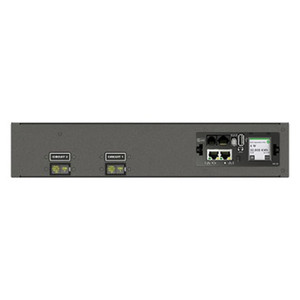
Vertiv VP7N30AS Switched Outlet-Level Monitoring PDU, 3-Phase 30A 240/415V
Overview
The Vertiv VP7N30AS is a vertical, 0U three-phase switched PDU rated for 30A at 200–415V WYE (17.2kW), built for high-density data center racks where per-outlet power control and real-time monitoring are non-negotiable. With 36 outlets split across C13 and C19 receptacles and dual RJ-45 management ports, the VP7N30AS gives operators visibility down to the individual socket level — so you can cycle a misbehaving server without touching anything else in the rack.
The switched outlet design means remote power cycling is available per-outlet via the onboard management interface, not just per-PDU. That distinction matters when you are managing a dense row of blade servers or storage arrays where a single stuck device can otherwise require hands-on access in a remote colocation cage.
Key Features
- 36 Outlets — C13 and C19 Mix: The combination of IEC C13 (typically 10A max) and C19 (typically 16A max) receptacles means this PDU accommodates both standard 1U and 2U servers and high-draw storage or network equipment on the same strip — eliminating the need for a second PDU to handle heavy loads in the same rack.
- 30A / 17.2kW at 200–415V WYE: Three-phase input at up to 415V WYE makes the VP7N30AS compatible with international three-phase distribution found in European and APAC data centers, as well as US 208V WYE deployments. At 17.2kW total capacity, this covers the power envelope of most fully-loaded high-density racks without requiring an oversized circuit.
- Per-Outlet Switching: Each of the 36 outlets can be switched on, off, or power-cycled independently through the management interface. For NOC teams managing remote sites, this eliminates costly truck rolls to simply reboot an unresponsive device — the payback on that capability alone often justifies the premium over a monitored-only PDU.
- Per-Outlet Monitoring — Current, Power, and Voltage: Real-time measurement at every outlet, not just at the inlet, lets you identify which specific server or device is drawing unexpectedly high current. This granularity supports capacity planning, identifies rogue loads before they trip a circuit breaker, and provides audit-ready power consumption records per device.
- Dual RJ-45 Ethernet Ports with Daisy Chain: Two Ethernet management ports support network redundancy or daisy-chaining multiple PDUs on a single IP address — reducing switch port consumption in rack deployments with several PDUs per row. DHCP, IPv4, IPv6, and VLAN-compatible protocols are all supported out of the box.
- SNMP v1/v2c/v3 + Modbus TCP: SNMP v3 provides authenticated and encrypted management traffic — a meaningful security upgrade over v1/v2c in shared-management-network environments. Modbus TCP support enables integration with building management systems (BMS) and DCIM platforms that use industrial protocols, which is increasingly common in hyperscale and enterprise data centers.
- Enterprise Authentication — LDAP, RADIUS, TACACS+: Native support for enterprise identity providers means PDU access can be centrally managed through Active Directory or RADIUS servers. Role-based access control via these protocols keeps audit trails clean and eliminates shared local credentials on individual units.
- SSH + HTTPS Management with Syslog: All management traffic can run over encrypted channels (SSH CLI, HTTPS web interface). Syslog output means PDU events — outlet state changes, current alarms, authentication attempts — feed directly into your SIEM or centralized log management without custom integrations.
- LCD Display with LED Indicators: The onboard LCD provides at-a-glance load status without requiring a laptop or network connection, which matters during initial commissioning or when the management network is unreachable. LED indicators add a secondary visual cue for outlet state.
- 3-Meter Input Cable: The 3m (approximately 10 ft) input cable provides enough reach from the floor-level power strip to the top of a standard 42U or 47U rack without requiring a cable extension — a practical detail that matters in tight hot-aisle/cold-aisle rows.
- 0U Vertical Mounting: The vertical, zero-U form factor mounts in the side channel of a standard open-frame or enclosed rack, preserving every rack unit for compute and storage. In fully-loaded racks this is not optional — it is the only way to get PDU functionality without sacrificing 1–2U of revenue-generating density.
- Reset Button + NTP / SMTP Alerting: A physical reset button enables recovery from a locked management controller without pulling the PDU from the rack. NTP synchronization ensures all timestamped power events are accurate for incident correlation, and SMTP support sends email alerts on threshold violations without requiring a separate monitoring agent.
Integration and Compatibility
The VP7N30AS supports SNMP v1/v2c/v3, Modbus TCP, HTTP/HTTPS, and SSH — the four protocols covering the widest range of PDU management platforms and DCIM tools in enterprise deployments. LDAP, RADIUS, and TACACS+ integration means the PDU slots into existing enterprise identity infrastructure without creating a separate credential silo. The daisy-chain capability on the dual RJ-45 ports is particularly useful in row-based deployments where reducing per-PDU IP address and switch port consumption is a design requirement.
For teams running Vertiv infrastructure management platforms, the VP7N30AS is designed to integrate natively within that ecosystem. The Modbus TCP support also opens a path to BMS integration for facilities teams tracking power consumption at the rack level alongside mechanical systems.
The 50/60 Hz input frequency compatibility and 200–415V input range mean this PDU is deployable across North American, European, and APAC power infrastructure — useful for organizations standardizing on a single PDU model across global data center footprints. Consult your power distribution design against local circuit specifications before ordering: confirm your feed is WYE-configured at the appropriate voltage and that your branch circuit breaker matches the 30A rating.
Frequently Asked Questions
Q: What outlet types does the VP7N30AS provide, and how many of each?
A: The VP7N30AS provides 36 total outlets in a mix of IEC C13 and C19 receptacles. C13 outlets suit standard servers and networking equipment; C19 outlets handle higher-draw devices such as high-density storage arrays. The exact C13/C19 split should be confirmed against the manufacturer's full specification sheet for the VP7N30AS.
Q: Can I remotely power-cycle individual outlets on the VP7N30AS?
A: Yes. The VP7N30AS is a switched PDU, meaning each of its 36 outlets can be individually switched on, off, or power-cycled via the web interface, SSH CLI, or SNMP — without affecting other outlets on the same strip.
Q: What three-phase input voltages does the VP7N30AS support?
A: The VP7N30AS accepts three-phase WYE input from 200V to 415V at 50 or 60 Hz, with a maximum current of 30A and a rated capacity of 17.2kW. This covers US 208V WYE and international 240/415V WYE distribution.
Q: Does the VP7N30AS support enterprise authentication methods like Active Directory?
A: Yes. The VP7N30AS supports LDAP, RADIUS, and TACACS+ authentication, enabling integration with Active Directory and other enterprise identity providers for centralized, role-based access control across PDU management.
Q: How does the daisy chain feature work on the VP7N30AS?
A: The VP7N30AS includes two Ethernet RJ-45 management ports that support daisy-chaining — allowing multiple PDUs to share a single IP address and network switch port. This reduces cabling complexity and switch port consumption in multi-PDU row deployments.
Q: What monitoring parameters does the VP7N30AS measure?
A: The VP7N30AS monitors current, power, and voltage at the per-outlet level — not just at the PDU inlet. This enables device-level power accounting and early detection of abnormal load conditions on individual servers or storage units.
The VP7N30AS is one of the few vertical switched PDUs in Vertiv's lineup that hits the 30A / 17.2kW mark on a three-phase WYE input while simultaneously supporting per-outlet monitoring and switching across all 36 receptacles — that combination is what makes it worth specifying over a cheaper monitored-only unit in environments where remote reboot capability is operationally critical.
Technical Highlights:
- Per-Outlet Switching at Scale: All 36 outlets — both C13 and C19 — are individually switched, not just monitored. At 17.2kW total capacity, this covers a densely loaded rack while keeping NOC teams out of the data hall for routine reboots.
- SNMP v3 with LDAP/RADIUS/TACACS+: SNMP v3's encrypted and authenticated sessions paired with enterprise directory integration means this PDU meets most enterprise security baseline requirements without additional configuration overhead — a real differentiator versus PDUs that ship with only v1/v2c and local user databases.
- 200–415V WYE Input Range: The broad input range is the spec that makes this unit genuinely dual-use for organizations running mixed US 208V and international 415V infrastructure — one SKU for both environments simplifies procurement and spare-parts logistics.
Deployment Considerations:
- The 3-meter input cable works for most standard rack depths and floor-level PDU tap-off arrangements, but measure your actual cable path before assuming it reaches — in contained hot-aisle configurations with overhead busway, 3m can be tight depending on tap position.
- The daisy chain feature conserves switch ports, but introduces a single point of failure for PDU management across the chain if the upstream PDU's management controller locks up — plan your daisy chain topology accordingly and keep the reset button accessible on the lead unit.
The VP7N30AS is the right specification for colocation providers and enterprise IT teams deploying high-density three-phase racks in international or mixed-voltage data centers where remote outlet-level control is a hard operational requirement, not a nice-to-have.