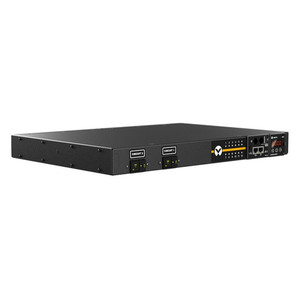
Vertiv VP7N31A5 Switched Outlet-Level Monitoring rPDU, 3-Phase, 30A, 240/415V, 17.2kW Horizontal
Overview
The Vertiv VP7N31A5 is a three-phase, horizontally mounted rack PDU engineered for dense data center and enterprise server room deployments where per-outlet power control and metering are non-negotiable. Rated at 30A input and capable of delivering up to 17.2kW at 200–240V single-phase or 346–415V WYE three-phase, the VP7N31A5 gives facilities teams granular visibility — current, voltage, and power — at every outlet, not just at the unit level. That distinction matters when you're troubleshooting an overloaded circuit at 2 a.m. or trying to validate power draw per server for capacity planning.
Explore the full Vertiv power distribution lineup for complementary rPDU models across capacity and form-factor options.
Key Features
- Switched Outlet-Level Control (12 Outlets, C13 + C19): Each of the 12 outlets — a mix of C13 couplers for 1U servers and C19 couplers for high-draw devices — can be switched on or off individually via software. That means remote power cycling without a hands-on visit to the rack. In a colocation environment or a remote edge site, that's the difference between a 5-minute fix and a costly truck roll.
- Per-Outlet Monitoring — Current, Voltage, Power: Unlike basic metered PDUs that report only aggregate inlet readings, the VP7N31A5 delivers current, voltage, and power measurements at each outlet. When you need to track per-server power consumption for chargeback, SLA reporting, or energy audits, outlet-level data is the only source of truth.
- 17.2kW at 30A Three-Phase Input: Three-phase 30A input at 240/415V WYE handles high-density compute loads — GPU servers, high-core-count blades, or storage arrays — without requiring separate single-phase feeds for each device. Matching the PDU to your facility's three-phase panel distribution simplifies cabling and keeps your UPS topology clean.
- LCD Display: The onboard LCD provides local readout of load status without requiring a network connection or laptop. Useful during initial commissioning or in environments where SNMP access hasn't been provisioned yet.
- Broad Protocol Suite — SNMP v1/v2c/v3, HTTPS, SSH, LDAP, RADIUS, TACACS+, Modbus TCP: SNMP v3 with authentication and encryption integrates natively into enterprise DCIM platforms and NMS tools (SolarWinds, PRTG, Nagios, and others). LDAP, RADIUS, and TACACS+ mean you can enforce role-based access without managing local accounts on each PDU — essential when you have dozens of units across multiple racks. Modbus TCP extends integration to building management systems (BMS) without a separate gateway.
- IPv4 and IPv6 Dual-Stack with NTP, SMTP, Syslog: IPv6 readiness protects against address exhaustion in larger deployments. NTP sync keeps time-stamps on power events accurate for log correlation. SMTP alerting pushes threshold alarms directly to your ops team — no polling required. Syslog export feeds your SIEM for compliance and audit trails.
- 3m Input Cable: The 3-meter whip gives enough reach to route cleanly to the top or bottom of a rack without extensions, accommodating both top-of-rack and bottom-of-rack power panel configurations.
- 1x RJ-45 Ethernet, 1x USB, 1x Serial Port: The RJ-45 port is your primary management interface. The USB port supports local configuration or firmware update without network access — practical when the PDU is being staged before deployment. The serial port enables out-of-band management from a console server, so the PDU remains accessible even when the IP network is down.
- Horizontal 0U Mounting: Designed to mount horizontally in the rack without consuming valuable rack unit space. In a fully populated 42U cabinet, every U counts — a horizontal form factor keeps all 42U available for revenue-generating compute.
Integration & Compatibility
The VP7N31A5 fits into existing rack power distribution architectures with minimal friction. SNMP v1/v2c/v3 support covers legacy NMS platforms and modern DCIM tools alike. Modbus TCP compatibility extends to BMS integrations common in colocation and enterprise facilities. RSTP (Rapid Spanning Tree Protocol) network support indicates the management controller handles redundant network topologies correctly — relevant if your out-of-band management network uses ring or meshed switching. DHCP and static IPv4/IPv6 addressing are both supported, accommodating both dynamic lab environments and rigidly structured production networks where static IP assignment is policy.
For high-availability deployments, pair the VP7N31A5 with a compatible UPS system upstream to ensure the PDU's switching capability remains available during utility events. Review your power distribution planning guide to size input circuits correctly for 30A three-phase loads — derate to 80% (24A continuous) per NEC guidelines before calculating per-outlet allocations.
Input frequency acceptance at both 50Hz and 60Hz means this unit deploys globally without a separate SKU for European or Asia-Pacific facilities running 50Hz grids — a genuine operational simplification for multi-region data center operators.
Frequently Asked Questions
Q: What is the maximum continuous load the VP7N31A5 should carry?
A: The VP7N31A5 is rated at 30A maximum input current. Per standard electrical practice (NEC 80% continuous load rule), plan for a maximum continuous draw of 24A on the input circuit. Per-outlet allocations should be budgeted accordingly against this derating.
Q: Does the VP7N31A5 support SNMP v3 with encryption?
A: Yes. The VP7N31A5 supports SNMP v1, v2c, and v3. SNMP v3 includes authentication and privacy (encryption) options, making it suitable for environments with network security policies that prohibit unencrypted management protocols.
Q: Can I manage the VP7N31A5 if the IP network is unavailable?
A: Yes. The unit includes a serial port for out-of-band console access via a console server, and the onboard LCD display provides local load readout without any network connection. The USB port also supports local configuration and firmware updates.
Q: What outlet types are included and how many of each?
A: The VP7N31A5 provides 12 total AC outlets combining C13 and C19 coupler types. C13 outlets support standard IEC-connected 1U/2U servers; C19 outlets handle higher-draw devices such as high-density blade chassis or large storage arrays. The exact per-type count is not specified in available documentation — verify with the manufacturer's current datasheet for the precise C13/C19 split.
Q: Is the VP7N31A5 compatible with building management systems (BMS)?
A: Yes. Modbus TCP is supported natively, which is the standard protocol for BMS integration in data center and facilities management environments. No additional gateway hardware is required for Modbus TCP connectivity.
Q: Does the VP7N31A5 work in both 50Hz and 60Hz facilities?
A: Yes. The unit accepts 50Hz and 60Hz input, making it deployable in North American (60Hz) and international (50Hz) facilities without a region-specific variant.
The VP7N31A5 is one of the more capable horizontal rPDUs in the Vertiv Geist EC line — the detail that earns it a spot in high-density racks is per-outlet switching combined with per-outlet monitoring of current, voltage, and power at a 17.2kW input capacity. Most deployments that reach out to me about this unit are either running dense GPU compute or high-core blade chassis where outlet-level granularity is the only way to do accurate per-server power accounting.
Technical Highlights:
- Three-Phase 30A / 17.2kW Input: Handling 17.2kW from a single PDU on a 30A three-phase WYE feed at 240/415V means you can serve a fully loaded 10kW–15kW rack with headroom, which is where modern compute density actually lands for GPU and high-core-count configurations.
- SNMP v1/v2c/v3 + LDAP/RADIUS/TACACS+: The combination of SNMP v3 (encrypted management) with enterprise AAA protocols (LDAP, RADIUS, TACACS+) is the right stack for environments under SOC 2 or ISO 27001 controls — you get auditable access logs and you don't have to maintain local credentials on each unit.
- Modbus TCP Native Support: This is the integration that BMS teams care about. Modbus TCP eliminates the need for a protocol gateway between the PDU and your facilities management system, which is a real cost and complexity reduction when you're managing dozens of PDUs across a raised-floor environment.
Deployment Considerations:
- Plan input circuit derating before finalizing your power budget: 30A max means 24A continuous under NEC rules. If your per-rack load projections are running close to that ceiling, consider whether a higher-amperage or dual-feed configuration better fits the growth trajectory.
- The C13/C19 outlet mix is fixed — verify the specific count of each type against your device inventory before purchasing. High-density blade chassis typically require C19; most 1U/2U servers use C13. A mismatch here requires adapters, which add failure points and void some equipment warranties.
This unit is the right call for colocation operators and enterprise data center managers who need per-outlet accountability — power cycling, metering, and access control — on three-phase 30A circuits in a zero-U horizontal footprint.