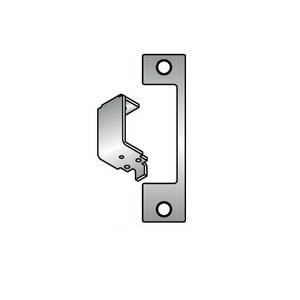
HES RP-26 Radius Faceplate
The RP-26 is a specialized mounting faceplate engineered for electric strike systems deployed on radius frame (curved) doors. If you're installing an electric strike on a curved door frame, this component solves a real problem: it bridges the gap between the strike housing and the curved frame profile, eliminating the unsightly gaps that otherwise force you to choose between an unfinished look or custom fabrication work.
Key Features
- Radius frame compatibility: Designed specifically for curved door applications — standard flat faceplates leave visible gaps on radius frames, requiring rework or leaving a sloppy installation. The RP-26 mounts flush to the curve.
- Seamless integration with HES electric strikes: Works with the full HES electric strike lineup without adapter plates or field modifications. No guessing on compatibility.
- Professional finished appearance: Eliminates the gap-and-filler approach. Result: a clean, integrated look that passes final walkthrough inspection in commercial and institutional facilities.
- Durable construction for high-traffic environments: Built to withstand repeated door cycles and the wear typical of commercial corridors, educational buildings, and healthcare facilities without loosening or degradation.
- Easy field installation: Mounts directly to existing radius frame doorsets — no frame replacement, no welding, no special tools required beyond standard fasteners.
When the RP-26 Makes Sense
Deploy this faceplate whenever you're upgrading or installing an electric strike on a radius frame door. Common scenarios: retrofitting a healthcare facility where curved frames are standard, completing a new commercial campus build with modern curved glass and metal frames, or integrating access control into secure facilities where the door design is fixed and you need a professional result on the first install.
If your doors are flat frames (standard rectangular frames), the RP-26 is unnecessary — use the standard faceplate that ships with the strike. But if you've got radius doors and you've seen the gap problem before, the RP-26 eliminates that field headache.
Integration & Compatibility
The RP-26 (often searched as RP 26) is designed to integrate with HES electric strike systems already in your specification or active deployment. Confirm your strike model against the HES product line — the RP-26 works across the standard strike portfolio for radius frame doors. No additional mounting hardware, no intermediate adapters, no firmware configuration. Install the strike, mount the RP-26, and move on.
This is a mechanical component with no electronics, no power requirements, and no integration complexity — it's purely a form-fit solution for the gap problem that exists when you pair a flat strike faceplate with a curved door frame.
Deployment Context
Use the RP-26 in any environment where professional appearance matters and radius frames are present: corporate office lobbies, university building entrances, hospital secure areas, government facilities, retail and hospitality spaces with curved glass entrances, and any site where aesthetic integration is part of the specification. It's a small component that prevents a visible defect in an otherwise finished installation.
Frequently Asked Questions
Q: Does the RP-26 work with all HES electric strike models?
A: The RP-26 is compatible with standard HES electric strikes on radius frame doors. Verify your specific strike model in the HES documentation to confirm compatibility — contact the manufacturer or your integrator if you're uncertain about your existing hardware.
Q: Can I install the RP-26 on a flat (non-curved) door frame?
A: No. The RP-26 is designed specifically for radius (curved) frames. Flat frames use the standard faceplate that ships with the strike. Using the RP-26 on a flat frame will result in an improper fit.
Q: What tools do I need to install the RP-26?
A: Standard fastening tools — typically a drill and standard screwdriver or hex bit. The RP-26 mounts using conventional hardware; no specialized access control tools are required.
Q: Is the RP-26 field-adjustable if the frame is slightly off-radius?
A: The RP-26 is engineered for standard radius door frame profiles. Highly irregular or custom frame geometries may require field shimming or custom fabrication — consult the manufacturer if you encounter non-standard geometry.
Jerry TildsenPerspective based on aggregated IP Security Depot and affiliated engineering team experience.
The RP-26 solves a specific, recurring field problem: the visible gap that appears when you mount a standard electric strike faceplate on a curved door frame. I've seen installations where integrators worked around this with caulk, spacer plates, or accepting a gap — all of which look unfinished. The RP-26 eliminates that compromise by engineering a faceplate geometry that actually matches the frame profile.
Technical Highlights:
- Radius-profile engineering: Unlike a flat faceplate, the RP-26 is contoured to match curved frame geometry, so there's no gap between the strike housing and the door frame. This is a mechanical fit-and-finish improvement, not a workaround.
- Full HES strike compatibility: Works across the standard HES electric strike portfolio without requiring custom mounting brackets or field modifications. Install the strike per spec, mount the RP-26, and you're done.
- Zero additional power or maintenance: This is a passive mechanical component — no electronics, no wiring, no configuration required. It's a pure form-fit solution.
Deployment Considerations:
- Verify your door frame is actually a radius (curved) profile before ordering. Standard flat frames use the strike's standard faceplate — the RP-26 is not a universal upgrade.
- Frame geometry must match HES engineering tolerances. Highly custom or irregular frame curves may require field evaluation before installation.
The RP-26 is essential in any commercial or institutional project where radius frame doors are standard and you want a finished, gap-free installation. It's particularly valuable in healthcare and higher-ed environments where curved glass entrances are common and visual integration is expected. Skip this if your doors are flat frames — it won't fit and won't help.