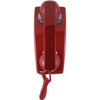
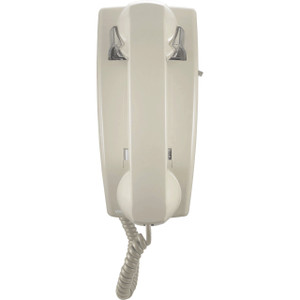
Viking Electronics K-1900-W2-RED Red Hot-Line Wall Phone with Non-Volatile Memory
The Viking Electronics K-1900-W2-RED is a single-number hot-line wall phone built for installations where instant, one-touch access to a designated line is non-negotiable — think elevator lobbies, parking structures, emergency call stations, and secure facility entry points. It mounts flush to a wall in a compact 4.0″ × 4.75″ × 9.0″ footprint, runs entirely off the telephone line (no separate power supply, no batteries), and stores its programmed number in non-volatile memory so a power interruption never erases your configuration. The red housing is deliberate — in emergency or high-visibility applications, color-coding matters.
Overview
The K-1900-W2-RED belongs to Viking's K-1900 Series hot-line phone family, which covers wall, desk, and panel form factors in both red and ash colorways. This wall variant (K-1900-W2-RED, also searched as K 1900 W2 RED) pairs a touch-tone dialer with selectable pulse dialing (10 or 20 pps), making it compatible with both modern VoIP gateways and legacy analog PBX systems that still require rotary-pulse signaling. The programming itself is done via any standard touch-tone phone — locally or remotely — so you don't need proprietary software or a laptop on-site to update the destination number.
For integrators building out emergency telephone systems or facilities teams managing multi-site hotline deployments, the line-powered architecture eliminates the battery-management burden that plagues standalone emergency phones. As long as the phone line has power (20V DC minimum at 18mA), this phone operates.
Key Features
- Non-Volatile Memory: The programmed 1–32 digit speed-dial number survives power outages without any backup battery. In an emergency-phone context, this is critical — you cannot afford a reset to factory blank after a grid event.
- Telephone Line Powered (20V DC / 18mA minimum): No transformer, no conduit run for 120VAC, no battery replacement schedule. The analog telephone line carries both signaling and power, which simplifies installation significantly in retrofits or locations where running a separate power circuit is cost-prohibitive.
- Touch Tone and Pulse Dialing (10/20 pps): Dual-mode dialing means you can drop this phone behind a VoIP ATA, a traditional key system, or a legacy CO line without a compatibility argument. Switch between 10 pps and 20 pps pulse depending on what the upstream equipment expects.
- Selectable Dial Speed (Normal 120ms / Fast 50ms): On congested analog infrastructure, faster tone timing (50ms) can reduce post-dial delay. Normal 120ms timing matches most standard telephony equipment. Selectable in the field without hardware changes.
- Compact Wall-Mount Form Factor (4.0″ × 4.75″ × 9.0″): At 3 lbs shipping weight, this mounts on a standard single-gang or surface-mount box. The vertical profile keeps it out of ADA clearance zones in corridor installations more easily than a desk unit would.
- Operating Temperature 0°C to 32°C (32°F to 90°F): Rated for interior conditioned-space use. This is an indoor phone — lobbies, corridors, elevator cabs, stairwells with HVAC. It is not rated for unheated garages or outdoor enclosures without supplemental housing.
- Operating Humidity 5% to 95% Non-Condensing: Handles the humidity range you'd encounter in most commercial interior spaces, including those adjacent to loading docks or mechanical rooms, as long as there's no direct condensation.
- Remote or Local Programming via Touch Tone: Update the destination number without dispatching a technician to the device. For multi-site facility managers, this means re-routing calls from a central office — relevant when a call center number changes or a security desk moves.
- Two-Year Limited Manufacturer Warranty: Viking backs the K-1900-W2-RED with a two-year limited warranty, which is above average for specialty telephone hardware in this category.
Integration and Compatibility
The K-1900-W2-RED connects to any standard analog telephone line — POTS, FXS port on a VoIP gateway, or analog station port on a PBX/key system. Because it supports both touch-tone and pulse dialing, compatibility with older telephony infrastructure is rarely an issue. The 20V DC / 18mA minimum line power requirement is well within the output spec of virtually every FXS port and POTS line in commercial deployment.
Pair this with a VoIP gateway if your facility has migrated off POTS — the phone itself has no network interface and requires no IP configuration. It is purely an analog endpoint. For facilities running a PBX or key telephone system, assign the hot-line to a dedicated analog station port and configure the speed-dial destination at the system level or program it directly into the phone's non-volatile memory. Either approach works.
The red colorway is the same hardware as the ash (K-1900-W2) variant — same dialer module, same memory, same power requirements. Color selection is an installation and code-compliance decision, not a feature difference.
Frequently Asked Questions
Q: Does the K-1900-W2-RED require a separate power supply or batteries?
A: No. The K-1900-W2-RED is telephone line powered, drawing a minimum of 20V DC at 18mA from the connected analog line. No external transformer, AC outlet, or battery is required.
Q: What is the maximum number of digits the K-1900-W2-RED can store in its speed-dial memory?
A: The speed-dial memory holds 1 to 32 digits — sufficient for direct-inward-dial numbers, long-distance numbers with access codes, or internal extension strings including feature codes.
Q: Can the K-1900-W2-RED be programmed remotely without visiting the phone location?
A: Yes. Programming is accomplished via any standard touch-tone phone, either locally at the device or remotely over the connected telephone line, so re-routing calls to a new destination number does not require a site visit.
Q: Is the K-1900-W2-RED suitable for outdoor installations?
A: The operating temperature range is 0°C to 32°C (32°F to 90°F) and the phone is rated for indoor conditioned-space use. Outdoor deployment would require a supplemental weatherproof enclosure, and temperature extremes outside that range are not covered by the specification.
Q: What is the warranty on the K-1900-W2-RED?
A: Viking Electronics covers the K-1900-W2-RED with a two-year limited manufacturer warranty.
Q: Will the programmed number be lost if the phone loses power?
A: No. The K-1900-W2-RED uses non-volatile memory, which retains the programmed speed-dial number through power interruptions without any battery backup required.
The detail I keep coming back to on the K-1900-W2-RED is the 20V DC / 18mA minimum line power requirement — it's a low enough draw that virtually every FXS port and analog CO line I've encountered in commercial deployments comfortably exceeds it, which means you're not going to hit a power-delivery mismatch when you drop this behind a VoIP gateway. The non-volatile memory means you can program the destination number during commissioning and walk away confident that a power blip six months later won't send the next caller into a dead line.
Technical Highlights:
- Non-Volatile Memory: Programmed 1–32 digit number survives power loss with zero battery dependency — in emergency phone applications, this is a life-safety reliability factor, not a convenience feature.
- Dual Dial Mode (Touch Tone + 10/20 pps Pulse): Covers both modern VoIP FXS ports and legacy analog PBX station ports without any hardware swap — useful when you're deploying across a mixed telephony estate.
- Line-Powered Architecture (20V DC min): Eliminates the AC circuit requirement entirely. In elevator lobbies or stairwells where pulling a 120VAC circuit is expensive or code-complicated, this is often the deciding factor in choosing this unit.
Deployment Considerations:
- The 0°C to 32°C operating range is strictly an indoor conditioned-space spec. Don't install this in an unheated parking structure or exterior kiosk without a heated enclosure — the upper limit of 32°C (90°F) will also be breached in unconditioned spaces during summer months in most of the US.
- Programming is touch-tone only — you'll need a DTMF-capable phone to set or change the destination number. If your site has already fully migrated to a system that doesn't present a DTMF dial tone for programming mode, verify the access method before installation.
This phone is well-matched to elevator cab installations, secure facility entry vestibules, and any indoor location where a dedicated single-destination emergency or courtesy line is required and running a separate power circuit is not practical. It's a straightforward, low-maintenance analog endpoint — no firmware, no IP stack, no configuration drift.