Viking Electronics K-1900-D2-RED Red Hot-Line Desk Phone with Non-Volatile Memory
Overview
The Viking Electronics K-1900-D2-RED is a telephone line-powered hot-line desk phone built for environments where a direct, pre-programmed call connection is non-negotiable — guard stations, lobby intercoms, emergency call points, and industrial facilities where staff can't fumble with a dial pad under pressure. The K-1900-D2-RED requires no external power supply: it draws operating current directly from the telephone line (20V DC at 18mA minimum), which eliminates a failure point and simplifies installation in remote or utility locations. Non-volatile memory means the programmed speed dial number survives power loss without requiring re-entry — a detail that matters when this phone sits in a stairwell or equipment room and nobody checks it until there's an emergency.
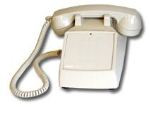
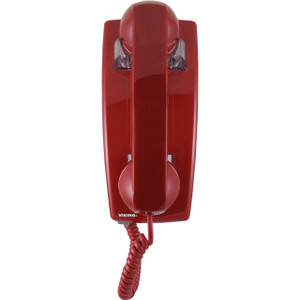
Available in red (this model) or ash, the K-1900-D2-RED is the desk-mount variant in the Viking Electronics telephone line. Its compact footprint — 9.0" x 8.25" x 4.75" — fits on a standard security console or desk without displacing other equipment.
Key Features
- Telephone Line Powered (20V DC / 18mA min): The phone draws operating current directly from the POTS line, so there is no power brick to install, no outlet to provision, and no battery to replace. In a guard booth or utility room, that's one fewer thing to fail during an outage.
- Non-Volatile Memory: The programmed speed dial number is retained even when line power is interrupted. Re-programming after a power disruption is not required — critical for unattended or infrequently checked emergency phones where a blank memory would mean a non-functional unit at exactly the wrong moment.
- 1–32 Digit Field-Programmable Speed Dial: Accepts dial strings up to 32 digits, which covers extensions with trunk access codes, PBX routing prefixes, and pause characters. This is field-programmable, so the phone can be reconfigured on-site without returning to a technician or depot.
- Touch Tone or Pulse Dialing: Supports both DTMF (touch tone) and pulse dialing modes. Pulse compatibility matters in older or hybrid telephony environments — rural facilities, legacy PBX systems, or industrial sites still running older central office equipment — where DTMF is not guaranteed.
- Dual Dialing Speeds: Normal tone dialing runs at 120ms; fast mode drops to 50ms. Pulse dialing runs 10 pps normal or 20 pps fast. Fast mode reduces the time-to-connect on speed dial calls, which is worth configuring on any high-call-volume or emergency-use phone.
- Hearing Aid Compatible Amplified Handset with Rotary Volume Control: The amplified handset with rotary volume control accommodates users with hearing aids (telecoil-compatible) and allows on-the-fly volume adjustment without menu navigation. For ADA-conscious deployments in public or semi-public areas, this removes a compliance checkbox.
- Wide Humidity Tolerance (5% to 95% non-condensing): Rated for 5% to 95% relative humidity, the K-1900-D2-RED handles the moisture swings common in warehouses, loading docks, and covered outdoor areas. The non-condensing caveat means it should not be installed where it will experience rapid temperature swings that cause condensation on the handset.
- Operating Temperature 0°C to 32°C (32°F to 90°F): Covers standard indoor commercial and industrial temperature ranges. Not rated for outdoor use in freezing or high-heat environments — plan accordingly for unheated spaces that drop below freezing in winter.
Integration & Compatibility
The K-1900-D2-RED connects to any standard analog POTS line or FXS port on a VoIP gateway, PBX analog card, or ATA adapter. It does not require a special line card or provisioning — if the port delivers 20V DC at 18mA or better under loop current, the phone operates. This makes it compatible with virtually every analog access control and intercom infrastructure currently deployed in commercial buildings.
For facilities running a VoIP PBX (Cisco, Avaya, FreePBX, 3CX), pair the K-1900-D2-RED with an ATA (analog telephone adapter) at the endpoint. The phone's speed dial string handles PBX extension dialing, trunk prefixes, and any required pause characters within the 32-digit field limit. Integrators deploying this alongside video surveillance systems as a guard-to-dispatch hotline will find the line-powered design convenient — a single cable run handles both the call path and device power.
The K-1900-D2-RED (often searched as K 1900 D2 RED) is one variant in Viking's K-1900 series. The companion K-1900W-2 is the wall-mount version with identical electrical specifications and a 4.0" x 4.75" x 9.0" footprint — useful when desk surface is not available. Choose the desk model when the phone needs to sit on a counter or console; choose the wall variant for corridor, stairwell, or panel-mount installations. For deployments requiring an emergency telephone with ruggedized or outdoor-rated housing, evaluate Viking's weather-resistant series instead.
Frequently Asked Questions
Q: Does the K-1900-D2-RED require an external power supply?
A: No. The K-1900-D2-RED is telephone line powered, drawing 20V DC at a minimum of 18mA directly from the analog POTS line or FXS port. No separate power adapter or outlet is needed.
Q: Will the programmed speed dial number be lost if power is interrupted?
A: No. The K-1900-D2-RED uses non-volatile memory, so the programmed number is retained through power interruptions without requiring re-entry.
Q: How long a dial string can be programmed into the speed dial?
A: The speed dial field accepts 1 to 32 digits, which is sufficient for most PBX extension strings with trunk access codes and pause characters included.
Q: Is the K-1900-D2-RED hearing aid compatible?
A: Yes. The handset is hearing aid compatible and amplified, with a rotary volume control on the handset for on-the-fly adjustment.
Q: What is the operating temperature range?
A: The K-1900-D2-RED is rated for 0°C to 32°C (32°F to 90°F). It is not designed for unheated spaces that drop below freezing or for direct outdoor exposure.
Q: What is the warranty on the K-1900-D2-RED?
A: Viking Electronics covers the K-1900-D2-RED with a two-year limited manufacturer warranty.
The detail I keep coming back to on the K-1900-D2-RED is the non-volatile memory combined with line-powered operation — that combination means this phone is functionally self-contained on a single cable. In a security deployment, you install it once, program the speed dial, and it stays ready indefinitely without a battery swap schedule or a power circuit to maintain. That's the right profile for an unattended guard post or a stairwell emergency phone where the only periodic check should be a functional test, not a maintenance task.
Technical Highlights:
- Line Power (20V DC / 18mA min): Draws operating current entirely from the telephone line, eliminating the need for a local power outlet or UPS provisioning at the endpoint — useful in remote or utility locations where AC power is inconvenient or unavailable.
- 32-Digit Speed Dial Field: The 32-digit programmable string is long enough to handle PBX trunk prefixes, extension numbers, and DTMF pause characters in a single stored sequence — so a one-touch call can navigate an IVR or route through a multi-hop PBX without user intervention.
- Dual Dialing Mode and Speed: Supports both DTMF (120ms normal / 50ms fast) and pulse (10 pps / 20 pps) dialing. Fast DTMF mode at 50ms is the setting to use on any high-traffic or time-critical emergency call point to reduce the dial-to-ring delay.
Deployment Considerations:
- The 0°C to 32°C operating range covers most climate-controlled interior spaces, but verify ambient temperatures in mechanical rooms, parking structures, and loading docks before specifying this model — spaces that drop below freezing in winter require a heater or a cold-rated alternative.
- The 5%–95% non-condensing humidity rating is permissive for most indoor industrial environments, but the non-condensing caveat is real — avoid mounting locations subject to rapid temperature swings that cause moisture condensation directly on the unit, such as near HVAC discharge vents or roll-up doors.
The K-1900-D2-RED is the right call for guard-to-dispatch hotlines, lobby security consoles, and emergency telephone points in commercial buildings where a single-button, line-powered, always-ready analog phone is the requirement — and where the red housing provides immediate visual identification of the emergency station from across the room.