Panduit FCT-7ZB 12-Port OM4 QuickNet Fiber Tap Cassette
Overview
The Panduit FCT-7ZB is a passive fiber tap cassette designed for in-line optical monitoring of high-density OM4 multimode backbone links without breaking the live circuit. Carrying 12 fibers through a rear MTP interface, it splits light at a 70/30 ratio across front live and front tap LC duplex port banks — giving your monitoring equipment a consistent 30% optical feed while 70% of signal power continues to the production path. If you need to attach a network packet broker, optical TAP analyzer, or IDS/IPS appliance to a live OM4 trunk without scheduling downtime, the FCT-7ZB is the cassette to install.
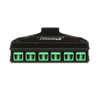
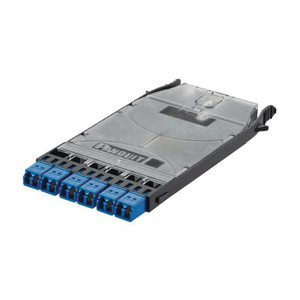
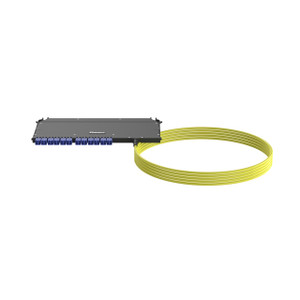
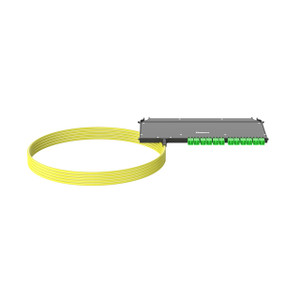
The QuickNet cassette form factor slides into standard Panduit QuickNet fiber enclosures, converting an MTP backbone to 6 duplex LC live ports and 6 duplex LC tap ports on the front face — 12 LC duplex connections total. Mounting is via M3 screw (#6 screw), compatible with Panduit's modular rack infrastructure. The unit is RoHS3 compliant and lists an active part status with a factory lead time of four weeks when ordering through distribution.
Key Features
- 70/30 Passive Optical Split: The FCT-7ZB delivers 70% of optical power to the live production path and 30% to the tap port — no active components, no injected light, no risk of disrupting the monitored link. This ratio is the industry standard for monitoring where the tap receiver is more sensitive than the live endpoint, making it appropriate for most analyzer and packet broker deployments.
- OM4 Bend-Insensitive Fiber: OM4 multimode supports 40G and 100G applications at standard data center distances (up to 150m at 40G OM4). The bend-insensitive design tolerates tighter routing inside dense enclosures without incurring additional attenuation — important when you are routing 12 fibers into a compact cassette bay.
- Front Live + Front Tap LC Duplex Ports (6 each): Both the live and tap connections are LC duplex on the front face, so your monitoring appliance and downstream switch both patch from the same panel face. No rear access required after installation, which simplifies cable management in populated racks.
- Rear 12-Fiber MTP Interface: The rear MTP connector terminates a 12-fiber trunk — the standard for QuickNet backbone infrastructure. One MTP pull connects all 12 fibers simultaneously, reducing installation time compared to individual LC trunk runs and preserving polarity across the backbone.
- 12 Total Ports in a Cassette Footprint: Six LC duplex live ports plus six LC duplex tap ports fit within a single cassette bay. In a populated QuickNet enclosure, this means you can tap multiple backbone trunks within a single rack unit — relevant for monitoring setups where panel density is constrained.
- M3 Screw Mounting: The #6/M3 screw attachment secures the cassette positively in the enclosure frame. Unlike tool-free snap-in cassettes that can migrate under cable pull load, a screw-retained cassette stays seated — a practical consideration in environments with frequent patching activity.
- RoHS3 Compliant: Confirms the cassette meets the current EU Directive 2015/863 hazardous substance restrictions. Required for projects with environmental compliance mandates or EU export requirements.
- Active Part Status: Panduit lists the FCT-7ZB as an active production part, not end-of-life or last-time-buy. For long-horizon data center builds where spares availability matters over a 5–10 year infrastructure lifecycle, active status reduces the risk of a forced migration to a different cassette family.
Integration & Compatibility
The FCT-7ZB is engineered for Panduit QuickNet fiber enclosures that accept standard cassette modules with MTP rear interfaces. The front LC duplex ports accept standard LC patch cords to connect live endpoints (switches, servers, storage) and tap endpoints (packet brokers, network analyzers, security monitoring appliances). The 30% tap output is sufficient for most commercial optical monitoring receivers — verify the minimum receive sensitivity of your monitoring appliance against the tap output level calculated from your source transmit power minus the tap ratio insertion loss before installing. The OM4 fiber designation makes this cassette compatible with 10G, 40G, and 100G OM4 multimode transceivers on both the live and tap sides, though the tap side link budget will be tighter by approximately 5 dB relative to a direct connection.
The FCT-7ZB (often searched as FCT 7ZB) belongs to the Panduit QuickNet tap cassette family alongside the FCT-7ZA and FCT-7ZD variants — those models address different split ratios or fiber types. Confirm the FCT-7ZB OM4 / 70/30 specification matches your infrastructure's fiber type and your monitoring receiver's sensitivity before substituting within the family.
Frequently Asked Questions
Q: What is the split ratio of the FCT-7ZB and how does it affect my monitoring setup?
A: The FCT-7ZB uses a 70/30 passive optical split — 70% of signal power passes to the live production port and 30% goes to the tap port. This means your monitoring appliance receives approximately 30% of the optical signal. Before deploying, verify that your packet broker or analyzer meets its minimum receive sensitivity at that reduced power level. No active components are involved, so the tap introduces no latency and cannot disrupt the monitored link.
Q: Is the FCT-7ZB compatible with single-mode fiber infrastructure?
A: No. The FCT-7ZB is specified for OM4 multimode fiber. Installing it on single-mode infrastructure would result in fiber type mismatch, severe insertion loss, and unreliable link performance. For single-mode tap requirements, a different cassette from Panduit's lineup would be required.
Q: What enclosure does the FCT-7ZB install into?
A: The FCT-7ZB is designed for Panduit QuickNet fiber enclosures that accept standard cassette modules with rear MTP interfaces. It mounts via M3 (#6) screws. Verify your enclosure model accepts this cassette form factor before ordering.
Q: How many fibers does the FCT-7ZB support and what are the front-panel connections?
A: The FCT-7ZB terminates a 12-fiber OM4 MTP trunk on the rear. The front panel provides 6 LC duplex live ports and 6 LC duplex tap ports — 12 LC duplex connections total. Both live and tap ports are accessible from the front face, so no rear access is needed once the cassette is installed and the MTP trunk is connected.
Q: Is the FCT-7ZB RoHS compliant?
A: Yes. The FCT-7ZB is listed as RoHS3 compliant, meeting EU Directive 2015/863 hazardous substance requirements. This is relevant for projects with environmental compliance mandates or EU market requirements.
Q: What is the lead time for the FCT-7ZB?
A: Panduit lists a factory lead time of four weeks for the FCT-7ZB. If your project schedule is tight, confirm current stock availability before committing to an installation date.
The FCT-7ZB is a purpose-specific passive optical TAP cassette, and the 70/30 split ratio is the spec that defines whether this is the right tool for a given monitoring deployment. At 30% tap output, you need a monitoring appliance with enough receive sensitivity to work at reduced optical power — calculate your link budget with that 30% share in mind before you commit to this cassette. In QuickNet OM4 backbone builds, the FCT-7ZB integrates cleanly without requiring active electronics or power, which matters in high-density colocation environments where power and space are both constrained.
Technical Highlights:
- 70/30 Passive Split: 70% to the live path, 30% to the tap — no active electronics, no added latency, no risk of disrupting the monitored OM4 trunk during normal operation.
- 12-Fiber MTP Rear / 12 LC Duplex Front: One MTP pull connects the backbone; six LC duplex live and six LC duplex tap ports on the front face allow patching from a single panel position without rear access after installation.
- OM4 Multimode, Bend-Insensitive: Supports 40G and 100G OM4 multimode distances; bend-insensitive fiber tolerates compact cassette routing without measurable additional attenuation in standard enclosure layouts.
Deployment Considerations:
- Run a link budget calculation before finalizing — the tap receiver's minimum sensitivity spec must be achievable at approximately 30% of the transmit power on that OM4 trunk. Short-distance 10G runs have comfortable margin; longer 40G/100G trunks already operating near OM4 distance limits leave less headroom on the 30% tap port.
- Panduit lists a four-week factory lead time on the FCT-7ZB. If this cassette is going into a fast-track data center build or a security monitoring expansion with a hard cutover date, verify stock availability before the project schedule locks.
The FCT-7ZB fits best in enterprise data centers and colocation environments where network operations teams need permanent passive monitoring taps on OM4 backbone segments — particularly for security appliance feeds, compliance packet capture, and IDS/IPS out-of-band monitoring — without the risk and downtime of in-line active TAP devices.