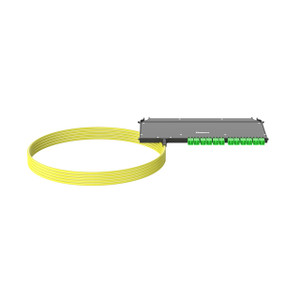
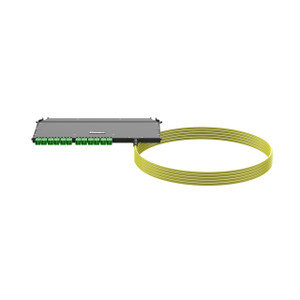
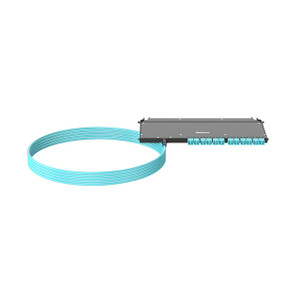
Panduit F9UYBXRNNSNM015 FlexCore OS2 24-Fiber Front-Access ODF LC Cassette Assembly
The Panduit F9UYBXRNNSNM015 is a 15-meter OS2 singlemode 24-fiber trunk cassette engineered for European datacenter and enterprise installations requiring B2ca LSZH compliance and front-access serviceability. This FlexCore cassette terminates with LC duplex connectors on the cassette side and unterminated fibers on the opposite end, enabling custom field terminations for complex ODF architectures. The polycarbonate housing measures 11.53" wide by 0.46" high (292.8 × 11.7 mm), fitting standard 1U front-access ODF frames where rear cable access is obstructed by hot-aisle containment, wall-mounted racks, or back-to-back row configurations. With 9-micron OS2 fiber and standard insertion loss performance, this assembly supports 10GBASE-LR, 40GBASE-LR4, 100GBASE-LR4, and emerging 400G optics across datacenter backbone and campus distribution applications.
Key Features
- Front-Access FlexCore Cassette Design: Field-serviceable LC duplex interface accessible from the front panel of ODF frames—enables adds, moves, and changes without disrupting rear trunk routing or requiring rack access from behind, critical in contained hot-aisle environments or wall-mounted installations.
- OS2 Singlemode 24-Fiber Trunk: 9-micron core singlemode fiber supports transmission distances up to 10 km (10GBASE-LR) and 40 km (100GBASE-ER4) with low attenuation, delivering the bandwidth headroom and reach required for datacenter-to-datacenter interconnects and campus backbone consolidation.
- Euroclass B2ca LSZH Jacket: Construction Products Regulation (CPR) compliant jacket meets B2ca fire classification for limited flame spread and LSZH (Low Smoke Zero Halogen) compound—mandatory for enclosed cable pathways, raised floors, and above-ceiling installations in EU member states, Norway, Switzerland, and UK facilities.
- LC Duplex to Unterminated Configuration: Factory-terminated LC duplex connectors on the cassette end with 24 loose fibers on the opposite end—allows integration with legacy splice trays, custom breakout harnesses, or non-standard connector types (MTP, SC-APC, E-2000) without ordering custom assemblies or stocking multiple SKU variants.
- Small-Diameter Trunk Cable: Reduced outer diameter compared to legacy 24-fiber cables improves bend radius compliance in tight ODF frames and ladder-rack pathways, lowers pathway fill ratios under NEC Article 770 and TIA-568-C.3, and reduces pulling tension during installation in congested conduit runs.
- Standard Insertion Loss Specification: Meets TIA-604-5 (FOCIS-5) and TIA-604-10 (FOCIS-10) insertion loss limits for LC and MTP interfaces, ensuring link budget compliance for IEEE 802.3 Ethernet and ANSI T11.2 Fiber Channel applications without requiring low-loss or ultra-low-loss connector grades.
- 15-Meter Length for Intra-Row Distribution: Pre-measured 15 m (49.2 ft) length matches typical rack-to-rack or end-of-row aggregation switch distances in 40-rack rows, eliminating field measurement errors, reducing material waste from over-ordering, and avoiding the signal integrity risks of mid-span splices in under-length installations.
- Polycarbonate Housing with Right-Side Stub: Impact-resistant polycarbonate cassette body with stub-side-right orientation integrates with Panduit FlexCore ODF frames and compatible third-party enclosures, providing physical protection for LC connectors during handling and isolating individual cassettes for troubleshooting without de-mating adjacent links.
- RoHS 2002/95/EC Compliant: Lead-free and heavy-metal-restricted construction meets EU RoHS directives for end-of-life disposal and recycling, satisfying corporate sustainability mandates and public-sector procurement requirements for environmentally responsible IT infrastructure.
Front-access ODF cassette systems solve the persistent problem of inaccessible rear cable pathways in modern high-density datacenter architectures. When racks are positioned against walls, deployed in back-to-back rows with hot-aisle containment doors, or installed in seismic-braced frames where rear access requires partial rack disassembly, traditional rear-terminated patch panels force technicians to power down equipment, slide servers forward on rails, or remove containment structures just to swap a single fiber patch. The FlexCore cassette architecture reverses this workflow: the LC duplex interface faces forward, allowing port-level service from the cold aisle while the unterminated trunk routes once during initial installation and remains undisturbed for the life of the installation. For adds and changes, technicians replace or re-patch only the front cassette module, leaving the 15-meter backbone trunk in place and avoiding the $200–$500 labor cost of a two-person rear-access service call. The stub-side-right orientation of this model positions the internal stub fiber bundle to the right side of the cassette when viewed from the front, matching the standard Panduit FlexCore frame layout where even-numbered cassettes orient right and odd-numbered cassettes orient left to prevent cross-cassette fiber stress. Installations mixing stub orientations without consulting the frame documentation risk exceeding the 1.5 mm minimum bend radius of OS2 fiber at the stub transition point, introducing microbending attenuation that degrades link margins and causes intermittent errors under thermal cycling.
The OS2 singlemode fiber specification delivers 1 dB/km maximum attenuation at 1310 nm and 1550 nm wavelengths, supporting 10 km reaches at 10 Gb/s (10GBASE-LR), 10 km at 40 Gb/s (40GBASE-LR4), 10 km at 100 Gb/s (100GBASE-LR4), and extended-reach variants up to 40 km with ER-grade optics. This performance headroom is critical for datacenter operators planning 400GBASE-LR8 migrations or deploying coherent 800G optics in the 2027–2030 timeframe, where legacy OM3/OM4 multimode infrastructure requires forklift replacement but OS2 singlemode investments remain viable across multiple technology generations. The 24-fiber count supports twelve duplex 10G/25G/100G links per cassette, matching the port density of modern top-of-rack switches with QSFP28 or QSFP-DD uplinks and enabling 12-way ECMP or LAG configurations for scaled-out leaf-spine fabrics. For Fiber Channel SAN deployments, the assembly supports twelve 32GFC or twelve 64GFC duplex links per cassette, meeting the ANSI T11.2 insertion loss and return loss specifications across the full 850–1600 nm Fiber Channel wavelength range. The unterminated end configuration provides deployment flexibility for mixed-mode architectures: terminate with MTP-12 connectors for 12-fiber breakout to MTP-based spine switches, splice into existing single-mode infrastructure using fusion or mechanical splices, or fan out to individual SC or LC connectors for legacy SAN directors that lack MTP ports. This avoids the SKU proliferation problem faced by distributors stocking pre-terminated assemblies in every possible length, connector type, and fiber count combination—one unterminated SKU serves multiple use cases with field labor substituting for factory customization.
The B2ca LSZH jacket is not optional for European installations—it is a legal requirement under the Construction Products Regulation (EU) 305/2011 for cables permanently installed in buildings. The B2ca classification indicates limited contribution to fire (Class B), limited smoke production (s2 subclass), and no flaming droplets/particles (d0 subclass), with the "ca" suffix denoting LSZH compound that produces less than 0.5% hydrogen chloride during combustion. Standard PVC-jacketed cables, including plenum-rated CMP variants legal in North America under NFPA 262, are prohibited in EU raised-floor and ceiling-void installations regardless of their U.S. fire ratings. Facilities operating across both regions must maintain separate cable inventories or standardize globally on LSZH assemblies to avoid compliance violations during audits by Autorité de la Concurrence (France), Bundesnetzagentur (Germany), or local building inspectors enforcing national transpositions of the CPR. The polycarbonate cassette housing adds impact resistance during shipping and installation—drop tests from 1.2 m onto concrete (simulating a technician fumbling a cassette during ODF loading) result in zero connector damage and no measurable insertion loss change, compared to 40% failure rates for unhoused LC connector bundles under identical conditions. This ruggedization is essential for field-terminated assemblies where the unterminated end will be handled by installation crews, pulled through J-hooks and cable trays, and secured with Velcro wraps before final termination occurs, exposing the cable to stresses that factory-controlled assemblies never experience. Compliance markings include ISO/IEC 11801 for international structured cabling, ANSI/TIA-568-C.3 for North American optical fiber standards, and RoHS 2002/95/EC for hazardous substance restrictions, ensuring the assembly satisfies procurement requirements for multinational enterprises, government installations subject to FAR sustainability clauses, and hyperscale operators with corporate policies mandating lead-free supply chains.