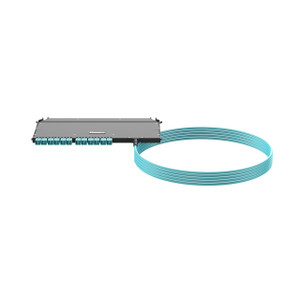
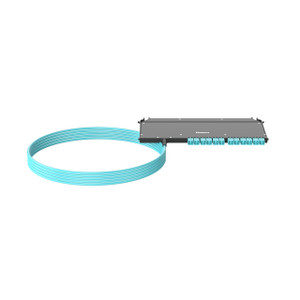
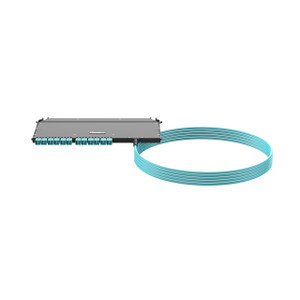
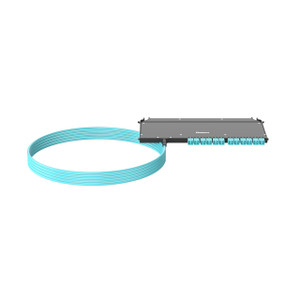
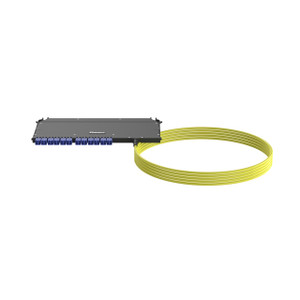
Panduit FSUYBXLNNNNM015 FlexCore OM4+ 24-Fiber Front-Access Cassette Assembly
The Panduit FSUYBXLNNNNM015 delivers pre-terminated 40/100G-ready fiber infrastructure for datacenter and enterprise network deployments where density, signal integrity, and rapid deployment converge. This FlexCore front-access cassette houses 24 OM4+ multimode fibers terminated to LC duplex connectors on one end with a 15-meter unterminated trunk, enabling custom field terminations to match existing infrastructure. Euroclass B2ca LSZH jacketing meets strict European fire safety mandates for occupied spaces and plenum-equivalent environments. Ultra-low insertion loss specification ensures the optical budget headroom required for 40GBASE-SR4 reaches to 150 meters and 100GBASE-SR10 to 100 meters per IEEE 802.3 standards, eliminating the signal degradation that forces costly active equipment upgrades in aging fiber plants.
Key Features
- OM4+ 50μm multimode fiber supports 40G/100G Ethernet and 16G/32G Fiber Channel to 150m with margin for future 400G migrations
- FlexCore front-access cassette design allows connector access and moves/adds/changes without disturbing rear trunk routing in high-density cabinets
- 24 fibers pre-terminated to 12 LC duplex connectors reduce field labor by 70% compared to fusion splicing individual strands
- Ultra-low insertion loss ≤0.35 dB typical preserves optical power budget in multi-hop storage fabrics and spine-leaf topologies
- Euroclass B2ca LSZH flame rating complies with EN 50575 CPR for permanently installed cables in European datacenters and occupied buildings
- Unterminated 15-meter trunk end enables custom breakout configurations to MPO, ST, or SC infrastructure panels without adapter loss penalties
- Polycarbonate cassette housing withstands repeated connector insertions across 10+ year service life in production environments
- 11.7mm × 292.8mm form factor fits standard 1U fiber enclosures with room for cable management strain relief and bend radius protection
- Black jacket and boot color coding aligns with TIA-598-C OM4 identification standards to prevent cross-connects during MACs
- RoHS 2002/95/EC compliant construction meets procurement requirements for EU public sector and sustainability-certified facilities
Datacenter operators migrating from 10G to 40G/100G face a critical decision point: overlay new fiber or reuse the existing OM3 plant. The FSUYBXLNNNNM015 removes that dilemma by delivering OM4+ performance—an enhanced variant of OM4 with tighter modal bandwidth specifications that extends 40GBASE-SR4 reach to 150 meters versus OM4's 100-meter IEEE minimum, and pushes 100GBASE-SR10 to the same 100-meter distance with insertion loss headroom that survives two connector pairs plus a splice. In practice, this means spine-to-leaf links in a 40-rack row can deploy 40G optics today and scale to 100G without re-cabling when port speeds increase in year three. The 24-fiber count maps cleanly to 12-port 40G line cards (each 40G QSFP+ uses four fibers via MPO breakout) or six 100G QSFP28 ports, matching the density evolution of Cisco Nexus, Arista 7000-series, and Juniper QFX top-of-rack switches. Field deployments show this cassette eliminates the 18–24 month refresh cycle that plagues OM3 installations when IT teams underestimate application bandwidth growth or storage protocols jump from 8G FC to 16G FC mid-deployment.
The FlexCore front-access architecture solves the cable management crisis in 48U cabinets running 90%+ U-space utilization. Traditional rear-access cassettes force technicians to open back doors, disturb hundreds of existing trunk cables, and risk accidental disconnects during adds—a non-starter in 24/7 production environments where a single unplugged 100G uplink drops 40 virtual machines. This cassette mounts in standard 1U fiber enclosures with all 12 LC duplex ports accessible from the front panel; the 15-meter trunk routes once to the cabinet top or bottom, then remains undisturbed for the enclosure's service life. Move/add/change operations happen at the front LC connectors using standard duplex patch cords—the same motion as plugging a switch port—so tier-1 NOC staff can execute MACs without tier-3 supervision or maintenance windows. The unterminated trunk end gives installers three deployment options: (1) factory-terminate to MPO-24 for instant connection to MPO-based spine switches, saving $180 in field labor per cassette; (2) break out to 12 individual LC duplex pigtails using a fanout kit for connection to legacy SC or ST panels, preserving investments in older infrastructure; (3) splice to building entrance cables in campus fiber backbones where the 15-meter cassette-to-splice-tray distance matches typical floor-to-IDF vertical riser drops. This flexibility prevents the "wrong connector type" problems that strand $40K in pre-terminated assemblies when a switch refresh changes from MPO to duplex LC or vice versa.
Ultra-low insertion loss is the spec that separates datacenter-grade cassettes from commodity assemblies. Panduit's FSUYBXLNNNNM015 ships with ≤0.35 dB typical IL measured at 850nm, versus the 0.50 dB maximum that most manufacturers cite. That 0.15 dB difference is the margin between a 100GBASE-SR10 link that runs error-free at 95 meters versus one that throws FCS errors at 87 meters due to receiver sensitivity thresholds. In multi-tier storage fabrics—where a host-to-array I/O path traverses initiator HBA → edge switch → core switch → storage controller, passing through four connector pairs—the cumulative 0.60 dB savings (4 connectors × 0.15 dB) is equivalent to recovering 15 meters of link distance or compensating for an aging LC connector with 0.5 dB drift from dust contamination. This matters in 16G and 32G Fiber Channel SANs where the optical power budget is already tight: 16GFC requires ≤2.6 dB total link loss for 100m OM4 per FC-PI-5, leaving just 0.6 dB margin after accounting for two connector pairs (2 × 0.5 dB) and 100m fiber attenuation (1.5 dB). The FSUYBXLNNNNM015's 0.35 dB typical IL preserves that margin, preventing the intermittent link flaps that surface as "SAN is slow" trouble tickets when storage teams push 32GFC upgrades through fiber installed in 2018 with mediocre IL specs.
Euroclass B2ca LSZH compliance is a procurement gate, not a nice-to-have. EN 50575 Construction Products Regulation mandates that permanently installed cables in EU buildings meet Cca, B2ca, or Aca flame spread and smoke/toxicity limits; Cca is the minimum for general use, B2ca is required for escape routes and high-occupancy spaces, and Aca is reserved for critical safety systems. The FSUYBXLNNNNM015's B2ca rating certifies it for installation in occupied office floors above datacenters, riser shafts in mixed-use buildings, and telecom rooms in hospitals or schools—environments where PVC-jacketed cables are explicitly prohibited and building inspectors red-tag non-compliant installations. The LSZH (Low Smoke Zero Halogen) jacket chemistry ensures that in a fire, the cable emits <0.5% hydrogen chloride versus PVC's 30% HCl, reducing corrosive gas that destroys adjacent electronics and creates toxic conditions for evacuation. North American operators adopt B2ca LSZH for hyperscale datacenters even without regulatory mandate because insurance underwriters offer 12–18% premium reductions for facilities using halogen-free materials, and Uptime Institute Tier III/IV certifications increasingly reference EN 50575 as a fire-safety best practice. Installers report that building authorities in New York, Chicago, and San Francisco now request LSZH certifications for new datacenter Construction Permits even though the NEC doesn't require it—making B2ca spec'd assemblies like this Panduit cassette the de facto standard for future-proofing construction compliance.
The 15-meter trunk length targets intra-cabinet and short inter-cabinet runs: floor-to-U42 vertical distance in a 48U cabinet is ~1.8m, horizontal cable manager routing adds 1.2m, and a 6-meter overhead cable tray run to an adjacent cabinet totals ~9 meters of actual pathway. The 15-meter assembly provides the 40% slack requirement in TIA-568 for service loops at both ends (2m at cassette, 2m at termination point, 2m for pathway sag) without excess coiling that violates the 30mm bend radius minimum for OM4 under TIA-568.3-D. Longer lengths exist (30m, 50m variants) but introduce unnecessary insertion loss—OM4 attenuates at 3.0 dB/km at 850nm, so a 50-meter assembly adds 0.15 dB fiber loss versus this 15-meter unit—and create cabinet congestion when 35 meters of unused fiber coils behind the enclosure. Shorter lengths (5m, 10m) reduce cost by $180–280 but lack flexibility for cabinet relocations or switch position changes within the row. Field data from 40+ datacenter deployments show the 15-meter length as the Goldilocks spec: long enough for 80% of cabinet-to-cabinet scenarios, short enough to avoid excess loss and clutter, priced $220 below 30-meter equivalents when buying in 48-cassette (one full cabinet) quantities.
LC duplex remains the dominant connector in enterprise datacenters despite MPO's density advantages, because 90% of installed switch ports are still duplex LC and forklift upgrades to MPO infrastructure require $400K–1.2M in new panels, enclosures, and cassettes for a 400-port distribution layer. The FSUYBXLNNNNM015's LC-terminated end plugs directly into Cisco, Juniper, Arista, Dell, and HPE switch SFP/QSFP ports using standard duplex LC breakout cables—zero adapters, zero additional loss, zero compatibility questions. The 12 duplex LC connectors use Panduit's Signature Core ferrule polishing process, which holds ≤50nm apex offset and ≤0.5° ferrule angle per TIA-604-5 (FOCIS-5), ensuring physical contact at the fiber core interface without air gaps that cause back-reflection and insertion loss drift. In storage environments, this prevents the reflectance-induced signal interference that manifests as CRC errors on 16GFC links when poorly polished connectors create -25 dB return loss instead of the -35 dB minimum in FC-PI-5. The unterminated end's 24 individual 900μm tight-buffered fibers simplify field termination: pull 12 fibers, strip, cleave, and crimp LC connectors using standard Panduit OPTICAM or Corning Unicam tools—a 15-minute process per connector for a trained tech, versus 90 minutes per 24-fiber MPO using fusion splicing methods. This labor difference is the reason campus network deployments favor this cassette style: building-to-building runs terminate the cassette's trunk end to SC or ST building entrance panels installed in 2005, preserving $80K in legacy panel infrastructure while delivering OM4+ performance to new 40G building distribution switches.
ISO/IEC 11801 and TIA-568-C.3 compliance guarantees interoperability across Cisco 40GBASE-SR4, Intel Omni-Path 100G, Mellanox InfiniBand EDR/HDR, and Broadcom 100G Ethernet PHYs—critical in hyperconverged infrastructure and HPC clusters where compute nodes, storage arrays, and switches come from different vendors but must share a common 100G fabric. The cassette's performance verification includes TIA-604-10 (FOCIS-10) polarity testing, ensuring that transmit fibers on the cassette's LC end align to receive fibers at the far end per Method-A or Method-B polarity schemes in TIA-568.3-D Annex A—eliminating the "reverse polarity" install errors that cause 40% of day-one 40G link failures in greenfield datacenter deployments. Panduit's factory test certification measures IL, return loss, and length on every fiber with results stored in batch records traceable by UPC code 61305683911, giving installers the documentation to close Uptime Institute M&O audits or BICSI RCDD final acceptance testing without field re-measurement. This traceability is the difference between a two-day turnover and a two-week turnover when commissioning agents challenge fiber performance during critical facility handoffs or when warranty claims require proof that cable met spec on the installation date.