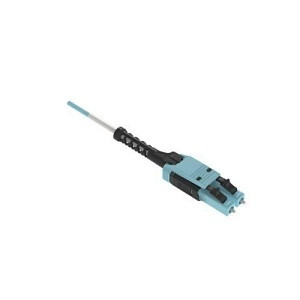
Panduit FZ2RLU1ZNNNM049 QuickNet OM4 LC Uniboot 49-Meter Fiber Optic Assembly
The Panduit FZ2RLU1ZNNNM049 is a factory-terminated 49-meter OM4 multimode fiber optic assembly engineered for high-speed data center and enterprise network deployments. This 2-fiber LC duplex uniboot cable delivers 40/100 Gigabit Ethernet readiness with a compact 2mm LSZH jacket, eliminating field termination labor while ensuring consistent optical performance across TIA-568.3-D and ISO/IEC 11801 specifications. Part of Panduit's QuickNet pre-terminated system, this assembly arrives tested, labeled, and ready for immediate deployment in telecommunications rooms, equipment distribution areas, and structured cabling backbones where installation speed and reliability determine project success.
Key Features
- OM4 50/125µm Multimode Fiber: Supports 40GBASE-SR4 to 150 meters and 100GBASE-SR10 to 100 meters, with full backwards compatibility for 10GBASE-SR and 1000BASE-SX applications
- LC Duplex Uniboot Connector: Single-boot design reduces patch panel footprint by 50% compared to traditional duplex LC cables, simplifying cable management in high-density environments
- Factory Pre-Terminated: Eliminates field termination labor, fusion splicing equipment costs, and per-connector testing time — typical installation speed gains of 70% over field-terminated solutions
- LSZH Jacket (Low Smoke Zero Halogen): Meets stringent European EN 50288-4-1 and IEC 60332-3-24 flammability standards, reducing toxic fume release in confined spaces and plenum environments
- 49-Meter Length (160.8 ft): Pre-sized for common multi-floor backbone and horizontal cross-connect runs, reducing on-site cutting and waste
- QuickNet System Integration: Factory-tested for insertion loss and return loss with serialized labeling for end-to-end circuit identification and documentation
- Physical Contact (PC) Polish: Precision-polished connector endfaces ensure typical insertion loss ≤0.3 dB and return loss ≥-20 dB per TIA-568.3-D Category OM4 requirements
- Aqua Jacket Color: Industry-standard OM4 color coding for instant fiber type identification during installation and maintenance
Pre-terminated fiber assemblies solve three critical deployment problems that field-terminated solutions cannot match: speed, consistency, and documentation. The FZ2RLU1ZNNNM049's factory termination process uses automated polishing and inspection systems that deliver insertion loss and return loss performance within 0.1 dB variance across the entire production run — a level of consistency impossible to achieve with field termination under job-site conditions. Each assembly ships with serialized labels mapping to factory test reports, allowing installers to document optical performance without expensive OTDR testing or certification equipment on-site. For a 24-strand backbone installation, this translates to eliminating 48 field terminations (96 connector endfaces), roughly 16 hours of skilled labor, and the entire cost of mobilizing fusion splicing equipment and test gear to the job site.
The LC duplex uniboot connector design addresses the cable management crisis in modern high-density data centers. Traditional duplex LC cables use separate boots for transmit and receive fibers, consuming two cable routing positions per link and creating tangled service loops behind patch panels. The FZ2RLU1ZNNNM049's uniboot design houses both fibers in a single compact boot with a push-pull tab, cutting patch panel space requirements in half while enabling tool-free polarity reversal via the internal crossover clip. In a 1U 96-port LC panel deployment, this space savings allows full population without cable bundle congestion, maintaining the 40mm bend radius required to prevent OM4 optical performance degradation. The 2mm cable diameter further enhances density gains — compared to 3mm distribution-style cables, 2mm assemblies reduce cable bundle cross-section by 55%, enabling tighter routing through ladder rack and overhead cable tray without exceeding NEC Article 300.17 conduit fill ratios.
OM4 fiber's 50/125µm core/cladding geometry and optimized 850nm laser bandwidth (≥4700 MHz·km effective modal bandwidth) make the FZ2RLU1ZNNNM049 a multi-generation investment for enterprise networks migrating from 10 Gigabit to 40/100 Gigabit Ethernet. At 49 meters, this assembly comfortably supports 100GBASE-SR4 (100m reach spec) with margin for connector pair loss and future splices, while 40GBASE-SR4's 150-meter reach spec provides even greater headroom for multi-floor riser installations. The same infrastructure simultaneously supports legacy 10GBASE-SR links (400m reach on OM4) and 1000BASE-SX connections, allowing phased network upgrades without forklift cabling replacement. This backwards compatibility eliminates the stranded-asset risk that plagued earlier migrations from OM1/OM2 to OM3, where insufficient bandwidth forced premature re-cabling when 40G adoption accelerated.
LSZH jacketing has transitioned from a European regulatory requirement to a global data center best practice driven by safety and insurance considerations. The FZ2RLU1ZNNNM049's LSZH jacket compound contains no halogenated flame retardants (fluorine, chlorine, bromine), reducing hydrochloric acid and dioxin release during cable fires to near-zero levels compared to PVC jackets. In confined spaces like telecommunications rooms, equipment closets, and under-floor cable distribution zones, this dramatically improves egress safety and reduces corrosive damage to active electronics during fire events. The compound meets IEC 60332-3-24 Category C bundle flame propagation limits (prevents vertical fire spread along cable bundles) while maintaining the flexibility and abrasion resistance required for repeated installations and service. For data centers pursuing LEED certification or European DGNB sustainability ratings, LSZH cabling contributes to materials health credits by eliminating PVC plasticizers and halogenated additives from the building materials inventory.
QuickNet's factory integration extends beyond physical termination to include end-to-end system documentation and traceability. Each FZ2RLU1ZNNNM049 assembly ships with a unique serial number laser-marked on both connector boots, corresponding to factory test data stored in Panduit's manufacturing database. Installers receive a test report showing actual insertion loss and return loss measurements for each fiber direction, typically ranging from 0.15 dB to 0.25 dB IL and -35 dB to -50 dB RL — performance levels that exceed TIA-568.3-D OM4 Channel limits by comfortable margins. This documentation satisfies building code inspectors and warranty administrators without requiring contractors to perform expensive Tier 2 OLTS testing or Tier 1 OTDR certification on every link. The serialized labels also enable circuit tracking through Panduit's PanView iQ infrastructure management software, linking physical cable IDs to logical network ports for MAC (Moves, Adds, Changes) documentation and compliance reporting.
The 49-meter length designation reflects real-world building geometry and structured cabling topology. In a typical three-story commercial building with 4-meter floor-to-floor height, a 49-meter backbone assembly accommodates a vertical riser run from ground-floor telecommunications room to third-floor intermediate distribution frame (12 meters of vertical rise) plus horizontal routing from riser closet to equipment room (20-30 meters) with service loop allowance at both ends. Pre-cut assemblies eliminate the waste and labor associated with pulling 100-meter spools and field-cutting to length — a process that generates 15-25% scrap on average and requires two-person teams to manage heavy reels in confined spaces. For retrofit installations in occupied buildings, the discrete 49-meter length ships in compact coils that fit through standard doorways and elevator cars, avoiding the logistical challenges of maneuvering 12-foot cable reels through finished corridors.
LC duplex connectivity has established itself as the dominant data center and enterprise fiber interface, displacing SC and ST connectors through a combination of density, performance, and tooling simplicity. The FZ2RLU1ZNNNM049's LC connectors use a 1.25mm ceramic ferrule with RJ-45-style form factor, enabling 2x the port density of SC connectors in the same panel space. The push-pull latching mechanism provides positive engagement feedback without requiring the twist-lock motion of ST connectors — a critical advantage when working behind populated racks with limited hand access. Physical Contact (PC) polish geometry positions the fiber endfaces in direct contact under spring pressure, eliminating the air gap that causes Fresnel reflection in non-contact connectors. This design delivers the ≥-20 dB return loss required for 10G+ applications where back-reflection can saturate VCSEL transmitters and degrade bit error rates. The ceramic ferrule material provides superior dimensional stability compared to polymer ferrules, maintaining endface geometry through 500+ mating cycles and temperature swings from -20°C to +70°C without performance degradation.
Compliance with TIA-568.3-D, ISO/IEC 11801, and ANSI/TIA-942-B standards ensures the FZ2RLU1ZNNNM049 integrates seamlessly into structured cabling systems designed to these specifications. TIA-568.3-D defines the optical performance requirements for OM4 cable assemblies (≤3.5 dB channel loss for 100m permanent link), while ISO/IEC 11801 Class OF-300 provides equivalent international specifications recognized across European and Asian markets. ANSI/TIA-942-B establishes data center cabling topology rules, including the 90-meter permanent link + 10-meter equipment cord allocation that this 49-meter assembly supports. For federal and defense installations, the FZ2RLU1ZNNNM049's construction aligns with Buy American Act domestic content requirements when specified through Panduit's North American production facilities, satisfying FAR 25.2 procurement regulations for government-funded projects.
The FZ2RLU1ZNNNM049 serves as a turnkey solution for network architects and cabling contractors who recognize that labor cost now exceeds material cost by 3:1 ratios in commercial installations, making pre-terminated infrastructure the only economically rational choice for new deployments and major retrofits. Factory termination shifts quality control from variable field conditions to controlled manufacturing environments, eliminating the weather delays, workspace lighting limitations, and craft skill variance that plague job-site fiber work. The result is a 49-meter OM4 backbone link delivered at lower total installed cost than field-terminated equivalents, with guaranteed 40/100G performance, comprehensive factory documentation, and manufacturer warranty covering the entire assembly as a single serialized unit rather than separately-warranted components.