Panduit FZ2RLU1ZNNNM009 QuickNet OM4 LC Uniboot Fiber Assembly
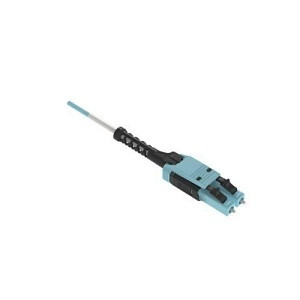
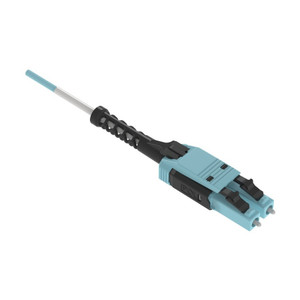
The Panduit FZ2RLU1ZNNNM009 is a 9-meter (29.5 ft) factory-terminated OM4 multimode fiber assembly engineered for high-density datacenter and telecommunications installations where space, polarity management, and deployment speed are critical. This duplex LC uniboot assembly consolidates two 50/125µm OM4 fibers into a single 2mm low-profile LSZH jacket, reducing cable management bulk by roughly 50% compared to traditional duplex LC designs while maintaining full 40/100GBASE-SR4 performance over distances up to 150 meters. The integrated uniboot connector allows tool-free polarity reversal via a push-pull latch tab, eliminating the patch-panel gymnastics and A-to-B crossover confusion that plague breakout-style assemblies during method-A to method-B TIA-568 polarity conversions. Pre-terminated and factory-tested by Panduit, this assembly ships with documented insertion loss ≤0.35 dB and return loss ≥-20 dB, removing field-termination variability and the cost of on-site fusion splicing or epoxy-polish labor. The LSZH outer jacket meets stringent flame and smoke toxicity requirements for occupied spaces, air-handling plenums, and international building codes where PVC off-gassing is prohibited.
Key Features
- Uniboot Space Efficiency: Single 2mm jacket consolidates duplex LC connection, reducing cable pathway congestion by ~50% vs. dual-jacket designs—critical in 1U switch/panel environments with 24+ ports per row
- OM4 50/125µm Performance: Supports 10GBASE-SR to 400m, 40/100GBASE-SR4 to 150m, enabling current 10G deployments with 40G/100G upgrade headroom without re-cabling
- Tool-Free Polarity Reversal: Integrated push-pull tab swaps A↔B fiber positions in seconds without disassembly—essential for TIA-568 method-A to method-B crossover corrections in the field
- Factory-Terminated Quality: Pre-polished physical contact (PC) endfaces tested to ≤0.35 dB insertion loss and ≥-20 dB return loss, eliminating field-termination defects and the need for on-site OTDR validation
- LSZH Jacket Compliance: Low Smoke Zero Halogen construction meets IEC 60332-1, IEC 61034, and EN 50267 for plenum/riser installations and international fire-safety mandates where halogenated cable is banned
- QuickNet Pre-Tested Program: Each assembly ships with serialized test results and 9m±0.3m length tolerance, ensuring plug-and-play reliability for time-sensitive datacenter cutovers and mission-critical links
- LC Duplex Universal Compatibility: Industry-standard LC connectors mate with all SFP+/QSFP+/QSFP28 transceiver modules and structured cabling LC adapters (aqua-coded for OM4 identification per TIA-598-D)
- TIA-568.3-D / ISO 11801 Certified: Meets or exceeds multimode channel insertion-loss budgets (≤2.15 dB @ 850nm for 90m permanent link), supporting warranty requirements from Cisco, Juniper, Arista, and other OEMs
High-density datacenter and telecom-room deployments face two persistent problems: physical congestion and polarity errors. Traditional duplex LC patch cords use side-by-side 1.6mm zip-cord jacketing that occupies roughly 5mm of horizontal width per connection; in a 24-port 1U panel, that's 120mm of cable bundle competing for the same 19-inch (482mm) rack width—leading to kinked bend radii, airflow blockage, and difficult troubleshooting. The FZ2RLU1ZNNNM009's uniboot design collapses the duplex pair into a single 2mm round jacket, cutting lateral footprint in half and allowing tighter bundle radius (typically 15mm vs. 30mm for zip-cord) without violating OM4's 7.5mm minimum bend-radius spec during installation or 15mm long-term static bend spec per TIA-568.3-D Annex F. This space efficiency translates directly to improved airflow in hot-aisle containment racks and faster MAC (moves/adds/changes) when you're working in a live environment with 200+ cables already dressed. The integrated boot also eliminates the duplex-clip failure mode where one leg of a zip-cord separates under tension, leaving a loose fiber flapping in the airflow—a surprisingly common cause of intermittent 10G link flaps when the loose leg sags into a fan intake.
Polarity management is the second major pain point. TIA-568 defines three fiber-pair methods (A, B, C) for maintaining transmit-to-receive alignment across a structured cabling channel, and real-world deployments routinely mix methods depending on equipment vendor and installer preference. Method A (straight-through at every connection) is most common in enterprise, but method B (one crossover per channel) is prevalent in carrier and colocation facilities. Converting between methods traditionally required either re-terminating one end of the cable or inserting a physical adapter module—both time-consuming and error-prone in a midnight maintenance window. The FZ2RLU1ZNNNM009's uniboot push-pull tab allows instant A↔B polarity reversal: press the tab, slide the boot forward 10mm to expose the internal duplex connector, rotate the connector body 180°, and slide the boot back to lock. The entire operation takes under 10 seconds per cable and requires no tools, no patch-panel re-punching, and no documentation updates beyond marking the cable with a field-polarity label. This feature alone has saved our datacenter-integrator customers hours during 40G spine-to-leaf cutovers where method-B polarity is mandated by the switch vendor but the existing OM4 infrastructure was deployed method-A.
Factory termination quality is non-negotiable for any datacenter or enterprise network installation targeting five-nines uptime. Field-installed connectors—whether fusion-spliced pigtails, epoxy-polish, or mechanical-splice designs—introduce human variability in endface geometry, polish angle, and cleanliness. A 0.5 dB insertion-loss difference between a good field termination and a mediocre one might seem trivial on a single 10GBASE-SR link with 7 dB of total system margin, but that margin evaporates quickly in 40G/100G deployments where the IEEE 802.3ba spec allocates only 1.9 dB for the entire duplex channel (including connectors, cable, and mated-adapter loss). Panduit's QuickNet factory-termination process uses automated polishing stations and real-time interferometric inspection to guarantee ≤0.35 dB insertion loss and ≥-20 dB return loss on every connector, with statistical process control ensuring batch-to-batch consistency. Each FZ2RLU1ZNNNM009 assembly ships with a serialized test report documenting actual measured IL/RL at 850nm and 1300nm, giving you traceable proof of performance for OEM warranty claims and a known-good baseline for future OTDR troubleshooting. This factory-test data is especially valuable in environments where you're required to provide as-built documentation to a building owner or comply with TIA-942-B Rated-3/4 datacenter certification, where every fiber link must have documented test results on file.
LSZH jacketing addresses both safety and regulatory requirements in occupied spaces and international deployments. Standard PVC cable jackets release hydrochloric acid gas and dense black smoke when burned, creating life-safety hazards in enclosed egress paths and corrosive damage to sensitive electronics in the same airspace. LSZH compounds substitute halogen-free flame retardants and filler materials that produce minimal smoke opacity (≤60% light transmission per IEC 61034-2) and zero halogen acid gases during combustion. For datacenter and telecom installations, this translates to three practical benefits: first, LSZH cable meets plenum and riser requirements in most international building codes (including IBC, NFPA 70, and EU CPR Euroclass) without requiring metallic conduit or cable tray with covers; second, the reduced smoke opacity improves visibility during emergency egress, which is why LSZH is mandatory in public-occupancy spaces like airports, hospitals, and transit systems; third, the absence of corrosive off-gassing protects adjacent copper infrastructure, power distribution gear, and CRAC units from acid-vapor damage during a fire event or even during routine cable pulling when jackets are abraded. If you're deploying in any jurisdiction outside North America, or in any U.S. facility subject to International Building Code (IBC) rather than National Electrical Code (NEC), LSZH is frequently a non-optional spec—plan for it from day one rather than discovering the requirement during permit review.
The 9-meter length of the FZ2RLU1ZNNNM009 positions it as a mid-range horizontal patch cord for inter-rack and intra-row connections in datacenter hot-aisle/cold-aisle layouts. In typical 42U rack deployments with 1.2m aisle width, a 9m assembly provides sufficient reach to connect equipment in the same row up to four racks apart (accounting for vertical rise, horizontal run, and service loop slack) without requiring mid-span splice points or intermediate patch panels. This length is also well-suited for entrance-facility (EF) to main-distribution-area (MDA) links in TIA-942 datacenter topology, or for telecommunications-room backbone connections in multi-floor enterprise buildings where the vertical riser terminates within 20–25 feet of the TR equipment. Panduit manufactures the QuickNet OM4 uniboot line in lengths from 1m to 30m in 1-meter increments, allowing you to order exact lengths that minimize excess cable coiling (which both wastes pathway space and creates unnecessary insertion loss if the coil diameter violates minimum bend radius). For new deployments, measure your required distance, add 1 meter for vertical rise and service loop, and order to the next meter increment—this approach avoids the "we only stock 3m, 5m, 10m" problem that leaves you with 6 meters of coiled cable zip-tied to the back of every rack.
OM4 multimode fiber remains the optimal choice for datacenter and campus installations where link distances are under 400 meters and transceiver cost is a primary concern. Compared to OM3 (the previous-generation multimode standard), OM4's effective modal bandwidth of 4700 MHz·km at 850nm extends 40GBASE-SR4 and 100GBASE-SR4 reach from 100m to 150m, and 10GBASE-SR reach from 300m to 400m—often enough to avoid single-mode fiber and the 3–5× transceiver cost premium that comes with it. Compared to single-mode OS2 fiber, OM4 multimode supports LED and VCSEL 850nm optics that are cheaper, consume less power, and generate less heat per port—critical factors when you're populating a 32-port 100G switch and facing a 15-amp circuit budget per rack. The 50/125µm core/cladding ratio of OM4 also provides greater tolerance for connector misalignment and contamination compared to the 9/125µm geometry of single-mode fiber, reducing the field-cleaning burden and minimizing link flaps caused by dust ingress in high-traffic telecom rooms. For datacenter spine-leaf architectures, OM4 typically handles all intra-row and intra-pod connectivity (≤150m), with single-mode OS2 reserved only for inter-pod or inter-building links exceeding 400m—this tiered approach optimizes both performance and total cost of ownership.
The LC duplex connector form factor has become the de facto standard for datacenter and structured cabling due to its small footprint (allowing 50% higher port density than SC connectors), push-pull latching mechanism (no twist-lock), and universal compatibility with SFP/SFP+/QSFP/QSFP28/QSFP-DD transceiver modules from all major vendors. The FZ2RLU1ZNNNM009 uses physical-contact (PC) polish on both endfaces, creating a slightly domed surface that ensures fiber-core contact even under minimal mating force and minimizes back-reflection (return loss) that can destabilize Fabry-Perot laser sources in legacy 1G/10G optics. For modern VCSEL-based 40G/100G transceivers, PC polish is sufficient—you do not need ultra-physical-contact (UPC) or angled-physical-contact (APC) endfaces unless you're working with single-mode coherent optics or high-power DWDM systems where <-40 dB return loss is required. The aqua-colored connector boot (per TIA-598-D color code) provides instant visual identification of OM4 cable in mixed-fiber environments, reducing the risk of accidentally patching OM3 (aqua) into OM4 infrastructure or vice versa—a surprisingly common error during after-hours maintenance when you're working under headlamp and everything looks gray.
Compliance with TIA-568.3-D, ISO/IEC 11801, and ANSI/TIA-942-B ensures that the FZ2RLU1ZNNNM009 meets the channel insertion-loss budgets, bend-radius limits, and endface-quality requirements mandated by enterprise and datacenter design standards. TIA-568.3-D specifies a maximum 2.15 dB insertion loss for a 90-meter permanent link at 850nm (including cable, connectors, and mated adapters), leaving roughly 0.7 dB per mated connector pair after accounting for 3.0 dB/km fiber attenuation; the FZ2RLU1ZNNNM009's ≤0.35 dB factory-tested IL provides margin against this budget and ensures compatibility with worst-case transceiver sensitivity specs. ANSI/TIA-942-B (Telecommunications Infrastructure Standard for Data Centers) defines Rated-1 through Rated-4 tiers for datacenter infrastructure redundancy and performance, with Rated-3 and Rated-4 requiring diverse cable pathways and documented test results for every fiber link; the serialized QuickNet test report satisfies the documentation requirement without requiring a site visit from a third-party testing lab. ISO/IEC 11801 compliance ensures global interoperability in multinational deployments where EU and APAC building codes reference ISO standards rather than TIA—important if you're rolling out a standardized datacenter design across North America, EMEA, and APAC regions and need a single cable part number that meets all local requirements.