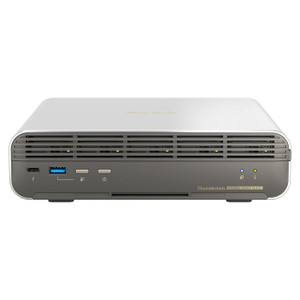
QNAP TDS-H2489FU-R2-4314-256G-US Dual-CPU 24-Bay U.2 NVMe All-Flash 2U Rackmount NAS
The TDS-H2489FU-R2-4314-256G-US is QNAP's flagship all-flash 2U rackmount NAS built around dual Intel® Xeon® Silver 4314 processors and 24 U.2 NVMe Gen 4 x4 SSD bays — purpose-engineered for organizations that need datacenter-class throughput, sub-millisecond storage latency, and the redundancy headroom to run production workloads without compromise. This is not a general-purpose file server; it is a dense, compute-heavy storage appliance aimed at media production pipelines, AI inference workflows, high-frequency surveillance analytics, and enterprise SAN/NAS consolidation. If your workload demands sequential bandwidth that spinning-disk or hybrid NAS simply cannot sustain, the QNAP storage line reaches its peak capability here.
Overview
The TDS-h2489FU R2 sits at the top of QNAP's NAS and network-attached storage rackmount lineup. Shipping in the TDS-H2489FU-R2-4314-256G-US configuration, it pairs two 16-core Xeon Silver 4314 CPUs with 256 GB of installed DDR4 ECC RDIMM memory — expandable to 1 TB across 32 DIMM slots (16 per socket). That compute density is what separates this platform from single-CPU all-flash NAS: you have genuine NUMA symmetry, so heavily threaded workloads like simultaneous 4K/8K transcode streams, multi-client iSCSI, and inline deduplication do not collapse onto a single processor die. The 5 GB onboard flash provides dual-boot OS protection, meaning a failed OS volume does not take down the entire appliance — a detail that matters in always-on deployments.
Key Features
- 24 x U.2 NVMe Gen 4 x4 Bays: PCIe Gen 4 doubles the per-lane bandwidth of Gen 3, translating directly to higher aggregate sequential throughput across all 24 slots. At this bay count you can populate the chassis with enterprise U.2 SSDs sized for your retention window — without compromising on I/O headroom as the drive count grows. This is the correct form factor for high-channel NVR deployments where simultaneous write streams from dozens of cameras must never queue.
- Dual Intel Xeon Silver 4314 (16 cores / 32 threads each): 32 physical cores total means CPU-bound tasks — inline compression, encryption, deduplication, and VM compute — have genuine headroom. Single-CPU all-flash NAS hits CPU ceilings well before storage bandwidth limits; this platform does not. The Xeon Silver 4300 series also supports Intel vPro manageability features useful in remote-hands environments.
- Up to 1 TB DDR4 ECC RDIMM (32 slots, 16 per socket): Registered ECC memory provides error correction at scale — essential when the appliance is hosting databases, VMs, or caching layers where silent bit-flip corruption is unacceptable. With 256 GB installed at ship, there is immediate room to scale memory to match growing caching or VM density without a chassis replacement. Maximum 1 TB capacity means the memory subsystem will not be the bottleneck in large-object caching workloads.
- 5 GB Flash — Dual-Boot OS Protection: Two independent OS flash volumes mean a firmware corruption or failed OS update does not brick the appliance mid-deployment. In remote or unmanned installations where physical hands-on recovery is expensive, this architectural choice directly reduces risk.
- 2U Rackmount Form Factor: 24 NVMe bays in 2U is a high bay-density-per-rack-unit ratio. For organizations managing rack space as a constrained resource — co-location facilities, dense edge data centers, broadcast production racks — fitting full all-flash capacity in 2U avoids the capacity sprawl of chassis-based or JBOFs. Pair with a high-capacity network switch to fully utilize the front-end bandwidth this platform supports.
- QNAP QTS/QuTS Hero OS: The h-series firmware designation indicates QuTS Hero, QNAP's ZFS-based OS variant. ZFS delivers native inline data integrity (checksums on every block), snapshot-based backup, and thin provisioning — not add-on features but architectural defaults. For organizations that have dealt with silent data corruption on other platforms, this matters more than raw throughput numbers alone.
Integration and Compatibility
The TDS-H2489FU-R2-4314-256G-US (often searched as TDS H2489FU R2 4314 256G US) is designed to integrate with enterprise storage networks via iSCSI, NFS, SMB/CIFS, and FC (depending on PCIe expansion). QuTS Hero supports Active Directory integration and LDAP, making it deployable into existing enterprise identity infrastructure without additional middleware. Its PCIe expansion slots allow adding 25GbE or 100GbE NICs for high-throughput SAN connections — a necessary consideration when 24 NVMe drives are capable of delivering bandwidth that 10GbE cannot fully absorb. Review your NVR and storage architecture planning to ensure front-end network capacity matches the back-end NVMe throughput this chassis supports.
Frequently Asked Questions
Q: What CPU is installed in the TDS-H2489FU-R2-4314-256G-US?
A: The TDS-H2489FU-R2-4314-256G-US ships with two Intel Xeon Silver 4314 processors. Each is a 16-core/32-thread CPU from the Xeon Silver 4300 series, giving the system 32 physical cores and 64 threads total.
Q: How much memory does the TDS-H2489FU-R2-4314-256G-US support, and what type?
A: The system supports up to 1 TB of DDR4 ECC RDIMM memory across 32 slots (16 slots per CPU socket). The TDS-H2489FU-R2-4314-256G-US ships with 256 GB installed, leaving 24 slots available for future expansion — up to the 1 TB ceiling using 32 GB RDIMMs per slot.
Q: What drive interface does the TDS-H2489FU-R2-4314-256G-US use?
A: All 24 bays use U.2 NVMe Gen 4 x4 — PCIe Generation 4 at full x4 lanes per slot. This is the high-performance U.2 form factor, not SATA or SAS. Drives must be U.2 NVMe; standard 2.5-inch SATA SSDs are not compatible with these bays.
Q: What is the dual-boot OS protection feature on the TDS-H2489FU-R2-4314-256G-US?
A: The 5 GB onboard flash supports two independent OS boot partitions. If the primary OS image fails or becomes corrupted — due to a power interruption during a firmware update, for example — the appliance can boot from the secondary partition. This reduces the risk of a full appliance outage from OS-level failures in unmanned or remote deployments.
Q: Is the TDS-H2489FU-R2-4314-256G-US suitable for high-channel video surveillance storage?
A: Yes, this is a legitimate fit for high-channel surveillance storage where sustained simultaneous write performance is required. The 24 U.2 NVMe Gen 4 bays deliver write throughput that spinning-disk or hybrid NAS cannot match, and the dual-CPU architecture handles the concurrent indexing and retrieval workloads that high-channel NVR platforms generate. Verify NVR vendor compatibility with QNAP's QuTS Hero iSCSI or NFS targets before deployment.
Q: Can the TDS-H2489FU-R2-4314-256G-US be expanded beyond 24 bays?
A: The base chassis provides 24 U.2 NVMe bays. QNAP's ecosystem supports external expansion enclosures via PCIe or Thunderbolt interfaces depending on the specific configuration, but drive bay expansion beyond the base 24 should be confirmed against QNAP's current compatibility documentation for this model before specifying in a design.
The TDS-H2489FU-R2-4314-256G-US is the platform I reach for when a client has exhausted what a single-CPU NAS can deliver and needs to stop compromising on either compute or storage throughput. The combination of dual Xeon Silver 4314 CPUs — 32 physical cores total — and 24 U.2 NVMe Gen 4 x4 bays in 2U means you are not paying for chassis space or power budget on headroom you will never use. Everything here is production-density from day one.
Technical Highlights:
- Dual-CPU NUMA Architecture: Two independent Xeon Silver 4314 sockets mean CPU-intensive operations — inline ZFS checksums, deduplication, encryption, and multi-tenant iSCSI sessions — distribute across 32 cores without competing for a shared die. Single-socket all-flash NAS hits CPU limits before NVMe bandwidth limits; this configuration reverses that constraint.
- 32 DDR4 ECC RDIMM Slots (256 GB installed, 1 TB max): Registered ECC is the correct memory type for a ZFS-based appliance — uncorrected bit flips in ARC cache can cause data integrity failures that are worse than a drive failure because they are silent. The 256 GB baseline is functional, but dense surveillance or VM-hosting deployments will want to populate additional slots early; 32 GB RDIMMs are well-priced and the 1 TB ceiling is not a practical limitation for most deployments.
- 5 GB Dual-Boot Flash: This is an operational continuity feature, not a marketing bullet. In a production deployment where a firmware update window goes wrong at 2 AM, the secondary OS partition is the difference between a 5-minute recovery and an emergency onsite call.
Deployment Considerations:
- U.2 NVMe Gen 4 bays are drive-type specific — confirm your drive vendor's U.2 compatibility matrix against QNAP's HCL before procurement. Enterprise U.2 SSDs vary significantly in write endurance ratings and sustained write performance under thermal load; spec TBW ratings against your expected daily write workload, not just capacity.
- At 24 NVMe drives, front-end network bandwidth will be the real ceiling. A 10GbE uplink will be saturated well before the storage subsystem is. Plan for 25GbE or 100GbE NICs via PCIe expansion if your workload involves large simultaneous transfers across multiple clients.
For a high-channel physical security operations center running AI-based video analytics with concurrent live view, on-demand forensic retrieval, and offsite replication — all from the same appliance — the TDS-H2489FU-R2-4314-256G-US is the correct specification. It is sized for the workload rather than for the purchase order.