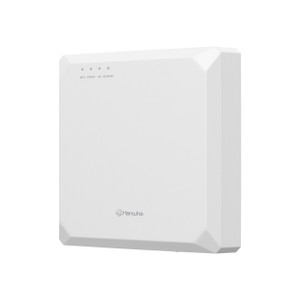
Hanwha NHP-P100 Single-Door IP Access Controller
The Hanwha NHP-P100 is a network-based single-door access control platform engineered for small-to-mid-scale distributed deployments where a monolithic access panel would be overkill but standalone readers would leave security gaps. Built on the OnCAFE platform, the NHP-P100 (often searched as NHP P100) combines multi-reader credential handling, comprehensive input/output supervision, and encrypted event logging in a compact form factor suitable for wall or DIN rail mounting. This is the logical choice if you're architecting access control for offices, retail, education, or light industrial facilities where you need enterprise-grade security without licensing complexity.
Key Features
- Dual OSDP reader support via single Wiegand/OSDP port: Manages up to 2 OSDP readers simultaneously, future-proofing your credential stack. This matters because OSDP (Open Supervised Device Protocol) is where reader intelligence lives—tamper detection, encryption, and secure key exchange happen at the reader level, not buried in controller firmware. When you eventually migrate from legacy magnetic stripe or proximity cards to modern encrypted OSDP, you don't rip out wiring; you just replace the reader.
- 3 supervised inputs plus 2 unsupervised OSDP Flex inputs: Supervised inputs detect tampering on door sensors, request-to-exit buttons, and emergency triggers. The 2 additional unsupervised Flex inputs handle auxiliary devices—motion sensors, fire alarm integrations, etc.—without requiring tamper monitoring. This separation lets you concentrate security resources where they matter (the credential path) while staying practical about peripheral devices.
- 1 Form-C relay output with field-configurable dry/12VDC/24VDC switching: A single relay that adapts to your wiring. Configure it as dry contact for edge device integration, 12V powered for direct door strike control, or 24V for solenoid drivers—no separate power supply juggling required. You set the output voltage in the field based on what's already running to the lock.
- 50,000 cardholder capacity with 250,000 offline event cache: Stores enough credentials locally to run standalone for extended periods if your network drops. The 250,000 event buffer means a busy 24/7 entrance won't overflow the log for weeks. When the network restores, all events sync back to your management platform with timestamps intact, so you never lose audit trail.
- PoE+ (802.3at) primary power at 480mA maximum, with 12VDC/24VDC fallback: A single 802.3at PoE+ injector from your network closet powers this device—no additional cable runs. If you have existing 12V or 24V DC distributed through your facility, you can tap into that instead. This flexibility is critical in retrofits where new power infrastructure is either impossible or prohibitively expensive.
- TLS 1.3 and AES-256 encryption for credentials and event transmission: Encrypts the cardholder database and all audit events in transit and at rest. TLS 1.3 eliminates older cipher-suite vulnerabilities that plague legacy access systems. For facilities handling sensitive access data or facing compliance audits (healthcare, finance, government-adjacent contracts), this is non-negotiable.
- Integrated tamper detection with accelerometer and enclosure switches: Detects if someone opens the unit or dislodges it from the wall. Tamper events log immediately so your security team knows the moment someone attempts unauthorized troubleshooting or removal.
- Compact aluminum housing (7.24" × 7.24" × 1.67") rated -20°C to +60°C: Fits in tight electrical closets or low-profile wall cutouts. The temperature range covers most indoor commercial and light outdoor (covered eave) installations. If you need full -40°C industrial-grade or +70°C data center specs, you'll need a different model from the Hanwha access control line.
Integration & Compatibility
The NHP-P100 pairs with access control management platforms that support IP-based controllers. Its OSDP port eliminates the need for legacy Wiegand-to-IP gateway modules, reducing network clutter. The 250,000 event offline buffer ensures audit continuity during WAN outages—critical for facilities with unreliable connectivity or geographically distributed sites. The field-configurable relay output integrates directly with standard electromagnetic locks, push-button exit devices, and alarm system contacts, minimizing integration hardware costs.
When to Choose a Different Model
If you need to manage more than one door per controller, look at Hanwha's multi-door access panels. If your facility requires biometric readers (fingerprint, facial recognition), verify compatibility with your chosen biometric vendor—not all biometric readers support OSDP natively. For outdoor installations requiring full submersion or harsh chemical environments, confirm that your enclosure upgrade path meets IP67 or higher standards.
Frequently Asked Questions
Q: Can the NHP-P100 run offline indefinitely if the network drops?
A: The controller stores up to 50,000 credentials locally and maintains a 250,000-event offline cache. It will continue to authorize cardholders based on its local database and log all access attempts. When your network returns, all events sync back to the management platform with timestamps intact. However, you cannot add or revoke credentials while offline—those changes must come from the management system.
Q: Does the NHP-P100 support multi-reader scenarios at a single door?
A: Yes. The controller supports up to 2 OSDP readers simultaneously via its single port. This enables scenarios like card + PIN or card + mobile credential at the same entrance without additional hardware.
Q: What's the maximum cable run from the controller to a remote door lock?
A: The relay output is a Form-C contact rated for low-voltage switching. Cable length depends on your specific lock's current draw and wiring gauge. For standard electromagnetic locks drawing under 1A, 24V runs up to 100 feet (30m) are typical, but verify with your lock manufacturer. If longer runs are needed, use a low-voltage booster relay.
Q: Is the NHP-P100 NDAA-compliant or Section 889 certified?
A: This information is not available in the manufacturer's published specifications. Contact Hanwha's security team or your systems integrator to verify compliance status for your procurement requirements.
Q: Can I mix legacy Wiegand readers and modern OSDP readers on the same NHP-P100?
A: The NHP-P100 supports Wiegand and OSDP on the same port but not simultaneously. You configure the port for either Wiegand or OSDP mode—you cannot have one reader in each protocol on a single controller. Plan migrations to OSDP reader-by-reader across multiple controllers if you need both protocols during a transition period.
Q: What PoE switch specifications do I need to power the NHP-P100?
A: The NHP-P100 draws a maximum of 480mA at 802.3at (PoE+). Most enterprise-grade PoE+ switches support this without strain. Verify your switch supports 802.3at (90W power budget per port minimum). If you're chaining multiple PoE+ devices on a single switch, confirm the total power supply can handle the aggregate load.
Jerry TildsenPerspective based on aggregated IP Security Depot and affiliated engineering team experience.
The NHP-P100 lands in a practical middle ground: it's not a full-blown enterprise panel (which demands licensed management infrastructure), and it's not a standalone reader gateway (which requires network visibility into each device). For warehouse or retail chains with distributed locations, this controller model works because you provision it with local credential caching and OSDP reader intelligence, then link it back to a central management platform via standard IP. The 480mA PoE+ draw is sensible—it won't throttle your switch power budget the way some edge devices do.
Technical Highlights:
- 50,000 cardholders + 250,000 offline events: Scales to handle enterprise cardholder databases without requiring distributed replicas. The 250,000-event buffer gives you roughly 4 weeks of continuous logging on a busy entrance before wrap-around—enough breathing room for typical network outage scenarios.
- Dual OSDP readers on a single port: OSDP moves crypto and tamper detection to the reader, not the controller. This means your access database stays secure even if someone compromises the network link between reader and controller.
- Field-configurable Form-C relay (dry/12V/24V): Eliminates SKU proliferation in your inventory. One controller model adapts to whatever strike or solenoid voltage is already running to the door.
- TLS 1.3 + AES-256 at rest: Removes older TLS 1.0/1.1 cipher weaknesses. Matters if your facility audit involves compliance frameworks (HIPAA, PCI-DSS adjacency, or government-adjacent contracts).
Deployment Considerations:
- The NHP-P100 is single-door only. Don't force it into multi-door scenarios by daisy-chaining readers; use a multi-door controller instead. Your audit trail will thank you.
- OSDP readers cost more upfront than legacy Wiegand, but you get tamper monitoring and encrypted key exchange. If your facility doesn't need that layer, Wiegand readers are cheaper—just accept that you're logging credentials on an unencrypted port.
- The -20°C to +60°C operating window covers indoor commercial and light covered-outdoor sites. Full outdoor installations (rain, direct UV, temperature swings) need an upgrade—verify enclosure options with your integrator.
- Event log capacity is generous, but sync back to your management platform regularly—don't rely on offline cache as your archive strategy.
Deploy the NHP-P100 where you have reliable network connectivity and modern OSDP readers already planned, or where you're willing to invest in OSDP migration over a 12–18-month window. For legacy Wiegand-only sites with shoestring budgets, this controller is overkill; a simpler gateway will suffice. For environments requiring biometric readers or specialized credential formats, validate OSDP compatibility with your biometric vendor before procurement.