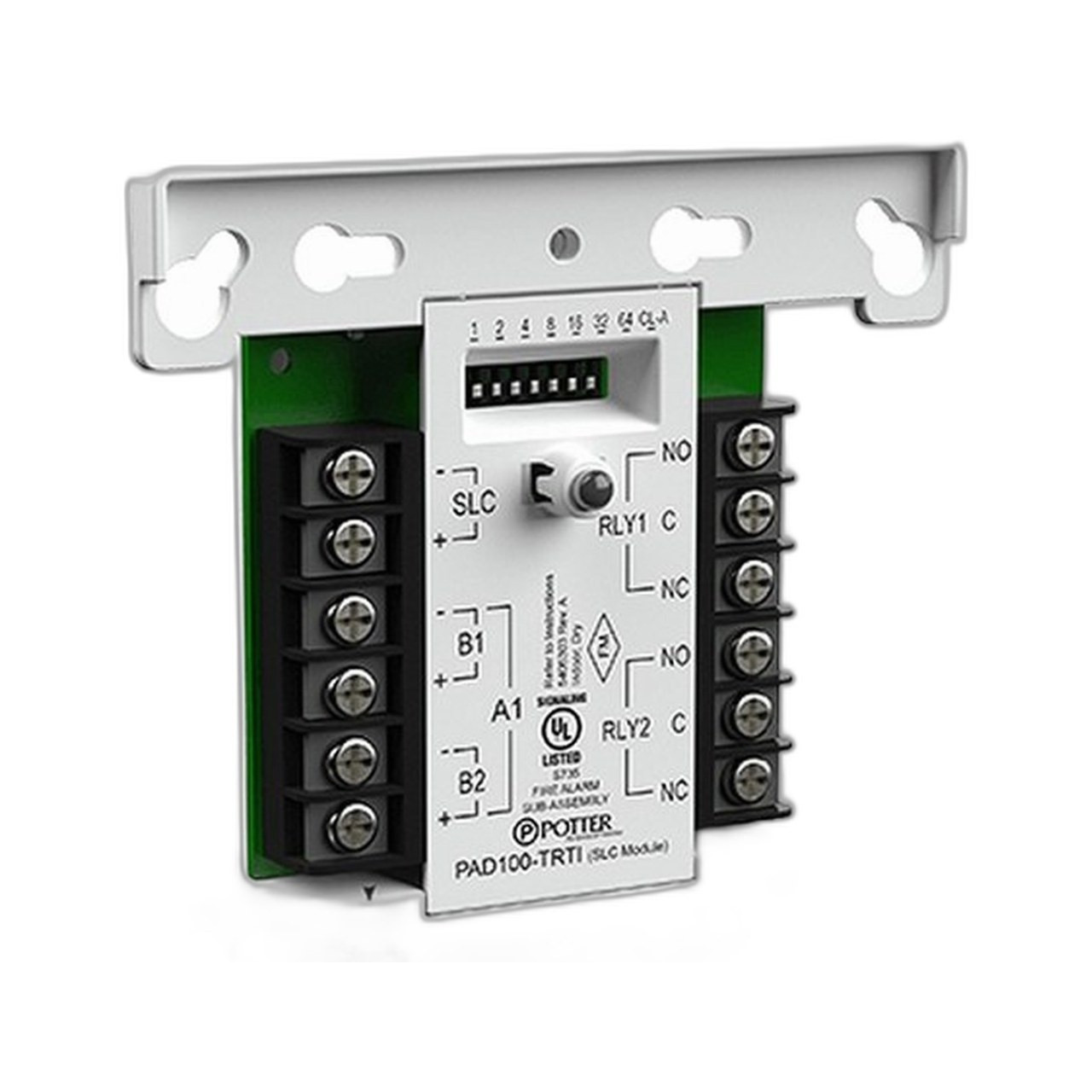
Potter PAD100-TRTI Two Relay Two Input Module
The Potter PAD100-TRTI (often searched as PAD100 TRTI) is a two-relay, two-input expansion module designed to solve a common integration challenge: when your main access control panel runs out of available I/O capacity. Instead of replacing the entire control system, this module adds two independent relay outputs and two discrete inputs, distributed across the facility wherever you need them. It's a straightforward way to scale without ripping out infrastructure.
Key Features
- Two Independent Relay Outputs: Each relay is separately controlled, meaning you can trigger a strike on door 3 without affecting the maglock on door 5. Relay contacts are rated for standard access control solenoid loads — electromagnetic strikes, mag locks, auxiliary warning devices — so no intermediate relay is required. This simplifies wiring and cuts installation cost and labor.
- Two Discrete Inputs: Monitor door position sensors (magnetic switches), request-to-exit buttons, alarm devices, or any dry-contact binary signal. Real-time input state monitoring feeds back to your control software, enabling immediate detection of propped doors, after-hours access attempts, or emergency egress activation.
- Terminal Block Wiring: All connections — power, relay loads, input sensors — use accessible terminal blocks. No proprietary connectors. Field installation in both new and retrofit deployments is straightforward; no special tools required beyond a standard screwdriver.
- Direct Potter System Integration: The PAD100-TRTI plugs into Potter's control system communication architecture, inheriting the same command and monitoring capabilities as native panel I/O. Configuration of relay trigger conditions is managed through Potter's control software — set conditions based on reader events, time schedules, or input state changes without hardware modification.
- Status Monitoring & Audit Trail: All input and relay states are continuously monitored. State changes log to the system for audit and compliance reporting. Critical for multi-door facilities where you need to know if a door was propped during a shift, or if an RTE device was triggered outside business hours.
- Compact Distributed Design: Module footprint is small enough for panel mounting or localized installation near door control points. Power requirements are standard 12 VDC or 24 VDC depending on your control panel configuration — verify with your system documentation before powering up.
Integration & Compatibility
The PAD100-TRTI is most commonly deployed in multi-door access control systems where the main control panel's native I/O is fully allocated. A typical installation: central panel controls doors 1–4; PAD100-TRTI expands to doors 5–6 or adds request-to-exit monitoring across multiple entry points. The two relay outputs handle any standard electromagnetic solenoid load — no derating required for standard 12V or 24V strike coils or mag locks. The two inputs accept any dry-contact sensor — door position switches, push-button RTE devices, tamper switches — with no additional conditioning required.
Integration requires terminal block wiring of power, relay load circuits, and input sensor pairs. No special cabling needed beyond standard access control wire gauges. Once powered and wired, the PAD100-TRTI appears in your Potter control software's I/O configuration menu. You assign relay outputs to specific door strikes or auxiliary devices, configure input monitoring rules (e.g., alarm on input 1 during locked hours), and set logging preferences. All configuration is persistent; no reprogramming needed after power cycling.
When to Choose a Different Model
If you require more than two relay outputs or more than two inputs, or if you need analog monitoring (e.g., temperature, voltage sensing) rather than discrete binary signals, evaluate higher-capacity I/O expansion modules in the Potter product line. For single-door retrofits or simple maglock installations, you may not need distributed I/O at all — verify your main panel's available I/O capacity first.
Frequently Asked Questions
Q: Can I use the PAD100-TRTI with non-Potter control systems?
A: The PAD100-TRTI is engineered for direct integration with Potter access control platforms. Compatibility with non-Potter systems depends on communication protocol support — consult your control panel documentation and Potter's integration guide before cross-vendor deployment.
Q: What is the maximum current rating for each relay output?
A: The relays are rated for standard access control loads — typical electromagnetic strikes and mag locks in the 1–3A range at 12 VDC or 24 VDC. Refer to your specific strike or maglock datasheet and the PAD100-TRTI datasheet to confirm the load falls within rated specifications.
Q: Does the PAD100-TRTI require its own power supply, or does it draw from the main panel?
A: The PAD100-TRTI is powered via the same 12 VDC or 24 VDC bus as the main panel. Verify your control panel has sufficient capacity to support both the panel and the module; undersized power supplies can cause erratic behavior. Consult your system's power budget documentation.
Q: Can I monitor input states in real-time from the control software?
A: Yes. The two discrete inputs report state changes (open/closed) to the Potter control software in real-time. State history is logged for audit trail purposes, enabling compliance reporting and after-the-fact investigations of access anomalies.
Q: Is installation field-serviceable on an existing system without downtime?
A: The PAD100-TRTI can be integrated into live systems, but proper planning is essential. Coordinate wiring of new relay and input circuits with your control panel's power-down procedures to avoid disrupting existing door access. Test all connections before returning the system to service.
Ted PerryPerspective based on aggregated IP Security Depot and affiliated engineering team experience.
I've deployed the Potter PAD100-TRTI in multi-door access control systems where the main control panel's I/O capacity reached saturation. This module solves the practical problem of adding relay outputs and discrete inputs without replacing the entire control system. The PAD100-TRTI is straightforward to integrate and provides reliable contact closure for strike control and maglock switching across distributed doors — no intermediate relays required.
Technical Highlights:
- Two Independent Relay Outputs: Each relay handles standard access control solenoid loads (electromagnetic strikes, mag locks, auxiliary devices) without derating. Separate control means you don't trigger unintended devices when activating a single door — critical in multi-door deployments where cross-talk can cause security incidents or false alarms.
- Two Discrete Inputs with Real-Time Monitoring: Door position sensors, RTE buttons, and alarm devices report state changes immediately to Potter control software. State logging enables audit trails and compliance reporting — you can prove a door was propped during a shift, or detect after-hours RTE activation without guesswork.
- Terminal Block Wiring & Simple Configuration: No proprietary connectors. Wiring is straightforward for integrators familiar with standard access control circuits. Configuration through Potter's control software — no firmware flashing or complex parameter tables — reduces commissioning time and risk of human error.
Deployment Considerations:
- Power Budget: Verify your main control panel's 12 VDC or 24 VDC supply has capacity for both the panel and the PAD100-TRTI relay coils under simultaneous activation. Undersized power supplies cause relay chatter, missed commands, or soft resets — test under worst-case load before going live.
- Relay Contact Rating: Confirm your strike or maglock draws within the PAD100-TRTI's relay spec. Over-current loads shorten relay life or cause contact erosion — a common silent failure in access control that leaves doors unlocked after hours.
The PAD100-TRTI is the right choice for integrators managing 6–12 door facilities where a single main panel would require expensive replacement or where distributed relay nodes reduce wiring cost across large floor plates. It's not overkill for a single-door retrofit, but it's the economical answer when you're scaling an existing Potter installation without forklift upgrade.