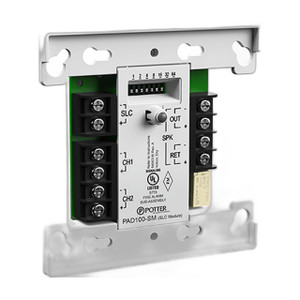
Potter PAD100-MIM Micro Input Module
Overview
The Potter PAD100-MIM is a micro input module engineered to extend input capacity of existing Potter PAD100-series access control systems. If you're running multi-door or multi-reader installations where input points exceed native controller capacity, this module adds distributed sensor monitoring without forcing a secondary full-size controller into your equipment layout. The PAD100-MIM integrates directly into Potter's access control protocol, meaning no separate network configuration or additional programming interfaces — it communicates transparently with the parent PAD100 controller using existing wiring and communication pathways.
Key Features
- Micro form factor: Compact design means the module fits into tight electrical enclosures, equipment cabinets, and wall-mounted panels where a full controller would be impractical. Space-constrained installations common in retrofit projects benefit significantly — you avoid the overhead of finding room for a second PAD100.
- Direct PAD100 integration: The PAD100-MIM operates as a native extension to Potter PAD100 controllers, maintaining full compatibility with Potter's proprietary access control protocol and communication standards. This eliminates the need for protocol conversion, middleware, or separate VMS licensing for the expansion points.
- Plug-and-play deployment: No separate network configuration beyond standard Potter PAD100 setup procedures. Commissioning time is minimal — the module communicates directly with the parent controller, reducing labor during initial installation and simplifying long-term maintenance workflows.
- Distributed input monitoring: Position input modules at strategic points throughout a facility—near magnetic locks, request-to-exit sensors, door status contacts, or monitoring points—without centralizing all equipment. This distributed topology minimizes cable runs, lowers installation labor, and improves sensor response times in large or geographically spread installations.
- Retrofit-friendly scaling: Multi-door and multi-reader sites frequently hit native PAD100 input limits. The PAD100-MIM lets you add capacity incrementally rather than replacing the entire controller, lowering total cost of ownership and avoiding system downtime during upgrades.
- Consolidates input management: All expansion inputs appear under the same PAD100 controller in the management interface, simplifying monitoring, alarm handling, and event correlation across distributed zones.
Integration and Compatibility
The PAD100-MIM is purpose-built for Potter PAD100-series ecosystems. It maintains 100% protocol compatibility and requires no separate communication setup. Existing wiring methodologies apply — the module connects directly to the parent controller using standard Potter communication pathways. This approach is particularly valuable in retrofit projects where adding a second full controller would introduce unnecessary hardware redundancy, complexity, and physical space demands.
Installers commonly deploy the PAD100-MIM in corporate campuses, healthcare facilities, government buildings, retail environments, and industrial sites where input points exceed single-controller capacity. Request-to-exit integration, door status monitoring, alarm input consolidation, and distributed sensor monitoring are typical use cases. The module's compact size makes it suitable for cabinet mounting, panel integration, or wall installation near reader hardware, keeping cable runs short and installation labor manageable.
Typical Applications
Multi-door access control expansion in campus environments; distributed sensor monitoring across multiple zones; request-to-exit (REX) sensor integration at multiple doors; door status and alarm input consolidation; retrofit upgrades to existing Potter installations where input capacity has been exceeded. Deployment scenarios include secondary entry clusters, remote building annexes, and multi-tenant facilities where centralizing all control equipment is impractical.
Why Choose This Module
If your access control footprint requires more input points than a single PAD100 provides, the PAD100-MIM avoids the complexity and cost of a second full controller. Its micro form factor solves the real constraint most integrators face in retrofit work: where do you physically put additional control equipment when cabinet space is already allocated? The PAD100-MIM answers that by staying compact while maintaining transparent integration with your existing Potter infrastructure.
When to Choose a Different Approach
If your installation requires full controller redundancy, failover capability, or independence between control zones, a second PAD100 controller may be more appropriate than a distributed input module. Similarly, if input scaling will eventually exceed what modular expansion can support, planning for a larger control platform from the outset may lower total lifecycle cost. Consult your access control architecture documentation and integrator team to confirm PAD100-MIM capacity aligns with your 3–5 year growth projections.
Frequently Asked Questions
Q: What is the maximum number of PAD100-MIM modules I can connect to a single PAD100 controller?
A: Refer to your Potter PAD100 installation and commissioning documentation for maximum expansion capacity. This varies by PAD100 firmware version and configuration.
Q: Does the PAD100-MIM require separate network cabling or IP configuration?
A: No. The PAD100-MIM communicates directly with the parent PAD100 controller using standard Potter wiring and protocol. No separate network configuration or IP address assignment is required.
Q: Can I install the PAD100-MIM in a remote location away from the main PAD100 controller?
A: Yes. The module's micro form factor and direct controller integration make it suitable for placement near clusters of readers, locks, or sensors at remote locations throughout a facility. Communication distance and wiring limitations follow standard Potter specifications — consult installation documentation for maximum cable runs.
Q: Is the PAD100-MIM suitable for retrofit installations?
A: Yes. The compact form factor and seamless Potter PAD100 integration make it ideal for retrofit scenarios where space is constrained and adding a full secondary controller is impractical.
Q: What inputs and monitoring types does the PAD100-MIM support?
A: The module supports distributed input monitoring including request-to-exit sensors, door status contacts, alarm inputs, and other binary sensors. Consult the PAD100-MIM datasheet for full input specifications and signal types.
Q: How is the PAD100-MIM physically mounted?
A: The micro form factor enables cabinet mounting, wall installation, and panel integration near reader hardware. Installation methodology is documented in Potter commissioning guides.
Ted PerryPerspective based on aggregated IP Security Depot and affiliated engineering team experience.
During system design for a multi-building campus retrofit, we evaluated the PAD100-MIM as a way to avoid installing secondary PAD100 controllers at remote door clusters. The micro form factor proved critical in tight electrical rooms where space allocation was already constrained. This module delivered the input scalability we needed without introducing unnecessary controller redundancy or network configuration overhead.
Technical Highlights:
- Micro form factor: Compact design fits into existing equipment enclosures and tight installation spaces, eliminating the need to find cabinet or wall space for a full secondary controller.
- Direct PAD100 integration: No separate network configuration or protocol conversion required — the PAD100-MIM communicates directly with the parent controller using standard Potter communication pathways, reducing commissioning time and maintenance complexity.
- Distributed input deployment: Position input monitoring points at strategic facility locations near readers, locks, and sensors, minimizing cable runs and improving sensor response times across multi-zone installations.
Deployment Considerations:
- Confirm PAD100 firmware version supports the maximum number of expansion modules you plan to deploy — capacity varies by controller configuration.
- Verify communication cable distance and wiring constraints match your facility layout — remote module placement must comply with Potter communication specifications.
- Plan input allocation carefully during design phase — once deployed, redistributing inputs across multiple modules requires reconfiguration of the parent PAD100 controller.
The PAD100-MIM makes sense for campus environments, multi-tenant facilities, and retrofit projects where input scalability is needed but physical or operational constraints prevent adding full secondary controllers. It's a practical solution when the constraint is 'where do we put more control equipment?' rather than 'do we need controller redundancy?'